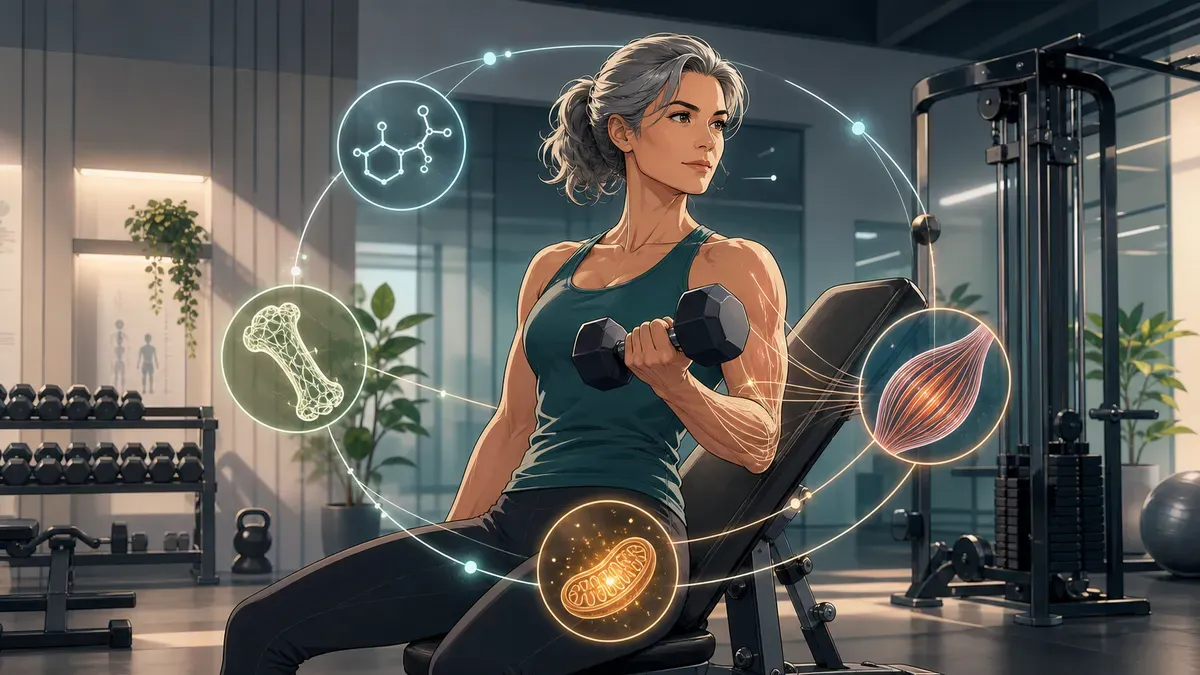
Testosterone in women after 40: does it matter for healthy aging?
Testosterone in women after 40 affects libido, muscle, bone, and metabolism, but labs and therapy claims need careful context. Learn what to track.
Testosterone is not just a male hormone. Women make it in the ovaries and adrenal glands, and it interacts with muscle, bone, mood, sexual desire, energy, and metabolic health. After 40, that makes it tempting to treat testosterone as the missing midlife switch: check a number, replace what is low, feel younger.
The science is more careful than the marketing.
Testosterone matters for women, but it is not a validated anti-aging treatment for otherwise healthy women. Low values do not map neatly to fatigue, brain fog, weight gain, or low mood. Blood testing is technically difficult at the low concentrations seen in women. And the strongest evidence for testosterone therapy is narrow: carefully selected women with hypoactive sexual desire disorder (HSDD), usually after a full biopsychosocial assessment.
For healthy aging, the useful question is not “Should every woman optimize testosterone after 40?” It is “When does androgen biology add useful context to muscle, bone, libido, metabolic risk, and recovery?”
What you’ll learn:
- What testosterone does in women after 40
- Why the menopause transition does not look like male testosterone decline
- Which symptoms may justify a hormone discussion, and which usually need broader workup
- Why female testosterone labs are easy to overread
- What to track for healthy aging before considering therapy
The short answer
Quick definition: Testosterone is an androgen hormone made by the ovaries and adrenal glands in women. It supports sexual desire, muscle and bone biology, red blood cell production, mood-related pathways, and metabolic signaling, but there is no well-defined “testosterone deficiency syndrome” for healthy women.
After 40, testosterone is worth understanding, but not isolating.
It may matter most when you see a pattern such as:
- Low sexual desire that is persistent, distressing, and not explained by relationship, medication, pain, sleep, depression, or estrogen-related symptoms
- Loss of strength or lean mass despite adequate protein and progressive training
- Low bone density with other hormone or nutrition clues
- High SHBG, low free testosterone, or low DHEA-S in a broader endocrine workup
- Surgical menopause or ovarian suppression, where androgen production can change more abruptly
It is less useful when used as a one-number explanation for every midlife symptom. Fatigue, poor recovery, weight gain, low mood, and brain fog can come from sleep debt, iron deficiency, thyroid disease, under-fueling, overtraining, depression, medication effects, perimenopause, insulin resistance, or low estrogen/progesterone signaling.
For the broader hormone map, see hormonal health and longevity. For women-specific screening after 40, use the women over 40 health checklist.
What testosterone does in women
Women produce much lower circulating testosterone than men, but that does not make it unimportant. Some testosterone acts directly through androgen receptors. Some is converted locally into estradiol by aromatase. Many effects happen inside tissues, which is one reason a blood value can miss the full picture.
Sexual desire and arousal
The best-supported clinical role is sexual desire. International consensus statements and ISSWSH guidance support testosterone therapy only for properly diagnosed HSDD after other contributors have been assessed. That is different from treating a low lab number or prescribing testosterone for vague low energy.
HSDD is not simply “lower libido than before.” It means low desire that causes personal distress and is not better explained by pain, relationship strain, depression, medication, untreated vasomotor symptoms, vaginal dryness, trauma, sleep loss, or another medical issue.
Muscle and strength
Androgens contribute to muscle protein turnover and neuromuscular function. In women after 40, however, the bigger practical drivers of muscle are still resistance training, adequate protein, sleep, and estrogen status through the menopause transition.
If strength is falling, the first question is not testosterone alone. It is whether training volume is progressive, protein is sufficient, recovery is adequate, and body composition is changing. Use muscle mass vs body weight and strength training after 40 for the foundation.
Bone health
Testosterone may support bone partly through conversion to estrogen and partly through androgen receptor effects. But for women, estrogen loss remains the dominant hormone story for bone around menopause. Low testosterone can add context, especially after oophorectomy or ovarian suppression, but bone decisions should not be made from testosterone alone.
Metabolism and body-fat distribution
The relationship between testosterone and metabolic health in women is U-shaped and context-dependent. Too little androgen signaling may relate to low muscle and low vitality; too much relative androgen activity can associate with visceral fat, insulin resistance, PCOS patterns, and metabolic syndrome risk.
SWAN research found that during the menopause transition, estrogen can fall while total testosterone changes less dramatically, creating a higher testosterone-to-estradiol ratio. That relative androgen shift has been associated with metabolic syndrome risk. This does not mean testosterone is bad for women. It means balance matters.
For the metabolic side of the transition, see insulin resistance in perimenopause and weight gain in perimenopause vs aging.
How testosterone changes after 40
Men and women age differently hormonally.
In men, testosterone often declines gradually from early or mid-adulthood. In women, testosterone also changes with age, but it does not usually drop in the same cliff-like way that estradiol does around menopause. Ovarian and adrenal androgen production, SHBG, body composition, insulin, medications, and estrogen therapy can all shift what is measurable and what is biologically available.
Important patterns:
- Total testosterone is not the whole story. SHBG binds testosterone. High SHBG can lower free testosterone even when total testosterone looks normal.
- Oral estrogen can raise SHBG. That can reduce calculated free testosterone more than transdermal estrogen in some women.
- DHEA-S is upstream context. It declines with age and acts as an adrenal androgen reservoir, but DHEA supplementation is not a casual fix.
- Surgical menopause can be different. Removing ovaries can reduce ovarian androgen contribution more abruptly than natural menopause.
- PCOS history matters. Women with a history of androgen excess may enter midlife with a different metabolic and androgen pattern.
If the question is estrogen versus progesterone rather than testosterone, use estrogen vs progesterone in perimenopause. Testosterone sits alongside that system, not outside it.
Symptoms: when testosterone belongs in the conversation
Testosterone may be worth discussing when the pattern is specific and persistent.
More relevant patterns
- Distressing low sexual desire after other contributors have been addressed
- Low arousal or reduced sexual thoughts paired with distress
- Surgical menopause or ovarian suppression with new symptoms
- Low free testosterone with high SHBG in a clinician-guided panel
- Loss of lean mass despite consistent training, adequate protein, and good recovery
- Low bone density with other hormone, nutrition, or menstrual-history clues
Less specific patterns
- General fatigue
- “I do not feel like myself”
- Brain fog
- Weight gain
- Low motivation
- Poor sleep
- Mood changes
These symptoms are real, but they are not testosterone-specific. In women after 40, they often need a broader workup: ferritin, thyroid markers, sleep quality, medication review, perimenopause status, depression/anxiety screening, B12, vitamin D, fasting insulin, HbA1c, training load, and under-fueling.
If sleep and cycle timing are part of the pattern, start with sleep in perimenopause.
Why testosterone testing in women is tricky
Testing can help, but the lab method matters more than many people realize.
Female testosterone concentrations are low, and many routine immunoassays were built for the higher male range. At female levels, small measurement errors can look clinically meaningful. The Endocrine Society has emphasized that clinicians should not diagnose a broad androgen-deficiency syndrome in healthy women based on symptoms and a low number.
If testing is appropriate, ask your clinician which method the lab uses. Liquid chromatography-tandem mass spectrometry (LC-MS/MS) is generally preferred for low-range sex steroid measurement. Interpretation often includes:
- Total testosterone
- SHBG
- Calculated free testosterone or free androgen index
- DHEA-S
- Estradiol when menopause status or estrogen therapy matters
- TSH and free T4 if symptoms overlap with thyroid disease
- Ferritin, CBC, B12, vitamin D, and metabolic markers when fatigue or low performance is the issue
What not to do: chase the highest “optimal” testosterone range you can find online. Women can experience androgen excess effects, including acne, unwanted hair growth, scalp hair shedding, voice changes, mood changes, and lipid changes. Some effects, such as voice deepening, may not fully reverse.
Therapy: what the evidence does and does not support
This is where precision matters.
The global consensus position statement concluded that the only evidence-based indication for testosterone therapy in women is HSDD after formal assessment. The ISSWSH clinical practice guideline gives more detail on patient selection, dosing, monitoring, and safety. The Endocrine Society recommends against using testosterone for general well-being, cognitive health, cardiovascular health, metabolic health, bone health, or a broad diagnosis of androgen deficiency in healthy women.
In the United States, there is no FDA-approved testosterone product specifically for women. Clinicians sometimes use carefully adjusted lower-dose male formulations off-label, but this requires monitoring to keep levels in the premenopausal female physiological range and to avoid supraphysiologic exposure. Pellet therapy and compounded products deserve extra caution because dosing can be harder to adjust and long-term safety data are limited.
This does not mean women should ignore symptoms. It means testosterone therapy should not be framed as a general longevity shortcut.
Discuss therapy only with a qualified clinician if:
- Low desire is persistent and distressing
- Other causes have been assessed
- You understand the lack of long-term safety data
- Baseline levels and follow-up levels can be monitored accurately
- The treatment goal is specific and measurable
What to track for healthy aging instead
For most women after 40, the aging signal is not testosterone alone. It is the pattern across muscle, bone, metabolic health, sleep, recovery, and symptoms.
1. Strength and lean mass
Track progressive strength metrics: grip strength, sit-to-stand performance, training loads, and lean mass if you have a reliable body-composition method. If these are stable or improving, your anabolic environment is probably functioning better than one hormone number suggests.
2. Bone risk
Track family history, fracture history, menstrual history, vitamin D status, calcium intake, resistance training, and DEXA timing when appropriate. Bone is a system, not a testosterone score.
3. Metabolic context
Track waist circumference, fasting insulin, HbA1c, triglycerides, HDL, ApoB, blood pressure, and sleep. If free testosterone is low but insulin resistance is high, the priority may be metabolic repair rather than androgen therapy.
4. Recovery
Track HRV, resting heart rate, sleep duration, sleep regularity, and training readiness. Testosterone may interact with recovery biology, but poor recovery is usually multi-causal.
5. Symptom specificity
Write down what changed, when, and whether it clusters with cycle timing, medication changes, sleep disruption, relationship context, pain, or training load. A clinician can work with a pattern much better than with “my hormones are off.”
How SuperAge helps you see the bigger pattern
SuperAge does not diagnose low testosterone or recommend hormone therapy. It helps you track the physiology that usually matters more for healthy aging after 40: strength-related habits, sleep, HRV, resting heart rate, activity, body composition trends, and biological-age direction.
That broader view is useful because testosterone questions rarely live alone. A woman may have low desire because of poor sleep and hot flashes. Another may have low free testosterone because SHBG is high. Another may have rising waist and insulin resistance because the estrogen-to-androgen balance is shifting during perimenopause. Another may simply be under-recovered from training and caregiving stress.
SuperAge helps you ask better questions:
- Is recovery falling before symptoms flare?
- Is strength declining despite enough training?
- Is waist increasing while weight is stable?
- Are sleep and HRV improving when symptoms improve?
- Are biological-age inputs moving in the right direction, regardless of one hormone value?
That is the useful frame: not “testosterone equals youth,” but “which measurable systems need support?”
FAQ
Do women need testosterone?
Yes. Women naturally produce testosterone, and it plays roles in sexual desire, muscle, bone, mood-related pathways, and metabolism. But needing testosterone biologically is not the same as needing testosterone therapy.
Does testosterone drop after 40 in women?
Androgen biology changes with age, ovarian function, adrenal output, SHBG, medications, body composition, and menopause status. Unlike estradiol, testosterone does not usually show a single menopause cliff in natural menopause. Free testosterone can still change substantially when SHBG changes.
Is low testosterone a real diagnosis in women?
There is no well-defined androgen-deficiency syndrome for healthy women that can be diagnosed from symptoms plus one low testosterone result. Clinicians may still evaluate androgen status in specific contexts, but broad self-diagnosis is risky.
Can testosterone help women build muscle after 40?
Testosterone is involved in muscle biology, but testosterone therapy is not recommended as a general muscle-building or anti-aging treatment for healthy women. Resistance training, protein, sleep, and metabolic health remain the primary levers.
What is the strongest evidence-based use of testosterone therapy in women?
The strongest evidence is for carefully selected women with hypoactive sexual desire disorder after formal assessment. It is not a general therapy for fatigue, mood, cognition, bone health, cardiometabolic health, or longevity.
What are signs of too much testosterone in women?
Possible signs include acne, unwanted facial or body hair growth, scalp hair thinning, oily skin, mood changes, voice deepening, clitoral enlargement, and unfavorable lipid changes. If symptoms appear during therapy, contact the prescribing clinician promptly.
Key takeaways
- Women make testosterone, and it matters for healthy aging, but it is not a stand-alone youth hormone.
- After 40, symptoms should be interpreted through muscle, bone, sleep, metabolic, sexual-health, and menopause context.
- A single low testosterone result does not diagnose a broad androgen-deficiency syndrome in healthy women.
- Testing is technically difficult at female ranges; method and SHBG context matter.
- Evidence-based testosterone therapy is mainly limited to HSDD after formal assessment.
- Do not use testosterone therapy as a general anti-aging, fatigue, cognition, or muscle-building shortcut.
- Track strength, lean mass, bone risk, sleep, HRV, waist, glucose, lipids, and symptoms together.
References
- Davis SR, Baber R, Panay N, et al. Global consensus position statement on the use of testosterone therapy for women. Journal of Clinical Endocrinology & Metabolism. 2019. https://pmc.ncbi.nlm.nih.gov/articles/PMC6821450/
- Parish SJ, Simon JA, Davis SR, et al. ISSWSH clinical practice guideline for the use of systemic testosterone for hypoactive sexual desire disorder in women. Journal of Women’s Health. 2021. https://pmc.ncbi.nlm.nih.gov/articles/PMC8064950/
- Wierman ME, Arlt W, Basson R, et al. Androgen therapy in women: a reappraisal. Journal of Clinical Endocrinology & Metabolism. 2014. https://academic.oup.com/jcem/article/99/10/3489/2836272
- Endocrine Society. Experts recommend against diagnosing testosterone deficiency in women. 2014. https://support.endocrine.org/news-and-advocacy/news-room/2014/experts-recommend-against-diagnosing-testosterone-deficiency-in-women
- Lasley BL, Santoro N, Randolf JF, et al. Changes in androstenedione, dehydroepiandrosterone, testosterone, estradiol, and estrone over the menopausal transition. Women’s Midlife Health. 2017. https://pmc.ncbi.nlm.nih.gov/articles/PMC5761074/
- Torrens JI, Sutton-Tyrrell K, Zhao X, et al. Relative androgen excess during the menopausal transition predicts incident metabolic syndrome in mid-life women: SWAN. Menopause. 2009. https://pmc.ncbi.nlm.nih.gov/articles/PMC2950016/
- Santoro N, Epperson CN, Mathews SB. Menopausal symptoms and their management. Endocrinology and Metabolism Clinics of North America. 2015. https://pmc.ncbi.nlm.nih.gov/articles/PMC4890704/
Related Articles
Boron: The overlooked mineral for hormones and bones
Boron supports testosterone, estrogen, vitamin D metabolism, and bone density — yet most adults get too little. Evidence-based guide to boron and longevity.