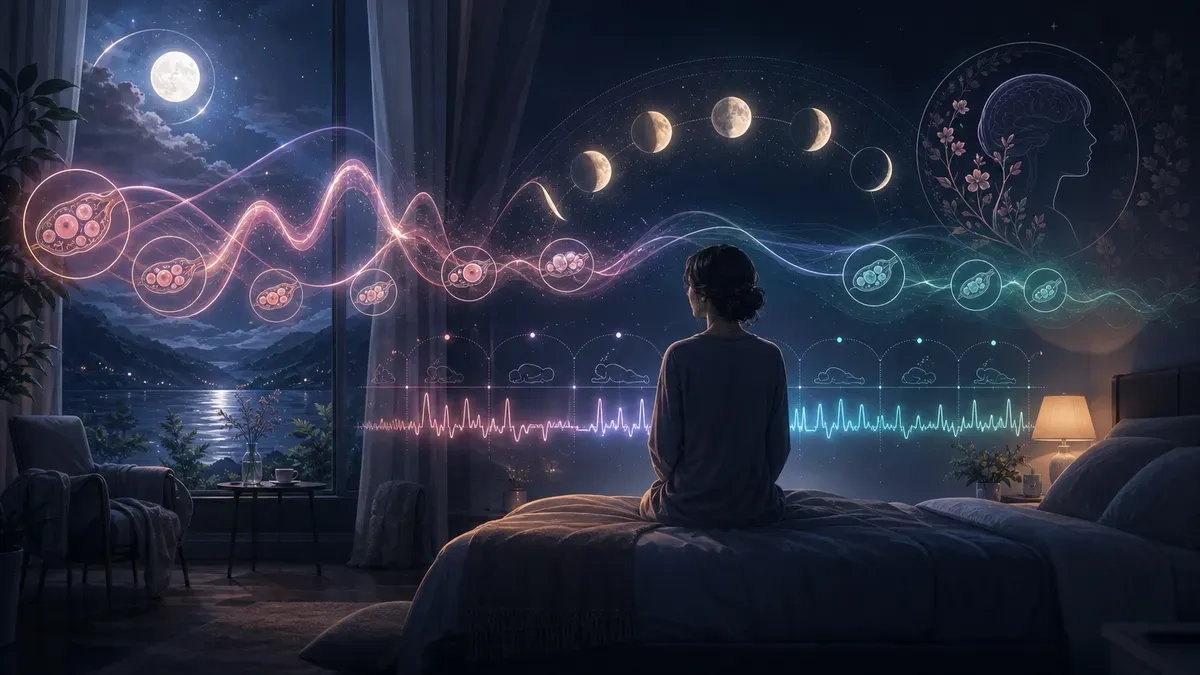
Sleep in perimenopause: why it changes before menopause
Sleep in perimenopause explained: why nights change before menopause, what recovery metrics reveal, and when symptoms deserve medical support without guessing.
Sleep in perimenopause can change before you think you are “in menopause.” Your periods may still come. Lab tests may still look ordinary. You may not have classic hot flashes. Yet you start waking at 3 a.m., running warmer at night, feeling less recovered after the same workouts, or seeing HRV drop for no obvious reason.
That pattern is common because perimenopause is not a clean estrogen decline. It is a transition marked by hormone variability, more anovulatory cycles, changing thermoregulation, and a nervous system that may become easier to wake. The result is often not just “bad sleep hygiene.” It is a measurable recovery shift.
This guide stays focused on the early transition: why nights change before menopause, which recovery signals are worth tracking, and when symptoms deserve medical support. For the broader longevity picture, see the sleep and longevity guide.
Key takeaways
- Sleep problems can begin in early perimenopause. They may appear years before the final menstrual period.
- The problem is often sleep maintenance. Many women can fall asleep but wake repeatedly or wake too early.
- Hormone fluctuation matters more than one lab value. Progesterone may decline earlier, estrogen may swing, and vasomotor symptoms can fragment sleep.
- Recovery metrics can make the pattern visible. HRV, resting heart rate, sleep timing, wake after sleep onset, temperature, and cycle notes are more useful than one nightly sleep score.
- Not every night sweat is “just hormones.” Snoring, gasping, severe fatigue, heavy bleeding, mood changes, and persistent insomnia deserve clinician review.
- Treatment is individualized. Hormone therapy and nonhormone options can help some symptoms, but decisions depend on risk factors and should be made with a qualified clinician.
What changes before menopause?
Menopause is defined retrospectively: 12 consecutive months without a period. Perimenopause is the transition leading up to that point. It can last several years and often begins with cycle changes: shorter cycles, longer cycles, skipped cycles, heavier bleeding, lighter bleeding, or new premenstrual symptoms.
Sleep can shift during this window because the endocrine system is becoming less predictable. You may still have estrogen. In fact, estrogen can be high on some days and low on others. The issue is not simply “low hormones.” The issue is variability, especially when ovulation becomes inconsistent.
Our guide to perimenopause and biological age covers the broader biomarker cascade. For sleep specifically, the early changes often cluster into four patterns:
| Sleep pattern | Common early-transition driver | What to track |
|---|---|---|
| Falling asleep is harder | Higher evening arousal, anxiety, lower progesterone tone | Sleep latency, bedtime HR, cycle day |
| Waking at 2-4 a.m. | Temperature shifts, stress hormones, alcohol sensitivity, night sweats | Wake after sleep onset, room temp, alcohol, symptoms |
| More light sleep, less deep sleep | Fragmentation and reduced sleep continuity | Deep sleep trend, awakenings, next-day recovery |
| Unrefreshed despite enough hours | Sleep apnea, periodic limb movement, mood symptoms, inflammation, under-recovery | Snoring, SpO2 trend, HRV, fatigue severity |
Why perimenopause disrupts sleep
Progesterone changes can remove a calming signal
Progesterone is not just a reproductive hormone. Its metabolite allopregnanolone interacts with GABA-A receptors, part of the brain’s calming system. In early perimenopause, ovulation may become less consistent. When ovulation is weaker or absent, progesterone output can fall even while periods continue.
That can feel like a nervous system that no longer downshifts at night: more racing thoughts, lighter sleep, and more awakenings. For a deeper hormone-specific explainer, see progesterone, sleep, and aging.
This does not mean every woman should take progesterone. It means that sleep changes in the early transition can have a real biological driver and deserve more than generic advice.
Estrogen swings affect temperature and vasomotor symptoms
Hot flashes and night sweats are vasomotor symptoms. They are closely tied to the menopausal transition and can wake you directly. But temperature instability can be subtler than a dramatic sweat. Some women describe waking hot, then chilled, then alert. Others see a wearable temperature shift without remembering a hot flash.
Estrogen also interacts with serotonin, norepinephrine, and thermoregulatory pathways. When levels swing, the temperature “neutral zone” can narrow, meaning small changes in room temperature, bedding, alcohol, or stress are more likely to trigger an awakening.
Sleep maintenance worsens before total sleep time collapses
Many perimenopausal women do not initially sleep fewer hours. Instead, sleep becomes less continuous. You may spend 7.5 hours in bed but accumulate more wake time, more light sleep, and fewer long blocks of deep sleep.
That distinction matters. If you only track bedtime and wake time, the problem looks invisible. If you track awakenings, wake after sleep onset, resting heart rate, and HRV, the transition becomes easier to see.
For stage-level context, see sleep stages by age and how to improve deep sleep.
Recovery demand rises
Perimenopause can also change the cost of the same lifestyle. A hard workout, a late dinner, two glasses of wine, a hot bedroom, or a stressful workday may have been tolerable at 35. At 45, the same inputs may produce a lower HRV night, a higher resting heart rate, or more wakeups.
That does not mean you are fragile. It means the margin for recovery may be narrower, especially during the late luteal phase, skipped cycles, or weeks with vasomotor symptoms.
What to measure instead of guessing
Consumer wearables are not diagnostic sleep studies, and they can misclassify sleep stages. Their value is trend detection. If you track the same metrics consistently, you can see whether nights are becoming more fragmented and which behaviors or cycle phases correlate with worse recovery.
| Metric | Why it helps | What to watch |
|---|---|---|
| Sleep latency | Shows how quickly the nervous system downshifts | Longer latency around certain cycle phases or stress blocks |
| Wake after sleep onset | Captures fragmentation better than total hours | Rising wake time despite the same time in bed |
| Sleep midpoint | Reveals circadian drift | Later midpoint on weekends or after poor nights |
| Resting heart rate | Reflects stress, alcohol, illness, heat, and under-recovery | 3-5 bpm above baseline for several nights |
| HRV | Reflects autonomic recovery | Drop from personal baseline, not comparison with others |
| Overnight temperature | Flags vasomotor or illness patterns | Repeated warm spikes before awakenings |
| Respiratory rate and SpO2 | Screens for breathing-pattern concerns | Snoring, oxygen dips, morning headaches, severe fatigue |
| Cycle and symptom notes | Connects physiology to transition stage | Worse sleep before bleeding, skipped cycles, or night sweats |
For HRV basics, use the HRV guide. If you train, a training readiness score can help you avoid pushing hard on days when sleep and autonomic recovery are clearly down.
A two-cycle tracking plan
Before changing ten things at once, collect a clean baseline for two cycles or roughly eight weeks if cycles are irregular.
Track:
- Bedtime and wake time
- Sleep latency
- Number of awakenings
- Wake after sleep onset
- Night sweats or temperature episodes
- Resting heart rate
- HRV
- Alcohol timing
- Caffeine cutoff
- Late meals
- Training intensity
- Bleeding days and cycle symptoms
Then look for patterns:
- Does sleep worsen 3-7 days before bleeding?
- Are wakeups worse after alcohol, even one drink?
- Does a hot bedroom push resting heart rate up?
- Does intense evening exercise lower HRV?
- Do skipped cycles coincide with worse sleep?
- Is fatigue disproportionate to the amount of sleep recorded?
This is more useful than asking whether one night was “good” or “bad.” Perimenopause sleep is noisy. Patterns are the signal.
Targeted fixes that match the pattern
This is not a generic sleep hygiene checklist. Use the symptom pattern to choose the highest-yield lever.
| Pattern | First lever to test | Why |
|---|---|---|
| Waking hot or sweaty | Bedroom at 65-68°F (18-20°C), lighter bedding, avoid alcohol near bedtime | Temperature instability is a common trigger |
| 3 a.m. alert wakeups | Earlier alcohol cutoff, earlier dinner, stress downshift before bed | Late metabolic and sympathetic activation can fragment sleep |
| Lower HRV after hard sessions | Move intense training earlier or reduce intensity premenstrually | Recovery capacity may vary by cycle phase |
| Long sleep latency | Consistent wake time, morning outdoor light, evening light reduction | Anchors circadian timing and lowers arousal |
| Snoring or oxygen dips | Ask about sleep apnea screening | Breathing disorders are treatable and often missed in women |
| Heavy bleeding with fatigue | Discuss iron status and gynecologic evaluation | Iron deficiency can worsen sleep and recovery |
Small experiments work best when they are measured. Change one variable for 10-14 nights, then compare trends. For example: keep the bedroom cooler for two weeks without changing caffeine, training, or supplements. If wake after sleep onset falls and resting heart rate improves, you have a useful lever.
When medical support matters
Perimenopause is normal. Severe sleep disruption is not something you have to simply endure.
Consider medical support if:
- Insomnia persists at least three nights per week for several months.
- Night sweats are frequent, drenching, or paired with unexplained weight loss or fever.
- You snore, gasp, wake with headaches, or feel sleepy while driving.
- Bleeding is very heavy, close together, or newly abnormal.
- Mood symptoms, anxiety, or depression are escalating.
- Sleep disruption is impairing work, relationships, or safety.
- Menopause-like symptoms begin before age 45, or periods stop before age 40.
Clinicians may consider several paths depending on the person: evaluation for sleep apnea, iron deficiency, thyroid disease, medication effects, anxiety or depression, abnormal uterine bleeding, vasomotor symptoms, or menopausal hormone therapy eligibility. The Menopause Society states that hormone therapy remains the most effective treatment for vasomotor symptoms for appropriate candidates, while its 2023 nonhormone statement reviews evidence-based nonhormonal options for people who cannot or prefer not to use hormones.
The key is individualized care. Hormone therapy is not a sleep supplement, and nonhormone medications are not casual wellness tools. Both require risk review, medication review, and a clear treatment goal.
How SuperAge helps connect sleep to recovery
By the time sleep feels broken, your recovery metrics may already have been changing for months. SuperAge helps make that visible by connecting Apple Watch sleep, HRV, resting heart rate, training readiness, and biological-age trends in one place.
That matters during perimenopause because the question is rarely, “Did I sleep exactly eight hours?” A better question is, “Did my body recover from last night?”
SuperAge can help you see:
- Whether HRV drops before certain cycle phases
- Whether resting heart rate rises on nights with temperature spikes
- Whether deep sleep trend improves after cooling the room
- Whether training readiness falls after fragmented sleep
- Whether recovery changes align with biological-age inputs over time
The app does not diagnose perimenopause, sleep apnea, or hormone status. It gives you a cleaner record to discuss with a clinician and a practical way to test what actually improves your recovery.
For the broader science of sleep as a longevity lever, use the sleep longevity guide. For the later transition and long-term aging frame, see menopause and biological age acceleration.
FAQ
Can sleep problems start before periods become irregular?
Yes. Some women notice sleep, anxiety, temperature, or recovery changes before cycles are obviously irregular. Perimenopause is variable, and one normal hormone test does not rule out transition-related symptoms.
Is waking at 3 a.m. a perimenopause symptom?
It can be, especially if it appears with night warmth, cycle changes, lower HRV, or new premenstrual symptoms. But 3 a.m. waking can also come from stress, alcohol, sleep apnea, depression, medications, thyroid disease, or other causes. Pattern tracking helps, but persistent symptoms deserve medical review.
Do I need hormone testing?
Often, perimenopause is identified clinically from age, cycle pattern, and symptoms rather than a single FSH or estradiol value. Hormones fluctuate widely during the transition. Testing may still be useful in specific situations, such as early symptoms, unusual bleeding, fertility questions, or when another condition must be ruled out.
Does progesterone help sleep in perimenopause?
Some women experience sleep improvement with clinician-prescribed progesterone as part of an individualized hormone plan, especially when vasomotor symptoms or progesterone-related sleep disruption are suspected. It is not appropriate for everyone and should be discussed with a qualified clinician.
What recovery metric should I trust most?
Trust trends more than any single metric. HRV, resting heart rate, wake after sleep onset, and subjective next-day energy together are more useful than one sleep-stage estimate. Wearable sleep stages are imperfect, but repeated changes in the same direction are worth paying attention to.
When should I ask about sleep apnea?
Ask sooner if you snore, gasp, wake with headaches, have high blood pressure, see oxygen dips, or feel unrefreshed despite enough time in bed. Women with sleep apnea may present with insomnia, fatigue, mood symptoms, or morning headaches rather than obvious loud snoring. See the sleep apnea guide for warning signs.
For a narrower decision guide, see Perimenopause symptoms vs biological age: what changes first?.
References
- NICHD. Menopause fact sheet
- ACOG. The Menopause Years
- ACOG. Sleep Health and Disorders
- SWAN. Sleep during the perimenopause: a SWAN story
- Kravitz et al. Sleep disturbance during the menopausal transition in a multi-ethnic community sample of women
- Baker et al. Sleep and sleep disorders in the menopausal transition
- The Menopause Society. 2022 hormone therapy position statement
- The Menopause Society. 2023 nonhormone therapy position statement
Related Articles

Recovery between workouts: what science says about rest days
Learn why recovery is when real fitness gains happen, how many rest days you need by training type, and how to use HRV, sleep, and nutrition to recover faster between workouts.