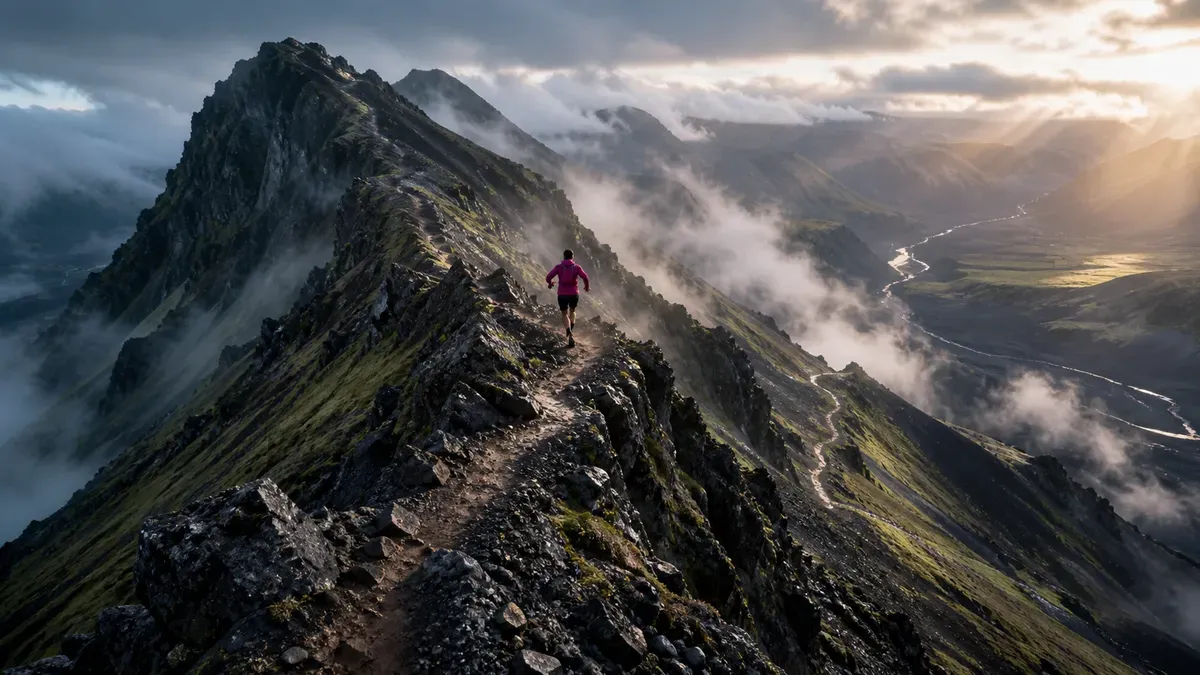
Skyrunning training: technique, fitness, and mountain safety
Build a skyrunning training plan for steep, technical terrain with uphill fitness, downhill skill, strength, pacing, fueling, and mountain safety.
Skyrunning training prepares you to run, power hike, descend, and make safe decisions on steep mountain terrain. It is not simply road running with more elevation, and it is not identical to every trail race. The sport combines sustained climbing, technical footing, fast changes in gradient, eccentric downhill load, weather exposure, and route-specific equipment rules.
The best preparation is equally specific and restrained: build an aerobic base, practise climbing at several intensities, expose the legs gradually to descents, learn technical movement at low speed, strengthen the tissues that manage propulsion and braking, and rehearse the course demands without turning every mountain day into a race.
Quick answer
To prepare for skyrunning, keep most training easy and add four specific elements:
- One uphill quality session using short or sustained climbing intervals.
- One easy mountain session that accumulates vertical gain and practises run-hike transitions.
- Progressive downhill exposure while fresh enough to make controlled foot-placement decisions.
- Two short strength sessions early in the plan, reducing to one as race-specific volume grows.
Start with terrain you can control. Increase only one source of difficulty at a time: duration, vertical gain, gradient, speed, altitude, or technicality. Train fueling, clothing, navigation, and mandatory equipment before race day. Fitness cannot compensate for an unsafe route choice, severe weather, altitude illness, or a descent that exceeds your skill.
Key facts
- Skyrunning combines steep mountain running with technical terrain and course-specific rules.
- Uphill sections demand high aerobic power and concentric force production.
- Downhill sections impose braking forces, eccentric muscle work, and rapid terrain decisions.
- Technical practice builds movement options that flat-road fitness cannot supply.
- Progressive exposure reduces the shock of unfamiliar climbing and descending loads.
What is skyrunning?
The International Skyrunning Federation sport rules define skyrunning as running on steep mountain terrain at low, medium, or high altitude. Hands and permitted equipment may assist progress, and technical sections are inherent to the sport. The rules distinguish several disciplines rather than one fixed race format.
Under the December 2025 rules, a standard SKY race is generally 12.4–28.0 mi (20–45 km), while SKYULTRA covers 31.1–49.7 mi (50–80 km). VERTICAL is uphill only, with at least 2,625 ft (800 m) of ascent and a minimum average incline of 20%. SKYSPEED is much shorter and steeper. Specific events can add mandatory equipment, cutoffs, technical ratings, weather procedures, and local rules.
These definitions matter because the word skyrunning does not describe one universal workout. A runner preparing for a 25 km SKY race with steep descents needs a different peak phase from someone entering an uphill-only VERTICAL event. Before building the plan, collect five course facts:
- distance and expected duration;
- total ascent and descent;
- longest continuous climb and descent;
- surface, exposure, and technical level;
- altitude, weather range, aid stations, and required equipment.
Skyrunning vs trail running
Trail running is the broader category: running on natural or unpaved terrain can include gentle woodland paths, rolling hills, deserts, coastlines, and ultramarathons. Skyrunning occupies a steeper and more technical mountain-specific space defined by its governing rules. The two overlap, but neither label alone tells you the complete load.
Use the actual course profile, not the marketing name. A shorter steep race may produce more calf strain, quadriceps braking, and decision fatigue per minute than a longer runnable trail. Conversely, a long race with moderate gradients can create a much larger fueling and durability problem.
Skyrunning vs vertical running
An uphill-only VERTICAL race isolates the ascent. A typical SKY race asks you to climb and descend, often repeatedly. Our vertical running training guide covers vertical speed, power hiking, steep-grade economy, and uphill-only race preparation in depth. This guide adds the complete skyrunning problem: technical transitions, descent skill, mountain exposure, and integrated race execution.
Why the terrain changes the sport
Flat pace loses meaning when gradient and footing change every few minutes. The same 10-minute mile can be easy on a road, impossible on a steep climb, and reckless on a rocky descent. Skyrunners need a broader dashboard: elapsed time, elevation change, grade, perceived effort, heart-rate trend, terrain, and movement quality.
Uphill running is an aerobic and force problem
Positive grade increases the work required to lift body mass. A recent review of uphill and downhill running found that uphill running generally increases oxygen demand, ventilation, heart rate, propulsive force, and activation of the hip and lower-leg muscles. Steps become shorter, contact time changes, and running may eventually give way to power hiking.
Aerobic capacity matters, but it is not the whole answer. A field study of short trail running found that VO2 max and vertical uphill treadmill speed predicted performance, while technical downhill sections produced the largest differences between runners (Bjorklund et al., 2019). You must be fit enough to reach the technical section with judgment intact—and skilled enough to use that fitness safely.
Use rating of perceived exertion as the common language across changing grades. Pace may collapse uphill and heart rate may lag at the start of an interval, but breathing and RPE still show whether the effort is easy, controlled hard, or unsustainable.
Downhill running is a braking and decision problem
Gravity assists forward motion, so breathing can ease while the legs absorb more energy. Downhill running relies heavily on eccentric contractions: the quadriceps and other muscles produce force while lengthening to control the body’s fall. Peak forces and braking demand can rise even when heart rate falls.
That mismatch explains why an athlete can feel aerobically comfortable during a descent and still experience substantial soreness or strength loss later. Our dedicated downhill running technique guide covers step control, visual scanning, braking, soreness, and a beginner exposure progression.
Descending is also a skill. On technical terrain, the runner must scan ahead, choose a line, change step length, avoid obstacles, balance with the arms, and decide when walking is faster than a fall. Research across more than 16,000 ultratrail results found that downhill pacing and the ability to limit late-race downhill slowing were associated with finish performance (Genitrini et al., 2022). That evidence comes from longer trail races, so it should guide the principle—not dictate a skyrace pace formula.
Altitude and exposure add separate risks
Skyrunning may occur at low altitude, but some courses climb high enough for hypoxia, cold, wind, solar exposure, and rapid weather changes to matter. Fitness does not prevent acute altitude illness. A fast ascent can expose a highly trained athlete to the same underlying risk as a slower participant.
If your race or training block includes high sleeping altitude, use a separate acclimatization plan. The altitude sickness guide explains headache, nausea, dizziness, ataxia, unusual breathlessness, and stop-or-descend decisions. The 2024 Wilderness Medical Society guidance emphasizes the ascent profile and warns that worsening neurologic or respiratory symptoms require descent and medical assessment—not a harder push to the finish.
The six abilities a skyrunner must train
1. Aerobic durability
Easy running and hiking provide the volume that supports recovery between climbs. They also create opportunities to practise fueling, footwear, layers, and movement on mild terrain without the fatigue of a hard session.
Most weekly endurance time should feel conversational. If every mountain outing becomes moderate, the athlete accumulates fatigue without enough intensity for a true quality session or enough ease for reliable recovery.
2. Uphill aerobic power
Use controlled intervals to raise the ceiling for climbing. Choose one of these formats according to experience:
- Short hills: 8–10 × 45–60 seconds at strong, repeatable effort, walking or jogging down fully enough to preserve form.
- Medium hills: 5–6 × 3–5 minutes at RPE 7–8/10, with 2–3 minutes easy.
- Long climbs: 2–3 × 10–15 minutes around threshold effort, with 4–5 minutes easy.
Do not combine all three in one week. Short hills emphasize force and cadence; medium intervals target aerobic power; long climbs develop sustainable race-specific output.
For the general physiology behind the ceiling, see the VO2 max training guide. Translate the interval into elevation only after you can repeat the effort with stable movement.
3. Power hiking
Walking is an essential competitive gait on steep terrain. Practise it before exhaustion chooses it for you.
Keep steps compact, lean from the ankles rather than folding at the waist, and use purposeful arms. On a safe climb, compare running and power hiking at the same RPE. Record vertical speed, breathing, calf strain, and how quickly the effort stabilizes. The better gait is the one that preserves elevation gain at a lower cost.
Train transitions too. Ten smooth changes between running and hiking teach more than one desperate switch late in a maximal climb.
4. Downhill tolerance and skill
Add descent exposure in small doses. Begin on a visible, predictable surface with four to six repetitions of 20–45 seconds. Stay relaxed, land with the feet near the body, scan two or three steps ahead, and finish each repetition able to stop smoothly.
Judge the dose over the next 24–72 hours. Mild quadriceps soreness can reflect unfamiliar eccentric work; pain that changes gait, focal bone pain, swelling, instability, or worsening symptoms requires a different response. Do not add speed, steepness, duration, and technicality in the same week.
5. Strength and tissue capacity
Strength training supports climbing force, braking tolerance, balance, and the ability to hold posture under fatigue. Twice per week in the early plan, choose four or five movements:
- split squat or step-up;
- squat or trap-bar deadlift;
- calf raise with straight and bent knees;
- controlled step-down;
- single-leg balance or low hop-and-stick;
- loaded carry or anti-rotation trunk exercise.
Use two to four sets with clean technique and leave repetitions in reserve. The goal is transferable capacity, not soreness that ruins the next mountain session. Reduce volume to one maintenance session as the race-specific phase grows.
6. Mountain judgment
Technical competence is more than foot speed. It includes turning around, choosing a safer line, adding a layer before becoming cold, recognizing deteriorating weather, carrying enough water, and knowing when an injury or symptom changes the plan.
Practise these decisions on low-consequence days. Race pressure is a poor classroom for a first navigation error, first pole deployment, first exposed ridge, or first attempt at eating while moving on rough ground.
Build the route-finding layer separately with the mountain navigation guide, which covers topographic maps, compass bearings, terrain checks, digital backups, and what to do when your position becomes uncertain.
An eight-week skyrunning training plan
This example assumes you already run three to five times per week, can complete an easy 60-minute run, and have no current injury. It is not a rehabilitation plan or a promise of readiness for every course. Match the long session and technical exposure to the race you actually chose.
| Weeks | Uphill quality | Mountain endurance | Downhill skill | Strength | Main objective |
|---|---|---|---|---|---|
| 1–2 | 8 × 60 sec controlled hills | 60–75 min easy rolling terrain | 4 × 30 sec gentle, visible descent | 2 sessions | Learn movement and establish tolerance |
| 3–4 | 5 × 4 min hard-repeatable | 75–105 min with run-hike practice | 5 × 45 sec controlled descent | 2 sessions | Build aerobic power and gait transitions |
| 5–6 | 3 × 10 min around threshold | 90–150 min on race-relevant terrain | 4–6 short technical segments while fresh | 1–2 sessions | Integrate climbing, descending, and fueling |
| 7 | 2 × 12 min near planned race effort | 75–120 min dress rehearsal below race load | Controlled race-specific practice | 1 light session | Rehearse equipment and execution |
| 8 | 4 × 2 min familiar uphill early in week | 30–50 min easy | No novel technical load | Mobility or very light strength | Reduce fatigue and retain rhythm |
Example week in the specific phase
- Monday: rest or 30–40 minutes very easy.
- Tuesday: uphill quality session plus easy cooldown.
- Wednesday: strength and optional short walk.
- Thursday: 45–70 minutes easy with four relaxed strides.
- Friday: rest or low-stress mobility.
- Saturday: mountain endurance session with planned run-hike and fueling practice.
- Sunday: 30–50 minutes easy; omit it when descent soreness or overall fatigue remains high.
Keep at least 48 hours between the uphill session and the longest mountain day. A technical descent inside Saturday’s run is already a muscular quality dose, even if heart rate remains moderate.
Progress vertical gain without a fake universal rule
There is no evidence-based percentage that makes weekly elevation gain safe for every athlete. A runner accustomed to 5,000 ft (1,524 m) per week and a road runner accustomed to zero elevation are not starting from the same place.
Track four variables separately:
weekly load = duration + vertical gain + intensity + technical difficultyChange one primary variable, then observe the response. Repeat a week when easy-run quality deteriorates, sleep worsens, soreness persists, pain becomes focal, or technical decisions become slower. Reduce the dose when normal walking or stair descent changes.
Technique for steep and technical terrain
Climb with short steps and a tall chest
As grade rises, shorten the stride and accept slower horizontal speed. Lean from the ankles, keep the hips available to extend, and avoid collapsing the chest onto the thighs. During power hiking, a brief hand-on-thigh assist may help on stable steep ground, but keep enough space to breathe.
Look through the trail
Alternate between a near field for immediate footing and a farther field for the next line, turn, or obstacle. Looking only at the shoes delays decisions; staring only ahead misses the surface. Slow down when the available sight line becomes shorter than the distance needed to stop.
Descend with adjustable steps
Use compact steps when traction or control declines. Let the arms widen for balance, keep the torso organized over the pelvis, and distribute braking across several steps. A long reaching step is often a sign that speed has exceeded current control.
Walk high-consequence sections
Running is optional; arriving safely is not. Walk slippery rock, snow, exposed traverses, congested passages, or terrain that you cannot reverse confidently. Course difficulty, weather, fatigue, and skill interact. A section that was runnable in a dry preview may require walking in rain or darkness.
Pacing by effort, terrain, and decisions
Start below the urge created by fresh legs and a crowded field. On early climbs, use breathing and RPE to prevent an effort that cannot be repaid. Heart rate can confirm the trend after several minutes, but it should not force you to chase a number through abrupt gradient changes.
Think in terrain blocks:
| Terrain | Primary pacing signal | Common mistake | Better decision |
|---|---|---|---|
| Runnable climb | Breathing, RPE, vertical speed | Chasing flat pace | Shorten stride and cap effort |
| Very steep climb | Vertical speed, calf strain | Refusing to hike | Switch before cadence collapses |
| Smooth descent | Control, line, leg response | Treating it as free recovery | Increase speed only while stopping remains easy |
| Technical descent | Vision, footing, consequence | Following another runner blindly | Choose your own safe line |
| Exposed or high terrain | Weather, symptoms, escape options | Letting the clock override safety | Slow, add protection, or turn around |
Save decision quality for the final third. The goal is not even speed; that is impossible across radically different gradients. Aim for an even internal cost early enough that you can still descend with coordination later.
Fueling, hydration, and equipment
Fuel the duration, not the label
For sessions under about 75 minutes, a normal pre-exercise meal and water according to thirst may be sufficient for many athletes. Longer or harder mountain sessions benefit from practised carbohydrate intake. A widely used evidence-based range is 30–60 g per hour for prolonged exercise, with up to 90 g per hour potentially useful beyond roughly 2.5 hours when multiple carbohydrate sources are trained and tolerated (Burke et al., 2011).
Those are ranges, not a challenge. Begin lower, practise on easy terrain, and use foods or drinks you can handle while moving. Gastrointestinal symptoms are common in trail events; race day is not the time to discover that a concentrated gel, high-fiber meal, or large fluid bolus does not work for you.
Avoid chronic underfueling. The IOC consensus on Relative Energy Deficiency in Sport describes how prolonged or severe low energy availability can impair health, recovery, bone health, immunity, and performance in athletes of any gender.
Hydrate without forcing a universal volume
Needs vary with temperature, humidity, altitude, duration, body size, pace, clothing, and sweat rate. Use the exercise hydration guide to measure a realistic range and decide when water, sodium, or post-session replacement fits the route. Practise a plan that prevents both severe dehydration and excessive drinking. The Wilderness Medical Society heat guideline recommends drinking to thirst in the field to avoid the paired risks of heat strain and exercise-associated hyponatremia.
Confusion, collapse, seizure, or severe deterioration during heat exposure is an emergency. Stop, move to a safer environment, begin appropriate cooling when heat stroke is suspected, and activate emergency care. Do not assume every sick athlete merely needs more water.
Use equipment only after rehearsal
Follow the event’s mandatory list and check whether poles are permitted. Shoes need secure fit and traction appropriate to the surface; no foam, plate, or tread removes the need to slow down. Carry layers for the plausible weather, not only the start-line forecast.
Practise pack access, pole deployment, jacket use, food retrieval, and emergency contacts with cold or tired hands. Equipment that cannot be reached while moving may not solve the problem it was meant to address.
Safety and injury-aware progression
A systematic review of 8,644 trail runners found wide variation in reported injury and illness rates, reflecting very different races and study methods. Feet, knees, lower legs, thighs, and ankles were commonly affected; blisters, abrasions, strains, cramps, sprains, gastrointestinal symptoms, and dehydration were prominent (Viljoen et al., 2021). The evidence base is still much stronger for race-day problems than for training injuries.
Do not turn that uncertainty into one promised prevention cue. Running-injury research does not support a single foot strike, cadence, or alignment correction as a universal shield. Use broader risk management:
- progress terrain exposure gradually;
- keep easy and hard days distinct;
- practise technical skills before fatigue;
- fuel enough to support training;
- address persistent pain early;
- carry event-required protection;
- respect weather, altitude, and route consequences.
Stop training and seek urgent care for chest pain, fainting, confusion, ataxia, severe or unusual breathlessness, signs of heat stroke, major trauma, or rapidly worsening symptoms. Seek clinical assessment for focal bone pain, significant swelling, inability to bear weight, repeated instability, or pain that changes normal gait.
People with cardiovascular, pulmonary, metabolic, renal, neurologic, or significant musculoskeletal conditions, those who are pregnant, and those returning after prolonged inactivity should discuss vigorous mountain exercise with an appropriately qualified clinician.
Track skyrunning adaptation with SuperAge
Skyrunning progress is not captured by one pace or one wearable score. SuperAge can place workouts, elevation, heart-rate trends, sleep, recovery, and broader health data in one view so you can ask a better question: Are you moving through comparable terrain with more control and no persistent rise in recovery cost?
Compare repeatable sessions. Look for more vertical gain at the same RPE, steadier breathing on a known climb, smoother descent decisions, less next-day soreness after the same exposure, or faster recovery across several weeks. Add non-device evidence such as appetite, mood, pain, confidence, and whether easy days still feel easy.
Download SuperAge to review fitness and recovery trends without treating one workout or wearable estimate as a diagnosis.
Common mistakes
Training only uphill
Strong climbing does not automatically produce safe, efficient descending. Include small, controlled downhill doses and technical practice.
Training every mountain day hard
Vertical gain can hide intensity. Keep most mountain time easy enough that the focused uphill session stays truly high quality.
Adding technicality under exhaustion
Learn a movement on low-consequence terrain while fresh. Fatigue can be added later; exposure and danger should not be the first progression variables.
Copying an elite plan
Elite athletes bring years of tissue adaptation, technical skill, recovery resources, and high aerobic capacity. Copy the principle of specificity, not their volume.
Ignoring the descent in load calculations
The downhill return from uphill repeats can create the largest eccentric dose. Walk down or use a treadmill when the intended stimulus is climbing.
Treating mandatory equipment as dead weight
Weather and injury can change a short race into a long wait. Carry the required gear and know how to use it.
Frequently asked questions
Is skyrunning the same as trail running?
No. Trail running is a broad category of off-road running. Skyrunning is defined by steep mountain terrain, technical sections, and discipline-specific course rules. Many events belong to both worlds, but preparation should follow the actual course.
How fit should I be before starting skyrunning training?
You should first tolerate regular easy running and at least a 60-minute session without concerning symptoms. Begin with nontechnical hills and hiking. A difficult race may require months or years of additional terrain-specific preparation.
How many hill sessions should I do each week?
One focused uphill session plus one easy mountain or hilly endurance session is enough for many recreational runners. More is useful only when your background, recovery, and total program support it.
Should I run or hike steep climbs?
Use the gait that produces the best sustainable vertical speed. Run when steps remain compact and economical; power hike when running adds little speed or sharply increases local fatigue.
Can a treadmill prepare me for skyrunning?
It can build controlled uphill volume without a downhill return. It cannot reproduce loose surfaces, technical descents, route choices, weather, exposure, or equipment handling, so it is one tool rather than a complete plan.
How do I train downhill without becoming extremely sore?
Start with a few short, gentle descents while fresh, then observe the response for 24–72 hours. Increase only one variable at a time and repeat the same dose until normal gait and easy training remain unaffected.
Do I need trekking poles?
Only when the event permits them and they improve your movement after practice. Poles require coordination and can be a burden on technical or crowded terrain. Check the exact rules before building them into training.
Is skyrunning suitable after 40?
It can be when health, experience, and progression support it. Preserve strength, increase technical exposure patiently, fuel adequately, and allow enough recovery. Age does not replace the need for an individualized risk assessment.
Key takeaways
- Skyrunning combines steep climbing, technical descending, environmental exposure, and mountain judgment.
- Prepare for the exact discipline and course rather than a generic mountain-running label.
- Keep most training easy; add one uphill quality session, one mountain endurance session, progressive descent practice, and strength.
- Track duration, vertical gain, intensity, and technicality separately.
- Pace by effort and control because flat-ground speed cannot describe changing terrain.
- Rehearse fueling, hydration, equipment, and safety decisions before race day.
- Fitness supports mountain performance, but it does not cancel weather, altitude, injury, or terrain risk.
References
- International Skyrunning Federation. Sport rules approved December 2025. 2026.
- Lu Z, et al. A review of uphill and downhill running: biomechanics, physiology and modulating factors. Frontiers in Bioengineering and Biotechnology. 2025.
- Bjorklund G, et al. Biomechanical adaptations and performance indicators in short trail running. Frontiers in Physiology. 2019.
- Genitrini M, et al. Downhill sections are crucial for performance in trail running ultramarathons. International Journal of Environmental Research and Public Health. 2022.
- Viljoen CT, et al. Epidemiology of injury and illness among trail runners: a systematic review. Sports Medicine. 2021.
- Small E. Wilderness Medical Society guidance on acute altitude illness. 2024.
- Lipman GS, et al. Wilderness Medical Society clinical practice guidelines for heat illness. Wilderness & Environmental Medicine. 2019.
- Burke LM, et al. Carbohydrates for training and competition. Journal of Sports Sciences. 2011.
- Mountjoy M, et al. IOC consensus statement on Relative Energy Deficiency in Sport. British Journal of Sports Medicine. 2023.
This article is for educational purposes and does not replace individualized medical, physiotherapy, mountain-safety, or coaching advice.
Related Articles

Pre-race anxiety: mental skills for calmer, sharper running
Pre-race anxiety is normal, but it need not control your run. Build a practiced routine for breathing, self-talk, focus, sleep, and race-day decisions.