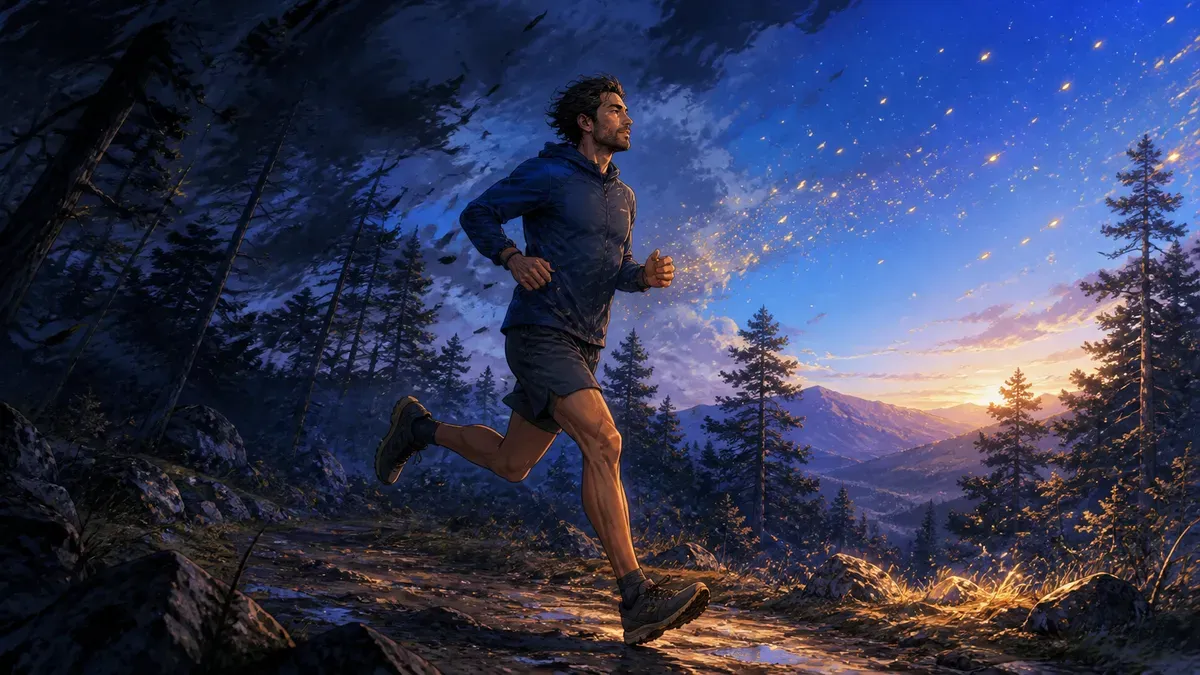
Runner's high explained: endocannabinoids, timing, and myths
Learn what runner's high feels like, why endocannabinoids now lead the science, when it may occur, and how to run for enjoyment without chasing pain.
Quick answer
Runner’s high is a short-lived state of unusual calm, pleasure, reduced anxiety, easier-feeling movement, or absorbed focus during or after sustained exercise. It is real for some people, but it is neither guaranteed nor a reliable sign that a workout was effective.
The old explanation credited endorphins alone. Human research now puts more emphasis on endocannabinoids—fat-derived signaling molecules such as anandamide and 2-arachidonoylglycerol (2-AG)—while recognizing that mood, attention, pain modulation, expectations, and several neurochemical systems interact. A 2021 randomized experiment found that 45 minutes of moderate running increased euphoria and reduced anxiety even when opioid receptors were blocked, while circulating anandamide and 2-AG rose (Siebers et al., 2021). That makes endocannabinoids strong candidates, not a complete causal proof.
If you want to make a pleasant run more likely, choose a familiar aerobic activity, begin easy, settle into a sustainable conversational-to-steady effort, and allow enough uninterrupted time to find rhythm. Do not increase distance, ignore symptoms, or force a hard pace to manufacture a feeling.
Key facts
- Runner’s high describes a transient cluster of pleasure, calm, lower anxiety, altered pain, and effortless focus.
- Acute endurance exercise often raises circulating anandamide and sometimes 2-AG, with large differences between people and protocols.
- Opioid blockade did not prevent running-related euphoria or anxiolysis in a randomized human experiment.
- Moderate sustained effort appears to create favorable conditions more consistently than very easy walking or all-out exercise in small laboratory studies.
- A pleasant mood lift does not require a dramatic runner’s high and still counts as a worthwhile exercise response.
The most useful way to understand runner’s high is as an occasional outcome of a well-matched bout of movement—not as a pace target, training zone, or reward owed to every runner.
What does runner’s high actually feel like?
There is no laboratory switch that changes from “off” to “high.” People use the same phrase for several overlapping experiences:
- an unexpectedly light, positive, or euphoric mood;
- quieting of worry or mental chatter;
- a feeling that stride and breathing have become automatic;
- reduced awareness of ordinary discomfort;
- relaxed alertness rather than stimulation;
- absorption in the route, rhythm, or present moment;
- a calm afterglow that continues briefly after stopping.
A classic runner’s high is more distinct than simply being glad a workout is over. Yet the boundary is subjective. Researchers usually measure individual features—mood ratings, state anxiety, pain thresholds, flow questionnaires, and blood concentrations—because there is no accepted clinical test or biomarker that proves someone experienced it.
It is also useful to separate three related states.
| Experience | Typical description | What it does not prove |
|---|---|---|
| Ordinary exercise mood lift | Less tense, more energetic, or more positive after moving | That a dramatic high occurred |
| Flow | Deep task absorption, clear feedback, reduced self-consciousness, action feeling automatic | A specific chemical mechanism |
| Runner’s high | A marked but temporary combination of euphoria, calm, reduced anxiety, analgesia, or flow-like ease | Superior fitness, correct training load, or immunity from injury |
Flow and runner’s high can coexist, but they are not synonyms. In a small study of 11 ultramarathon runners, flow and physical relaxation increased after the first hour of a six-hour run and then declined, even while some cortical changes continued (Schneider et al., 2016). That is one reason not to treat a subjective peak as a stable physiological zone.
The endorphin story is incomplete
Endorphins are endogenous opioids: molecules the body makes that participate in pain and stress regulation. Blood concentrations can rise with prolonged exercise, which helped create the familiar explanation that endorphins cross into the brain and cause runner’s high.
The evidence became more complicated. A positron-emission tomography study in 10 trained athletes found changes in opioid-receptor binding after a two-hour run, and those changes correlated with euphoria ratings in several brain regions (Boecker et al., 2008). That study supports central opioid involvement, but its small sample and observational ligand changes cannot establish that opioids alone generate the experience.
The stronger challenge came from the 2021 randomized, double-blind study. Sixty-three regular endurance exercisers completed running and walking conditions after receiving either naltrexone, an opioid-receptor antagonist, or placebo. Moderate treadmill running increased euphoria, reduced anxiety, and raised anandamide and 2-AG. Blocking opioid receptors did not abolish the mood effects (Siebers et al., 2021).
The responsible conclusion is not “endorphins do nothing.” Opioid signaling may still contribute to pain processing or interact with other systems. The experiment shows that the measured euphoria and anxiety reduction did not depend on opioid signaling in the way the simple endorphin story predicts.
Why endocannabinoids lead the current explanation
The endocannabinoid system helps regulate stress, reward, pain, appetite, memory, and physiological balance. Its best-studied signaling molecules include:
- anandamide (AEA): named from a Sanskrit-derived word associated with bliss;
- 2-arachidonoylglycerol (2-AG): another major endogenous ligand with broad signaling roles;
- CB1 and CB2 receptors: targets through which endocannabinoids influence neural and peripheral processes.
Endocannabinoids are not cannabis, and an exercise response is not intoxication. They are molecules produced within the body, released and cleared rapidly as part of normal signaling.
Early human work found that 50 minutes of treadmill running or cycling at a moderate effort raised anandamide in trained students (Sparling et al., 2003). Later studies linked acute exercise with changes in anandamide, 2-AG, mood, anxiety, and pain sensitivity, although protocols and results vary.
A systematic review focused specifically on runner’s high included 21 human exercise studies. Fourteen of 17 acute-exercise studies detected an increase in at least one endocannabinoid, but the authors concluded that reliable proof that endocannabinoids cause runner’s high in humans was still missing because of methodological limits (Siebers et al., 2023). A broader meta-analysis likewise found overall increases in anandamide and 2-AG after acute exercise, alongside substantial heterogeneity related to intensity, fitness, measurement timing, and other conditions (Desai et al., 2022).
Animal research offers stronger causal tools but a narrower translation. In mice, blocking cannabinoid receptors prevented running-related reductions in anxiety and pain, while opioid blockade did not; euphoria itself cannot be measured in mice (Fuss et al., 2015). The experiment explains plausible receptor pathways, not exactly what a human runner feels.
Think of the current model as an orchestra rather than a solo. Endocannabinoids appear prominent, while endogenous opioids, dopamine, serotonin, catecholamines, brain-derived neurotrophic factor, temperature, attention, learned expectations, and the environment may shape different parts of the experience.
When does runner’s high happen?
No study has established a universal minute, mileage, heart-rate zone, or pace. The best-supported practical pattern is sustained aerobic work that is challenging enough to create a physiological signal but controlled enough to remain rhythmic.
In one small intensity study, recreationally fit runners showed significant endocannabinoid changes after moderate treadmill running, while very low and very high intensities did not produce the same response (Raichlen et al., 2013). In the 2021 naltrexone experiment, 45 minutes of moderate running produced the measured mood and endocannabinoid effects. A 2024 pilot involving 16 people reported higher mood, anandamide, and 2-AG after a 60-minute outdoor run, but the sample was far too small to define who will experience runner’s high or at what time (Gasperi et al., 2024).
These studies suggest conditions to test, not a prescription:
- Warm up gradually. The opening minutes often feel mechanically and mentally busy.
- Settle below all-out intensity. Use a pace you could sustain, with breathing controlled enough for short phrases.
- Keep the task simple. A familiar route or steady treadmill session reduces decisions.
- Allow continuity. Frequent stops, urgent pace checks, and notifications can disrupt rhythm.
- Let the outcome be optional. Monitoring every minute for euphoria makes absorption less likely.
The max-heart-rate and exercise-zones guide can help you interpret intensity, but no zone guarantees runner’s high. Heart-rate formulas have individual error, heat and hills change cardiovascular strain, and subjective ease can shift day to day.
How common is runner’s high?
There is no trustworthy population percentage. Studies use different definitions, recruit different kinds of exercisers, and often ask about separate features rather than a single all-or-none event. Small samples cannot tell us how often an average runner should expect it.
Even endocannabinoid responses vary. In a 2017 study of 36 adults with low, moderate, or high habitual activity, both a prescribed aerobic bout and a self-selected bout increased circulating endocannabinoids and improved mood. The prescribed condition produced a larger anandamide increase, while preferred exercise produced greater improvement in several mood measures (Brellenthin et al., 2017). Chemical change and subjective experience did not move as one simple dial.
Newer research reinforces that caution. A 2026 randomized crossover study of 30 healthy young adults found large person-to-person differences in anandamide and 2-AG during low- and moderate-intensity cycling. Low-intensity exercise reduced negative affect even though aggregate endocannabinoid changes were inconsistent (Yabe et al., 2026). A better mood does not require the same biochemical pattern in everyone.
Not experiencing runner’s high does not mean that:
- you ran too slowly;
- the session did not improve health or fitness;
- you lack mental toughness;
- your endocannabinoid system is deficient;
- you should extend the run or add intensity.
Consistency, appropriate progression, and recovery matter far more than an occasional peak feeling. Our exercise-consistency guide explains why repeatable training beats emotionally dramatic sessions over time.
A low-pressure way to explore a better-feeling run
The goal of this session is not to “trigger” runner’s high. It is to create safe conditions for rhythm and notice the complete response.
| Segment | Effort cue | Attention cue |
|---|---|---|
| First 10 minutes | Very easy; full sentences possible | Relax hands, jaw, and shoulders |
| Next 15–25 minutes | Comfortable-to-steady; short sentences possible | Notice cadence, breathing, and surroundings without judging |
| Optional 10–20 minutes | Hold the same effort only if form and symptoms stay normal | Let pace be an outcome, not a target |
| Final 5–10 minutes | Gradually easier | Notice mood, pain, heat, and coordination honestly |
Beginners should not jump to a 45- or 60-minute continuous run just because those durations appear in experiments. Start with run-walk intervals and build gradually; the start-running-after-40 guide offers a conservative foundation for any adult beginning or returning.
If steady running feels monotonous rather than absorbing, choose another rhythmic aerobic activity. Cycling, brisk uphill walking, swimming, rowing, and cross-country skiing can also change endocannabinoid concentrations. “Runner’s high” is the popular name, not proof that running owns the biology.
Environment can help without becoming a requirement
A quiet route, music, a companion, a treadmill, or a natural setting may each help a different person reduce friction. Use the environment that supports safe attention. Do not use headphones where traffic, wildlife, terrain, or other hazards require full awareness.
Competition can sharpen attention for one runner and increase self-monitoring for another. A 2023 study in men found different relationships between flow and catecholamines in competitive versus noncompetitive running drills, illustrating that context changes the psychological response (Karsai et al., 2023). It does not establish one ideal setting for everyone.
When race pressure rather than route choice is what interrupts rhythm, the pre-race anxiety guide offers breathing, attention, and process-goal tools without promising a chemically engineered calm.
Do not chase analgesia or ignore warning signs
Reduced discomfort is one reported feature of runner’s high, but pain modulation is not tissue protection. A pleasant state can coexist with dehydration, heat strain, a developing bone or tendon injury, or excessive effort. It cannot make damaged tissue safe.
Stop the session for chest pain or pressure, fainting, confusion, severe or unusual shortness of breath, loss of coordination, new neurological symptoms, or rapidly worsening pain. Seek urgent medical help when symptoms are severe or suggest a cardiovascular, heat-related, or neurological emergency. The American Heart Association advises stopping endurance exercise and obtaining medical review when exertional warning symptoms occur (Franklin et al., 2020).
Also stop and reassess for focal pain that changes your stride, escalating bone pain, or symptoms that persist after the run. Euphoria is not permission to finish a route.
The U.S. Physical Activity Guidelines emphasize starting low, progressing gradually, selecting activity appropriate to current fitness, and seeking professional guidance when chronic conditions or symptoms affect what is safe (ODPHP, 2018). If you are returning after illness, injury, prolonged inactivity, pregnancy, or a new diagnosis, individualized advice matters more than a generic runner’s-high protocol.
For pregnancy specifically, use the exercise-during-pregnancy safety guide to adjust intensity, impact, position, and warning-sign decisions instead of chasing a particular running sensation.
Runner’s high, healthy aging, and SuperAge
Runner’s high may make movement memorable, but healthy aging is built by the less cinematic pattern: regular aerobic work, muscle-strengthening activity, sleep, adequate nutrition, and sensible recovery. You never need euphoria to gain cardiovascular or metabolic benefit.
The complete exercise guide for longevity is the primary hub for balancing aerobic fitness, strength, power, mobility, and consistency across decades. Runner’s high is an optional experience inside that much larger system.
Aging can change pace, heat tolerance, recovery time, medication effects, and injury history without removing the capacity for enjoyment or flow. Match the route and effort to present fitness. The running-economy guide explains how technique, strength, and sustainable efficiency matter more than forcing speed.
SuperAge can help place a good-feeling run inside a longer pattern by comparing activity with sleep, resting heart rate, HRV, and health trends. Use that context to ask:
- Was the run pleasant because the effort matched readiness?
- Did sleep and energy remain normal afterward?
- Did the same route feel smoother at a similar effort over several weeks?
- Did pain, fatigue, or resting signals change in the following days?
No app or wearable can detect runner’s high, prove endocannabinoid release, or clear an injury. The value lies in remembering context rather than awarding a biochemical score.
If a compelling run is followed by several days of poor sleep, heavy legs, low motivation, or worsening performance, use the recovery-debt guide to interpret the cluster rather than allowing one enjoyable session to dominate the decision.
Download SuperAge to review exercise and recovery trends alongside the subjective notes that devices cannot measure.
Common runner’s-high myths
“It starts after exactly 30 minutes”
Experiments often use 45–60 minutes because researchers need a standardized exposure. That does not establish a threshold. Training status, modality, intensity, environment, expectation, and measurement timing all vary.
“Run harder to release more feel-good chemicals”
Very hard exercise can increase stress, discomfort, and attentional demand. Small studies suggest a moderate-intensity window for some endocannabinoid responses; more intensity is not automatically more reward.
“Endorphins are the single cause”
Central opioid signaling may participate, but opioid blockade did not eliminate euphoria or anxiety reduction in the strongest direct human experiment. Current evidence favors a multi-system explanation with endocannabinoids prominent.
“Anandamide in blood proves what happened in the brain”
Circulating concentrations are useful markers, not a direct film of neural signaling. Blood sampling, receptor activity, production sites, clearance, and subjective experience do not map one-to-one.
“Only trained runners can experience it”
Most mechanistic studies are small and often recruit fit participants, so they cannot define an exclusive group. Beginners may enjoy mood improvements but should progress for tissue tolerance rather than copy laboratory duration.
“If pain fades, the injury is gone”
Exercise-induced hypoalgesia changes perception temporarily. It does not repair tissue or remove the reason for focal pain.
Key takeaways
- Runner’s high is an occasional cluster of pleasure, calm, lower anxiety, altered pain, and flow-like ease.
- Ordinary post-exercise well-being is valuable even when no dramatic high occurs.
- Endocannabinoids are leading mechanistic candidates, but no single molecule fully explains the human experience.
- Human opioid-blockade evidence challenges the idea that endorphins alone cause runner’s high.
- Sustained moderate aerobic work creates plausible conditions; no minute, pace, distance, or heart-rate zone guarantees it.
- Person-to-person variability is normal and not a fitness diagnosis.
- Build duration gradually and never chase euphoria through exhaustion, pain, heat strain, or unsafe terrain.
- Judge a run by its fit within a sustainable week, not by whether it produced a peak feeling.
FAQ
How long do you have to run to get runner’s high?
There is no proven minimum. Human experiments have often used about 45–60 minutes of moderate aerobic exercise, but those protocols are research choices, not universal thresholds. Beginners should use shorter run-walk sessions and increase duration gradually rather than chase the study duration.
What is the difference between runner’s high and flow?
Flow is deep absorption in a well-matched task, with clear feedback and less self-conscious monitoring. Runner’s high usually refers to a broader mood and body experience that may include euphoria, calm, reduced anxiety, analgesia, and flow. They can overlap without being identical.
Are endorphins or endocannabinoids responsible?
Endocannabinoids currently have stronger direct support for the euphoria and anxiety-reduction components, especially because opioid blockade did not prevent them in a randomized human study. Endorphins and other systems may still influence pain, stress, and the overall response. The evidence supports interaction, not a one-chemical answer.
Can walking or cycling cause a runner’s high?
Potentially. Acute aerobic exercise across several modalities can raise endocannabinoids and improve mood. The dramatic subjective experience is not guaranteed, and some intensity studies found a stronger response to moderate running than low-intensity walking. Choose a rhythmic activity appropriate to your fitness and joints.
Why have I never experienced runner’s high?
The experience is variable and has no reliable prevalence estimate. Genetics, fitness, exercise dose, context, expectations, mood, sleep, and measurement language may all matter. Its absence does not mean your training is ineffective or your biology is abnormal.
Can runner’s high become addictive?
Enjoying exercise and wanting to repeat it is usually beneficial. Concern arises when exercise becomes rigid or compulsive, continues through injury or illness, compensates for eating, causes distress when missed, or displaces sleep and relationships. Those patterns deserve support from a qualified health or mental-health professional.
Does runner’s high improve performance?
It may make effort feel smoother or reduce self-consciousness temporarily, but it is not a dependable performance tool. Pacing, fitness, fueling, heat, terrain, and fatigue still govern the session. A pleasant state should not override a race plan or warning symptoms.
Can a wearable detect runner’s high?
No. Heart rate, pace, HRV, and movement do not measure euphoria, receptor activity, or endocannabinoid release. A short subjective note is more honest: record mood, calm, discomfort, and perceived flow, then view those observations beside recovery and training context.
References
- Siebers M, et al. Exercise-induced euphoria and anxiolysis do not depend on endogenous opioids in humans. Psychoneuroendocrinology. 2021.
- Siebers M, Biedermann SV, Fuss J. Do endocannabinoids cause the runner’s high? Evidence and open questions. The Neuroscientist. 2023.
- Desai S, et al. A systematic review and meta-analysis on the effects of exercise on the endocannabinoid system. Cannabis and Cannabinoid Research. 2022.
- Fuss J, et al. A runner’s high depends on cannabinoid receptors in mice. Proceedings of the National Academy of Sciences. 2015.
- Raichlen DA, et al. Exercise-induced endocannabinoid signaling is modulated by intensity. European Journal of Applied Physiology. 2013.
- Sparling PB, et al. Exercise activates the endocannabinoid system. NeuroReport. 2003.
- Brellenthin AG, et al. Endocannabinoid and mood responses to exercise in adults with varying activity levels. Medicine & Science in Sports & Exercise. 2017.
- Gasperi V, et al. Investigating runner’s high after a 60-minute outdoor run. International Journal of Molecular Sciences. 2024.
- Boecker H, et al. The runner’s high: opioidergic mechanisms in the human brain. Cerebral Cortex. 2008.
- Yabe T, Ando D, Koyama K. Low-intensity exercise reduces negative affect via circulating endocannabinoid dynamics. European Journal of Applied Physiology. 2026.
- Franklin BA, et al. Exercise-related acute cardiovascular events and long-term training. American Heart Association Scientific Statement. 2020.
- U.S. Department of Health and Human Services. Physical Activity Guidelines for Americans, 2nd edition. 2018.
Related Articles
Pre-race anxiety: mental skills for calmer, sharper running
Pre-race anxiety is normal, but it need not control your run. Build a practiced routine for breathing, self-talk, focus, sleep, and race-day decisions.