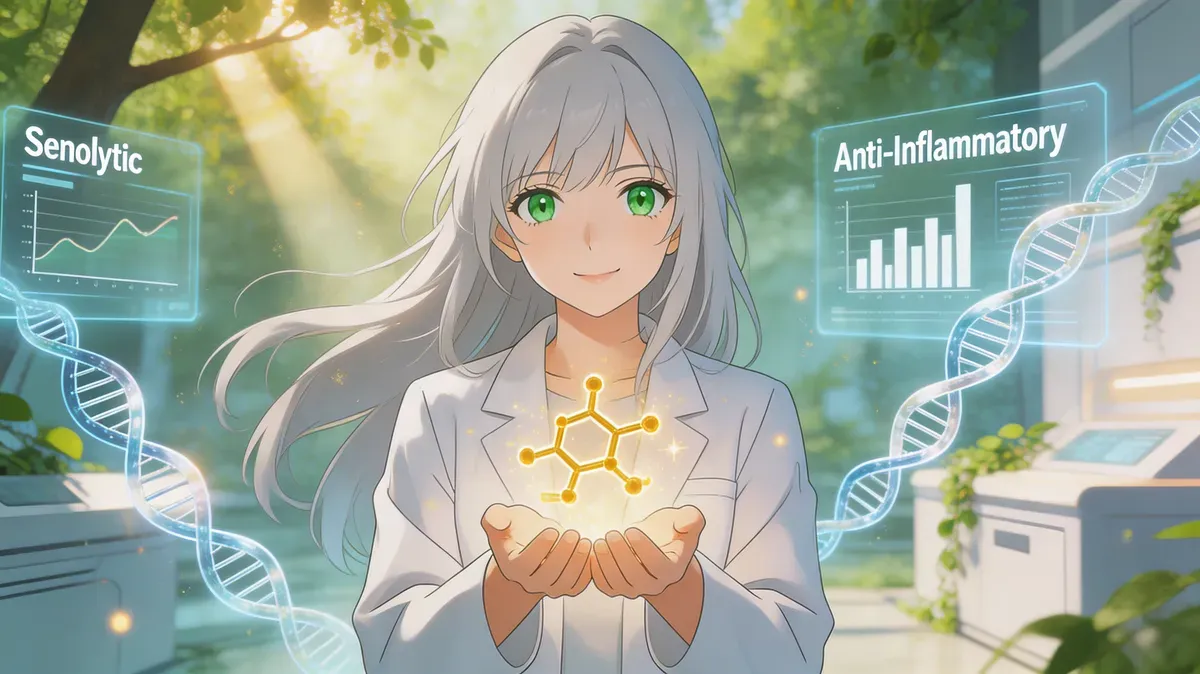
Quercetin: The flavonoid with senolytic and anti-inflammatory power
Quercetin clears senescent zombie cells and fights chronic inflammation. Explore the science, food sources, dasatinib+quercetin research, and dosage for longevity.
In 2015, a landmark study at the Mayo Clinic demonstrated that clearing senescent “zombie cells” from aging mice extended their lifespan by 36%. The drug combination used? Dasatinib — a leukemia medication — paired with quercetin, a flavonoid found in onions, apples, and green tea. It was the first time a compound available in every grocery store had been shown to kill the cells that drive aging.
Since then, quercetin has become one of the most intensely studied natural longevity compounds. In 2025, a pilot clinical trial in eBioMedicine (The Lancet) showed that dasatinib plus quercetin improved cognitive scores in older adults at risk for Alzheimer’s — the first human evidence that senolytic therapy can benefit brain aging.
But quercetin isn’t just a senolytic. It’s a potent anti-inflammatory, antioxidant, and immune modulator with a dual mechanism that no synthetic drug can fully replicate. Here’s what the science actually says — and what it doesn’t.
What you’ll learn:
- How quercetin selectively kills senescent cells while sparing healthy ones
- Why the dasatinib + quercetin combination is the most validated senolytic protocol
- What food sources provide therapeutic quercetin levels
- The honest limitations and who should (and shouldn’t) consider supplementation
What is quercetin?
Quercetin (3,3’,4’,5,7-pentahydroxyflavone) is a plant flavonoid — specifically a flavonol — found widely in fruits, vegetables, and grains. It’s one of the most abundant dietary flavonoids, with average daily intake estimated at 10-100 mg depending on diet.
Quick definition: Quercetin is a naturally occurring flavonoid found in onions, apples, and berries that acts as both a senolytic agent (clearing senescent “zombie cells”) and a potent anti-inflammatory, making it one of the most versatile natural compounds in longevity research.
Quercetin in the longevity landscape
What makes quercetin unusual among longevity compounds is its dual mechanism:
- Senolytic — it selectively induces apoptosis (programmed death) in senescent cells
- Senomorphic — it suppresses the inflammatory secretions (SASP) of senescent cells it doesn’t kill
This means quercetin both removes zombie cells and quiets the ones that remain — a one-two punch against one of the most damaging hallmarks of aging.
How quercetin fights aging: the science
Senolytic mechanism: killing zombie cells
Senescent cells accumulate with age and resist normal programmed death by upregulating anti-apoptotic survival pathways. Quercetin targets these survival pathways:
- PI3K/Akt inhibition — Quercetin blocks the PI3K/Akt signaling pathway that senescent cells rely on for survival
- Bcl-2 family modulation — Reduces expression of anti-apoptotic proteins (Bcl-2, Bcl-xL) that protect senescent cells from death
- SIRT5 pathway — Inhibits Akt phosphorylation via the SIRT5/PI3K/Akt axis
- mTOR/STAT3 suppression — Disrupts additional survival signals through mTOR and STAT3 pathways
The result: senescent cells become vulnerable to their own death signals and undergo apoptosis, while healthy cells — which don’t depend on these survival pathways — are unaffected.
Anti-inflammatory effects
Chronic low-grade inflammation (inflammaging) is a central driver of age-related disease — and a defining feature of immune system aging that also promotes autoimmune diseases in older adults. Quercetin combats inflammation through multiple mechanisms:
- NF-kB inhibition — Blocks the master inflammatory transcription factor (a mechanism shared with curcumin, though through different binding sites)
- SASP suppression — Reduces inflammatory secretions from senescent cells (IL-6, IL-8, MCP-1, TNF-alpha)
- COX-2 and LOX inhibition — Blocks pro-inflammatory enzyme pathways
- NLRP3 inflammasome suppression — Prevents assembly of the inflammasome complex responsible for IL-1beta production
Antioxidant activity
Quercetin is one of the most potent natural antioxidants:
- Scavenges superoxide, hydroxyl, and peroxyl radicals
- Chelates transition metals (iron, copper) that catalyze oxidative damage
- Upregulates endogenous antioxidant enzymes through Nrf2 pathway activation
- Protects LDL cholesterol from oxidation
Autophagy promotion
Quercetin also activates autophagy — the cellular cleanup process — through AMPK activation and mTOR inhibition, providing an additional layer of cellular maintenance beyond senolytic clearance.
The dasatinib + quercetin protocol
The most studied senolytic combination pairs quercetin with dasatinib (a tyrosine kinase inhibitor used in leukemia treatment). This combination exploits different vulnerabilities in different senescent cell types.
Why the combination works
- Dasatinib effectively targets senescent human fat cell progenitors (pre-adipocytes)
- Quercetin more effectively targets senescent endothelial cells and some other cell types
- Together they cover a broader range of senescent cell populations than either alone
Key preclinical findings
| Study | Model | D+Q Protocol | Key Result |
|---|---|---|---|
| Zhu et al. (2015) | Aging mice | Intermittent dosing | 36% lifespan extension, improved physical function |
| Xu et al. (2018) | Old mice (transplanted senescent cells) | Monthly, 3 days | Improved walking speed, endurance, grip strength |
| Hickson et al. (2019) | Diabetic kidney disease (human) | 3 days on, 28 off | Reduced senescent cells, lower SASP markers |
| Palmer et al. (2023) | Nonhuman primates | Long-term intermittent | Reduced inflammation in adipose tissue |
The 2025 Alzheimer’s pilot trial
Published in eBioMedicine (The Lancet), this study tested D+Q in older adults at risk for Alzheimer’s:
- Protocol: 100 mg dasatinib + 1,250 mg quercetin, 2 consecutive days every 2 weeks, for 12 weeks
- Safety: No serious adverse events related to intervention
- Efficacy: Montreal Cognitive Assessment (MoCA) scores increased significantly by 2.0 points in participants with lowest baseline scores
- Biomarkers: CSF senescence markers showed trends toward reduction
This was a feasibility study, not a definitive efficacy trial — but it demonstrated that intermittent senolytic therapy is safe and may benefit cognitive aging.
Critical note: intermittent dosing
Unlike most supplements taken daily, senolytics work through intermittent “hit-and-run” dosing:
- Senescent cells take days to weeks to accumulate
- Brief treatment windows clear existing senescent cells
- Long breaks between doses allow normal cells to function without interference
- Continuous high-dose quercetin is NOT the senolytic protocol
Quercetin alone: what can it do?
While the D+Q combination gets the most research attention, quercetin alone has meaningful effects.
Senolytic activity (without dasatinib)
Quercetin alone shows senolytic activity in specific cell types:
- Senescent endothelial cells — moderate clearance
- Senescent adipocytes and pre-adipocytes — significant clearance
- Senescent bone marrow stem cells — some activity
However, quercetin alone is less potent and less broadly effective than the D+Q combination. For senolytic purposes specifically, quercetin alone is a weaker intervention — and head-to-head screening data from the Mayo Clinic found fisetin to be more potent than quercetin across multiple senescent cell types.
Anti-inflammatory benefits (daily supplementation)
For inflammation reduction, daily quercetin supplementation has more consistent evidence:
- Multiple clinical trials show reduced hs-CRP and inflammatory cytokines
- Doses of 500-1,000 mg/day show anti-inflammatory effects within 4-8 weeks
- May reduce exercise-induced inflammation and upper respiratory infections in athletes
- Synergistic with vitamin C, which stabilizes quercetin and improves absorption
- A related flavone, apigenin (found in parsley and chamomile), shares quercetin’s NF-κB inhibition mechanism while also inhibiting CD38 — the enzyme responsible for age-related NAD+ degradation — making it a complementary flavonoid in an anti-inflammaging protocol
Cardiovascular protection
- Reduces blood pressure in hypertensive individuals (meta-analysis: -3.7 mmHg systolic)
- Improves endothelial function through increased nitric oxide bioavailability
- Reduces LDL oxidation — a key driver of atherosclerosis
- May slow arterial stiffening through anti-inflammatory mechanisms
Food sources: getting quercetin naturally
Quercetin is widely available in common foods, though concentrations vary dramatically.
Top dietary sources
| Food | Quercetin (mg per serving) | Serving Size |
|---|---|---|
| Capers (raw) | 180-234 mg | 1 tablespoon (9 g / 0.3 oz) |
| Red onion | 32-60 mg | 1 medium (110 g / 3.9 oz) |
| Kale | 23-50 mg | 1 cup raw (67 g / 2.4 oz) |
| Cranberries | 15-25 mg | 1 cup (100 g / 3.5 oz) |
| Sweet potato (raw) | 10-20 mg | 1 medium (130 g / 4.6 oz) |
| Apples (with skin) | 10-15 mg | 1 medium (182 g / 6.4 oz) |
| Broccoli | 6-10 mg | 1 cup (91 g / 3.2 oz) |
| Blueberries | 5-8 mg | 1 cup (148 g / 5.2 oz) |
| Green tea | 2-5 mg | 1 cup (237 mL / 8 oz) |
| Red grapes | 3-5 mg | 1 cup (151 g / 5.3 oz) |
Can food provide senolytic doses?
The D+Q protocol uses 1,250 mg quercetin — equivalent to eating roughly 20-40 raw red onions in a sitting. Food-derived quercetin is excellent for daily anti-inflammatory support but cannot realistically achieve the acute senolytic doses used in clinical trials.
For anti-inflammatory benefits, however, a diet rich in capers, onions, kale, and berries provides meaningful quercetin alongside hundreds of synergistic phytocompounds — an approach consistent with the Mediterranean diet pattern.
Dosage, safety, and practical considerations
Dosage by purpose
| Purpose | Dose | Protocol | Evidence Level |
|---|---|---|---|
| Anti-inflammatory support | 500-1,000 mg/day | Daily, with meals | Moderate |
| Antioxidant support | 250-500 mg/day | Daily | Moderate |
| Senolytic (with dasatinib) | 1,250 mg | 2 days on, 2-4 weeks off | Emerging clinical |
| Senolytic (quercetin alone) | 1,000-1,500 mg | Intermittent (experimental) | Preclinical |
| Immune support | 500-1,000 mg/day | Daily during cold/flu season | Moderate |
Absorption enhancement
Quercetin has moderate bioavailability (~16% in standard form) that can be significantly improved:
- With vitamin C — stabilizes quercetin and increases absorption
- With bromelain — pineapple enzyme improves absorption
- Phytosome formulations — lipid-wrapped quercetin shows 20x higher bioavailability
- With fat-containing meals — as a flavonoid, quercetin is partially fat-soluble
Side effects and safety
Quercetin is generally well-tolerated at doses up to 1,000 mg/day:
- Common: Mild headache, tingling sensations (typically transient)
- GI symptoms: Nausea, stomach discomfort at high doses
- Drug interactions: May interact with antibiotics (fluoroquinolones), blood thinners, and cyclosporine
- Kidney concerns: Very high doses (>1,500 mg/day long-term) may theoretically increase kidney stone risk in susceptible individuals
Who should exercise caution
- Those on blood-thinning medications
- People taking fluoroquinolone antibiotics
- Those with a history of kidney stones
- Pregnant or breastfeeding women (insufficient safety data at supplement doses)
How SuperAge helps you track inflammaging
Quercetin’s primary benefits — reducing inflammation and clearing senescent cells — translate into measurable improvements in the biomarkers that SuperAge tracks.
Monitoring inflammatory burden
Chronic inflammation manifests as elevated resting heart rate, reduced HRV, poor recovery from exercise, and accelerated biological aging. SuperAge tracks these metrics continuously through Apple Health, giving you a real-time window into your inflammatory status.
Biological age trajectory
Whether you’re pursuing senolytic protocols under medical supervision or simply eating more onions and kale, SuperAge’s biological age calculation reveals whether your approach is moving the needle. Reduced inflammation shows up as improved cardiovascular metrics, better recovery scores, and a declining biological age.
Frequently asked questions
Can I take quercetin as a senolytic without dasatinib?
Quercetin alone has some senolytic activity, particularly against senescent endothelial cells and adipocytes. However, it’s significantly less potent than the dasatinib + quercetin combination. If you’re interested in senolytic therapy, discuss the D+Q protocol with a physician experienced in longevity medicine. Self-administering dasatinib is not recommended.
How much quercetin should I take daily for anti-aging?
For general anti-inflammatory and antioxidant support, 500-1,000 mg/day with meals is the most studied range. Pair with vitamin C for improved absorption. For senolytic effects, intermittent high-dose protocols (not daily supplementation) are used under medical supervision.
Is quercetin safe to take long-term?
Daily supplementation at 500-1,000 mg appears safe based on clinical trials lasting up to 12 weeks. Long-term safety data beyond 12 months is limited. Food-derived quercetin through a polyphenol-rich diet is considered safe indefinitely and provides additional synergistic compounds.
Does quercetin interact with medications?
Yes. Quercetin can interact with fluoroquinolone antibiotics, blood thinners (warfarin, aspirin), cyclosporine, and some chemotherapy drugs. It also inhibits certain cytochrome P450 enzymes. Always consult your healthcare provider before supplementing if you take prescription medications.
What’s the best food source of quercetin?
Capers are the richest source by weight (up to 234 mg per tablespoon), followed by red onions (~40 mg per medium onion) and kale (~35 mg per cup). A Mediterranean-style diet naturally provides 20-50 mg/day through diverse sources.
Key takeaways
- Dual mechanism: Quercetin acts as both a senolytic (killing senescent cells) and senomorphic (suppressing inflammatory SASP secretions), making it uniquely versatile among longevity compounds
- Clinical evidence is emerging: The 2025 D+Q Alzheimer’s pilot trial showed cognitive improvement and safety, marking a milestone for human senolytic therapy
- Food sources are abundant: Red onions, capers, kale, and apples provide quercetin alongside synergistic phytocompounds — but food cannot achieve senolytic doses
- Safety is good but not unlimited: Well-tolerated at supplement doses with some drug interactions to watch — senolytic dosing should only occur under medical supervision
Fight aging at the cellular level
Whether through dietary quercetin for daily anti-inflammatory support or supervised senolytic protocols, targeting senescent cells represents one of the most promising frontiers in longevity science. The key is measuring whether your strategy is working.
Ready to track your biological age? Download SuperAge and monitor the metrics that reveal how your cellular health translates into real aging — or real rejuvenation.
References
- Zhu Y et al. (2015) — “The Achilles’ heel of senescent cells: from transcriptome to senolytic drugs,” Aging Cell. First identification of D+Q as a senolytic combination.
- Xu M et al. (2018) — “Senolytics improve physical function and increase lifespan in old age,” Nature Medicine. D+Q lifespan extension in mice.
- Hickson LJ et al. (2019) — “Senolytics decrease senescent cells in humans,” eBioMedicine. First human D+Q trial in diabetic kidney disease.
- eBioMedicine (2025) — Pilot study of D+Q for cognition and mobility in older adults at risk for Alzheimer’s disease.
- Palmer AK et al. (2023) — “Long-term D+Q effects on aging outcomes in nonhuman primates,” reduced inflammation in adipose tissue.
- Salehi B et al. (2020) — “The therapeutic potential of quercetin,” comprehensive review of mechanisms and clinical evidence.
- Boots AW et al. (2008) — “Health effects of quercetin: from antioxidant to nutraceutical,” European Journal of Pharmacology.
Last updated: 2026-03-15. This article is regularly reviewed to ensure accuracy.
The information provided does not replace professional medical advice. Consult your healthcare provider before starting any supplementation.
Related Articles
Senolytics: Can clearing zombie cells actually reverse aging?
Senescent 'zombie' cells accumulate with age and drive inflammation, disease, and biological aging. Learn how senolytics work and what the science actually shows.