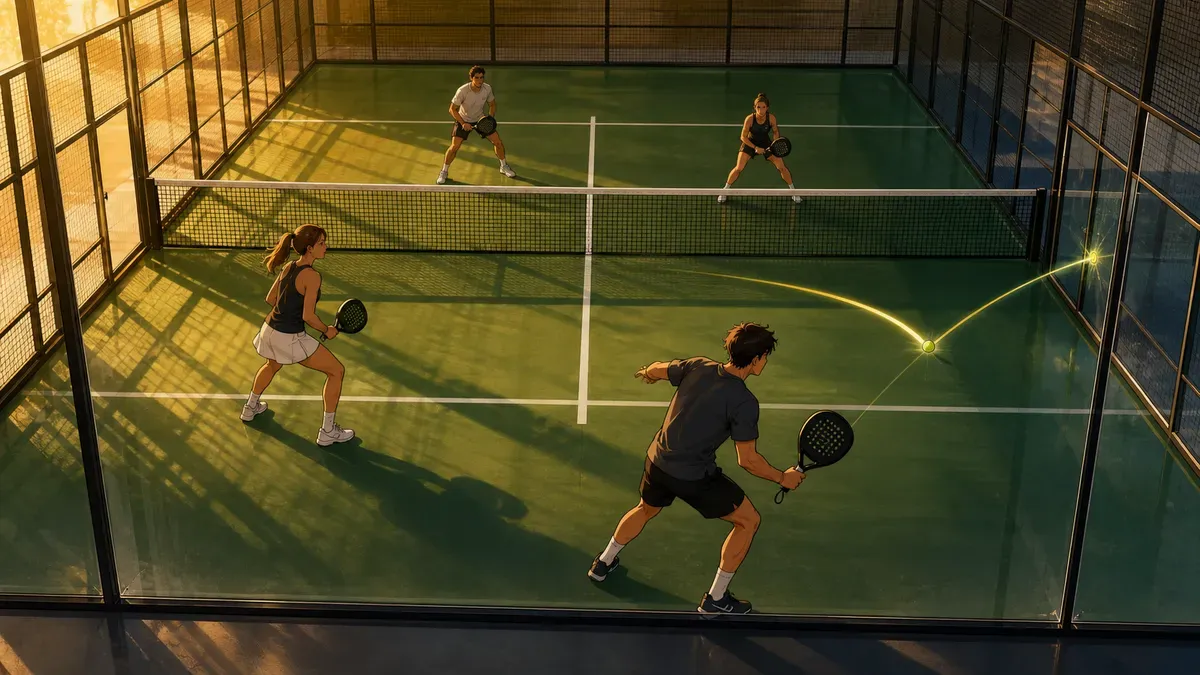
How to play padel: rules, scoring, walls, and beginner tactics
Learn how to play padel with current rules, scoring options, legal wall rebounds, simple tactics, safety tips, and a first-session plan for beginners.
Padel is a doubles racket sport played on an enclosed court. The scoring looks like tennis, but the underhand serve, smaller court, permanent doubles format, and playable walls change how every point develops. You do not need to hit hard to begin. You need to understand which rebounds are legal, keep the ball in front of you, move with your partner, and learn when to defend from the back or advance toward the net.
This guide follows the International Padel Federation rules whose current review applies from January 1, 2026. A social league or club may choose a particular scoring option or simplify match length, so confirm the local format before play. The official rulebook, not a casual explanation, settles competition disputes.
Quick answer
How do you play padel? Two pairs play on a 32.8-by-65.6-ft (10-by-20-m) enclosed court. A point starts with an underhand serve struck at or below waist level after one bounce and sent diagonally into the opposite service box. The return of serve must bounce. After that, either pair may volley or let the ball bounce once; after that first bounce, it may rebound from the glass or fence and remain playable until a second ground bounce. The usual score is 15, 30, 40, game, with sets normally won at six games by two.
Key facts
- A padel serve begins with a bounce behind the service line and contact at or below waist level.
- The receiving player lets a legal serve bounce before returning it.
- A rally stays alive when one ground bounce is followed by a wall or fence rebound.
- The serving pair usually seeks the net while the receiving pair first protects the back court.
- Beginner progress depends on placement, partner spacing, and rebound reading before power.
Padel at a glance
The current FIP Rules of Padel define a fully enclosed rectangular court and the legal sequence for serving, returning, rebounds, scoring, and point loss.
| Feature | Padel rule | Beginner meaning |
|---|---|---|
| Players | Two players per pair, two pairs per court | Standard padel is a 2-vs-2 game |
| Court | 32.8 ft × 65.6 ft (10 m × 20 m) | It is shorter and narrower than a tennis court |
| Serve | Underhand after a bounce, diagonal, at or below waist level | Start with control rather than speed |
| Return | The serve must bounce before it is hit | Do not volley the return of serve |
| Rally bounce | One ground bounce is allowed | A wall or fence rebound after that bounce does not end the point |
| Score | 15, 30, 40, game; usually best of three sets | Confirm whether advantage, Star Point, or Golden Point is in use |
| Racket cord | The safety cord around the wrist is compulsory | Put it on before every point |
The court and why the walls matter
The official rectangle is 32.8 ft (10 m) wide and 65.6 ft (20 m) long, divided by a 32.8-ft (10-m) net. The net is about 34.6 in (0.88 m) high in the center and 36.2 in (0.92 m) at the ends. The end enclosure reaches 13.1 ft (4 m), combining wall and metallic fencing under the permitted court designs.
Those dimensions create two connected games:
- Near the net, players can volley and pressure space before the ball reaches the back wall.
- Near the back, players can let a deep ball pass, rebound from the glass, and then return it before the second ground bounce.
The wall is not an automatic rescue. The sequence decides legality. If an opponent’s shot bounces in your court and then hits your glass or fence, you may play it. If your shot lands in the opponent’s court and then reaches their wall or fence, it is also live. But if your return travels directly into the opponent’s wall or fence before touching their floor, you lose the point.
You may also use your own glass as part of a return: the ball can leave your racket, hit your own wall, cross the net, and then bounce in the opponent’s court. That shot is legal when the rest of the return satisfies the rules. Beginners should learn the simple direct return first and add deliberate wall use with instruction.
Glass versus metallic fence
During a rally, both the inside walls and the metallic fence are parts of the court after a legal ground bounce. Their rebounds differ. Glass is comparatively predictable; fence rebounds can lose speed or leave at an awkward angle. Give yourself more space near the fence and keep the racket preparation compact.
The serve is a special case. A served ball that lands in the correct box and then touches the metallic fence before its second bounce is a fault. A ball that reaches the glass after the legal service bounce can remain in play. That one distinction resolves many first-session arguments.
How padel scoring works in 2026
Padel uses the familiar sequence love, 15, 30, 40, game. Under the traditional advantage format, 40-all is deuce; a pair must then win two consecutive points. A set is normally won by the first pair to reach six games with a two-game margin. At 6-6, a tie-break is normally played to at least seven points with a two-point margin. A match is usually best of three sets.
The 2026 FIP rules list three game-scoring options:
| Format | What happens at 40-all? | What to ask before play |
|---|---|---|
| Advantage | Deuce repeats until one pair wins two consecutive points | Is full advantage scoring being used? |
| Star Point | Two advantage cycles can occur; after the third deuce, one deciding point settles the game | Which side will the receiving pair choose for the deciding point? |
| Golden Point | One deciding point is played immediately at deuce | Is the league using no-advantage scoring? |
Do not assume that the format from a video, another club, or a previous tournament applies today. The organizer should establish the scoring method in advance. Short social sessions may also use mini sets or a match tie-break instead of a complete third set.
Tie-break order in plain language
The first server delivers one point from the right. The other pair then serves two points, beginning from the left, and service continues in blocks of two while the established rotation is preserved. The first pair to seven with a two-point margin wins the tie-break and the set 7-6. Players change ends after every six tie-break points.
How to serve legally
Every point begins behind the service line. The server stands between the imaginary extension of the center service line and the side wall, bounces the ball inside that area, and strikes it at or below waist level. At least one foot must remain in contact with the ground at impact. Walking, running, or jumping into the serve is not legal.
The serve travels diagonally. The first point of a game begins from the right service side toward the receiver’s left box; the side alternates after every point. Lines count as in. The server gets a second attempt after a first fault.
A serve is a fault when, among other cases:
- the server misses the ball while attempting to hit it;
- contact is above the waist;
- the server touches or crosses the relevant line early;
- the ball misses the diagonal service box;
- the ball lands in the correct box but then touches the metallic fence before its second bounce;
- the ball hits the server, the server’s partner, or something either player carries.
If a legal serve clips the net and still lands correctly without creating a fence fault, it is a net serve and is repeated under the rulebook’s let procedure.
A repeatable beginner serve
Use the serve to start a playable point, not to imitate a tennis ace:
- Stand in a balanced staggered position behind the line.
- Bounce the ball slightly in front of the hitting hip.
- Use a compact low-to-high swing and comfortable contact below the waist.
- Aim several feet inside the service box rather than at a line.
- Recover forward with your partner while staying aware of the return.
An observational study of 2,148 points from high-level and beginner matches found that the serving pair’s formation changed how quickly and how far the server moved toward the offensive position. The study describes tactics, not a universal prescription, but it supports rehearsing the serve and first movement as one connected action (PLOS ONE, 2021).
Return, volley, and rally rules
The returner must let the serve bounce in the service box and strike it before a second ground bounce. After a valid return, volleys are allowed. During the rally, a pair loses the point if the ball bounces twice, a player or racket touches the net while the ball is live, the ball touches a player or clothing, the pair hits it twice, or a return fails to land legally in the opposing court.
Use this three-question test when a rebound looks confusing:
- Did the ball first bounce in the correct opponent court? If not, the return is out.
- Has the ball bounced on the ground twice? If yes, the point is over.
- Did a player, racket, clothing, or loose equipment touch the net or ball illegally? If yes, that pair loses the point.
The racket safety cord is not optional under FIP rules. If a player drops the racket or the cord breaks during the point, the pair loses that point. Stop before play to secure it rather than trying to fix it during a rally.
Padel versus tennis: the differences that change play
Padel borrows tennis scoring, a central net, alternating service, volleys, and the idea of winning sets. The practical differences are larger than they first appear.
| Padel | Tennis | Tactical effect |
|---|---|---|
| Standard play is doubles | Singles and doubles are standard | Partner spacing and communication are constant |
| Serve follows a bounce and is underhand | Serve is normally hit overhead without a bounce | Placement and the next position matter more than raw serve speed |
| Court is enclosed and legal rebounds use walls | Perimeter walls are not part of play | Deep balls can become defensive opportunities |
| Smaller court | Larger court | Short reactions and compact preparation matter |
| Solid perforated racket without strings | Strung racket | Contact sensation and stroke mechanics differ |
| Net position is shared by a pair | Court coverage varies by singles or doubles | Advancing together prevents a large exploitable gap |
Do not transfer a full tennis swing unchanged. The enclosed space, shorter reaction time, lower-bouncing situations, and wall timing reward compact preparation and controlled placement.
Four beginner tactics that solve most early points
1. Move with your partner
Imagine a horizontal rope connecting the pair. When one player moves forward, the other closes forward; when one retreats for a lob, the other protects the exposed space. Perfect symmetry is not required, but a large front-back split gives opponents an easy diagonal gap.
2. Earn the net together
The net is usually the attacking position because volleys take time away from opponents and create angles. After serving, move forward under control with your partner. From the back, use a high lob or a low ball that makes the opponents volley upward before advancing. Do not sprint blindly through the middle of an opponent’s stroke.
The same PLOS ONE study found that serving pairs won more points than returning pairs at both observed levels, while high-level players moved toward the net faster. It does not prove that every beginner should rush forward on every ball. It does show why the serve, transition, and pair formation belong in the same tactical lesson.
3. Defend behind the ball
At the back of the court, allow enough room for a deep shot to reach the glass. Turn and move with the rebound rather than planting your feet and swinging late. A soft ball through the middle is often better than a desperate winner near the side fence.
4. Make opponents play one more ball
Early improvement comes from reducing unforced errors. Aim through the middle, over the lower central part of the net, and away from low-percentage lines. Use speed only when balance, contact point, and partner position support it.
Research on recreational male players found different impact positions between trained and novice groups across serves, volleys, smashes, groundstrokes, wall strokes, and lobs. Because it was observational and limited to men, it cannot define one ideal contact for everyone. It does support learning each stroke in its actual court context rather than treating every ball like the same forehand (International Journal of Environmental Research and Public Health, 2021).
Your first padel session
Book a coached introduction or play with someone who can explain the enclosure and stop unsafe habits early. A useful first hour is not a full competitive match from the first ball.
| Minutes | Task | Success measure |
|---|---|---|
| 0-8 | Raise body temperature, move laterally, rehearse easy stops, and make compact swings | You can change direction without slipping or crossing feet blindly |
| 8-18 | Rally cooperatively without walls | Ten controlled contacts using a short swing |
| 18-28 | Let easy feeds bounce from the back glass | You wait for the rebound and strike before the second ground bounce |
| 28-38 | Practise legal serves and returns | Most serves land safely inside the correct box |
| 38-48 | Serve, move forward, then play a cooperative point | Both partners change position together |
| 48-60 | Play a short game with the agreed scoring option | Everyone can call the score and explain why a point ended |
Finish before fatigue turns every rebound into a surprise. The complete padel fitness training guide covers braking strength, lateral movement, shoulder capacity, and match endurance once the basic game makes sense.
Safety, warm-up, and load
Padel combines repeated changes of direction, quick reactions, overhead strokes, and close walls. In a 2025 survey of 457 recreational adults, 36.5% reported an injury over the previous year, with lower-limb injuries the largest group. The retrospective survey can identify associations but cannot prove that any one habit caused or prevented injury (Physical Therapy in Sport, 2025).
Use the evidence as a reason for sensible preparation, not as a personal risk calculator:
- wear court-appropriate footwear with secure laces;
- attach the racket cord before entering a point;
- clear spare balls from the playing area;
- warm up forward, backward, and lateral movement before full-speed rallies;
- look before moving close to a partner’s swing;
- learn glass rebounds at low speed before chasing sharp angles;
- increase match frequency, gym load, or hard overhead volume one variable at a time;
- stop for sharp pain, swelling, instability, a head impact, chest pain, fainting, or unusual breathlessness.
Stretching alone is not an injury-prevention program. The guide to stretching and injury evidence explains why a warm-up also needs temperature, movement rehearsal, and progressive force. Use the training-load curve when you begin adding matches to running, cycling, or strength work.
Padel can contribute meaningful physical activity, but a match is not a complete weekly program. The World Health Organization recommends adults accumulate 150-300 minutes of moderate aerobic activity or 75-150 minutes of vigorous activity weekly, plus muscle-strengthening work on at least two days (WHO guidelines, 2020). Count padel according to its real duration and effort, then fill the gaps rather than assuming one social game covers every capacity.
Use SuperAge after the game, not for line calls
Once you can play a repeatable session, trends can help organize training and recovery. Record match duration, perceived effort, hard rallies, soreness, sleep, resting heart rate, and HRV against your own baseline. A 2025 study of 52 amateur players found cardiovascular load rose across sets even though the measured jump and grip tests did not show a corresponding decline (Sensors, 2025). The sample was small, so use it as context for late-match demands, not a prediction of your response.
SuperAge can connect activity and recovery patterns across weeks. It cannot judge whether a serve clipped the fence, diagnose pain, or replace a coach’s view of partner spacing. Use the rulebook for rules, instruction for technique, and health data for better questions about repeatability.
Ready to see how padel fits your broader week? Download SuperAge and compare match load, sleep, and recovery trends without turning one score into a verdict.
If you want the cardiovascular evidence behind the sport, read is padel good cardio?. For the wider adherence and social-sport context, see the best sports for longevity. The fitness library brings together training, mobility, strength, and sport guides.
Frequently asked questions
Can the ball hit the wall in padel?
Yes. After an opponent’s shot bounces once in your court, it may rebound from the glass or metallic fence and remain playable until a second ground bounce. Your own return can also hit your wall before crossing the net. Your shot must then bounce in the opponent’s court before directly reaching their wall or fence.
Can you volley in padel?
Yes, during a rally. You cannot volley the return of serve because the receiver must let the serve bounce in the correct box. After the serve has been legally returned, either pair may volley.
Is padel always doubles?
The official game is played by two pairs, one pair on each side of the net. Some venues have informal singles courts or sessions, but their dimensions and procedures are not the standard doubles game described by FIP rules.
How many serves do you get in padel?
The server normally gets two attempts. A first fault leaves a second serve. Two consecutive faults lose the point. A legal net serve is handled under the let and net-service rules rather than automatically counting as a fault.
Is the padel serve underhand?
Yes. The server first bounces the ball behind the service line and contacts it at or below waist level with at least one foot on the ground. It is not a tennis-style overhead serve.
What is the difference between Star Point and Golden Point?
Golden Point settles the game with one deciding point immediately at deuce. Under the 2026 Star Point option, two advantage cycles can occur; if the score reaches the third deuce, one deciding point settles the game. Confirm the selected format before starting.
Can the serve hit the glass in padel?
After landing in the correct service box, the ball can continue to the glass and remain playable. If it touches the metallic fence before the second bounce, the serve is a fault. The returner must still play the ball before its second ground bounce.
What should a beginner learn first in padel?
Learn a legal serve, a controlled return, how to wait for a back-glass rebound, and how to move with a partner. Add lobs and volleys next. Smashes, sharp fence angles, and elaborate formations can wait until placement and awareness are reliable.
Key takeaways
- Padel is standard doubles on an enclosed 32.8-by-65.6-ft (10-by-20-m) court.
- The serve is underhand after a bounce, travels diagonally, and gives the receiver a mandatory first bounce.
- Walls and fencing remain playable after one legal ground bounce; the second ground bounce ends the point.
- The 2026 rules permit advantage, Star Point, and Golden Point game scoring, so players should confirm the chosen format.
- Net position matters, but beginners should advance as a pair and value placement over power.
- Coaching, progressive load, a complete warm-up, and prompt attention to symptoms make the first weeks safer and more useful.
References
- International Padel Federation. Rules of Padel: review of application 01.01.2026. 2026.
- Ramón-Llin J, et al. Comparison of service tactic formation on players’ movements and point outcome between national and beginner level padel. PLOS ONE. 2021.
- Courel-Ibáñez J, et al. Ball impact position in recreational male padel players: implications for training and injury management. International Journal of Environmental Research and Public Health. 2021.
- Declève P, et al. Prevalence and injury profiles for recreational padel players. Physical Therapy in Sport. 2025.
- Marcos-Rivero B, et al. Evolution of physiological responses and fatigue analysis in padel matches. Sensors. 2025.
- World Health Organization. WHO guidelines on physical activity and sedentary behaviour. 2020.
Related Articles

Cardio without running: choose your activity and build a week
Build cardio without running with walking, cycling, water exercise, or indoor options. Learn effort cues, practical sessions, and a weekly plan you can adapt.