Caregiver brain fog: stress, sleep loss, and warning signs
Caregiver brain fog often follows overload and broken sleep. Learn what the evidence shows, how to reduce risk, and when cognitive changes need care.
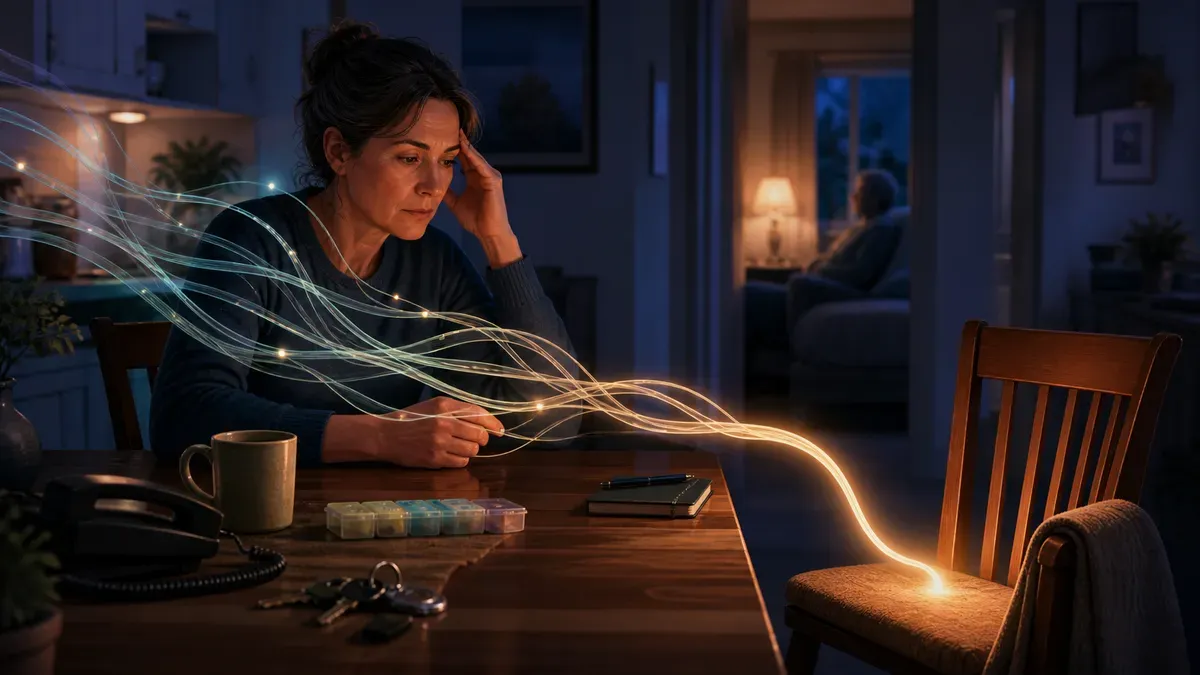
Caregiver brain fog can feel frightening when the person you support already has memory loss. You may lose the thread of a conversation, reread the same message, forget why you entered a room, or worry that every lapse means you are developing the same condition.
In many caregivers, the more immediate explanation is an overloaded attention system working through interrupted sleep, chronic vigilance, grief, and too many decisions. That pattern is real, but “brain fog” is not a diagnosis. Caregiving does not make a new or progressive cognitive change safe to ignore, and it does not prove that the caregiver is developing dementia.
Quick answer
Caregiver brain fog often improves when sleep, task load, and support improve. Start by protecting one uninterrupted sleep block, moving critical information out of memory and into a shared system, and arranging a real handoff rather than adding another wellness task. Book a clinical review when fog persists, worsens, or affects medication, money, driving, work, or safe care. Sudden confusion, trouble speaking, one-sided weakness, a severe new headache, or inability to stay safe requires urgent help.
Key facts
- Dementia caregiving increases sustained cognitive load because monitoring, planning, emotional regulation, and interruption compete for attention.
- Broken or insufficient sleep reduces daytime alertness and can worsen attention, working memory, and error control.
- Small caregiver studies report attention and executive differences, but they do not show that ordinary caregiver lapses equal dementia.
- External memory systems reduce preventable mistakes by moving medication, appointment, and handoff details out of an overloaded mind.
- Progressive or safety-relevant change needs assessment even when stress and sleep loss are plausible contributors.
Why caregiving can make thinking feel unreliable
Memory is not a single storage tank. To remember a new instruction, the brain first has to notice it, hold it long enough to encode it, and retrieve it when needed. Caregiving can disrupt every step without damaging the memory system itself.
Continuous monitoring consumes attention
A caregiver may listen for movement at night, watch for wandering, repeat explanations, track medications, coordinate appointments, answer relatives, manage bills, and anticipate the next behavior change. Even during a quiet moment, part of attention may remain assigned to “what could happen next.”
That makes prospective memory especially vulnerable: remembering to do something later. Missing a pharmacy call or forgetting to bring a form can reflect interruption and overload rather than loss of stored knowledge.
Sleep can be long enough on paper but fragmented
Time in bed is not the same as restorative sleep. A spouse who wakes, calls out, wanders, or needs help can divide the night into short pieces. The caregiver may also stay alert after the event has ended.
The joint American Academy of Sleep Medicine and Sleep Research Society consensus recommends at least seven hours of sleep on a regular basis for healthy adults and links shorter sleep with impaired performance, more errors, and accident risk. Seven hours is a population guide, not a personal pass/fail score; continuity, timing, illness, and individual need still matter.
Grief, depression, anxiety, and physical illness can overlap
Caregiving for a partner with memory loss can include ambiguous loss: the relationship is still present, but familiar reciprocity or shared plans may be changing. Sadness, irritability, anxiety, loneliness, and exhaustion can narrow attention and make retrieval feel slower. The mental health and biological aging guide explains why mood and physiology should be assessed together without reducing either one to a single score.
The National Institute on Aging lists exhaustion, anxiety, disconnection, sleep trouble, hopelessness, pain, reduced self-care, and substance misuse among signs that a caregiver needs support. These are not character flaws. They are reasons to assess the caregiver as a patient, not only as the person who brings someone else to appointments.
Pain, infection, thyroid disease, anemia, sleep apnea, medication effects, alcohol, hearing loss, and depression can also contribute to cognitive symptoms. Do not let a caregiving role become the explanation for everything.
What the caregiver cognition evidence actually shows
Research supports concern without supporting panic.
A 2014 review of 37 studies covering 749 dementia caregivers and 3,396 non-caregiver peers found that many studies reported differences in sleep, cognition, immune function, inflammation, and other objective outcomes. The studies varied greatly in design and measurement, so they could not establish one universal caregiver effect.
In a small cross-sectional study of 31 dementia caregivers and 25 controls, caregivers performed worse on two attention tasks but not on a word-list memory task. Sleep quality was the only measured factor that statistically mediated the caregiver-attention relationship in that sample. The finding is useful, but a small one-time comparison cannot prove that caregiving caused the difference or predict an individual’s future cognition.
A later study of 50 primary dementia caregivers connected specific stressors and caregiver burden with performance in working memory, executive function, and implicit memory. Again, the sample was small and observational.
Longer-term evidence is mixed and vulnerable to confounding. Spousal caregivers may differ from comparison groups in sleep, vascular risk, depression, finances, isolation, age, shared environment, and health behavior. A systematic review of spousal caregiving, bereavement, and cognition found evidence of poorer cognitive outcomes in some studies, but it does not mean that caregiving inevitably causes dementia.
The evidence-based conclusion is narrower: dementia caregiving can create conditions that make thinking less efficient, and persistent cognitive change deserves attention rather than dismissal. The wider physiology is covered in our guide to chronic stress, cortisol, and aging, but no cortisol reading can diagnose the cause of one person’s cognitive symptoms.
Caregiver brain fog or a cognitive warning sign?
Look for pattern, trajectory, and consequence—not one forgotten name.
| Pattern | More consistent with overload or sleep loss | More concerning for a cognitive disorder |
|---|---|---|
| Timing | Worse after broken nights, conflict, illness, or high-demand days | Appears without a clear trigger and gradually becomes more frequent |
| Variability | Improves after rest, a handoff, or a lower-load day | Remains present across rested and less stressful periods |
| Type of lapse | Loses focus, forgets an intention, needs to reread | Repeats questions, loses familiar skills, or cannot retain recent events |
| Insight | Notices the lapse and creates a workaround | Others see a change that the person minimizes or cannot recognize |
| Daily function | Tasks remain reliable with lists and protected attention | Bills, medications, navigation, cooking, or work become unreliable |
| Direction | Stable or improving after support changes | Progressive decline over months |
These columns are clues, not a home diagnostic test. Stress, depression, sleep disorders, medication effects, and early cognitive disease can coexist. Read brain fog vs MCI for a broader comparison of state changes, baseline traits, and progressive trajectories.
Use consequences to choose the next step
Seek emergency help now
Call your local emergency service for sudden confusion or a sudden neurological change, especially with facial droop, one-sided weakness or numbness, trouble speaking or understanding speech, loss of balance, vision change, or a severe unexplained headache. The CDC stroke guidance emphasizes that every minute counts, even if symptoms improve after a few minutes.
When severe head pain peaks within seconds to minutes or is followed by collapse, the thunderclap headache and loss of consciousness guide explains what witnesses should record while emergency help is on the way.
Urgent help is also appropriate when the caregiver cannot stay awake safely, has thoughts of self-harm or harming someone else, becomes severely agitated or disconnected from reality, or cannot ensure immediate safety for the person receiving care. Use local crisis and emergency services; do not wait for a tracking experiment.
Book a prompt clinical visit
Arrange an appointment when cognitive symptoms:
- persist for several weeks despite some recovery opportunity
- are clearly worsening or are noticed by other people
- interfere with driving, medication, finances, cooking, work, or safe supervision
- occur with depression, severe anxiety, heavy alcohol use, or escalating sedative use
- begin after a new medication, dose change, infection, head injury, or other health event
- coexist with loud snoring, breathing pauses, morning headaches, or marked daytime sleepiness
Bring examples rather than a general label. “I forgot two evening doses after being awake three nights” gives a clinician more to work with than “my memory is bad.”
Monitor while reducing the load
A short monitoring period is reasonable when the fog has a clear trigger, daily safety is intact, and symptoms improve with sleep or help. Track for seven to fourteen days while changing one or two upstream factors. Monitoring is not permission to endure an unsafe arrangement.
A safety-first reset for an overloaded caregiver
The goal is not to become better at carrying an impossible system. It is to make the system require less perfect memory.
1. Protect one real sleep block
Choose the longest feasible uninterrupted block and assign another adult, paid service, or respite program to cover it. If no overnight help is available, ask the clinical team whether nighttime symptoms, pain, urination, breathing, medication timing, or behavior changes can be treated more effectively.
A nap may improve alertness, but it cannot reliably compensate for repeated dangerous sleep loss. If you are fighting sleep while driving, stop driving and arrange another route.
2. Move critical information outside your head
Create one shared source of truth for:
- current medications, dose times, and last administered dose
- clinician and emergency contacts
- allergies and major diagnoses
- upcoming appointments and transport
- recent behavior or symptom changes
- who is responsible during each handoff
Use a paper sheet, whiteboard, or shared digital note that the actual care team can access. Avoid parallel lists in several apps. A checklist is a safety tool, not proof that your memory is failing.
When personal reminders rather than shared care instructions keep circulating at bedtime, use a bounded brain dump for sleep to capture one next action without turning the bedroom into a second shift.
3. Add friction before high-risk actions
Use a pill organizer only if it fits the medication plan and cannot be confused with the care recipient’s medicines. Set a double-check for dose changes. Place bills on autopay when appropriate, freeze new credit if scams are a risk, and require a second person for major financial or care decisions during periods of severe sleep loss.
If either person’s driving is in question, pause and seek assessment. A wearable alert or family promise cannot make unsafe driving safe.
4. Ask for a named task, not generic help
“Let me know if you need anything” often produces no relief. Request one bounded action:
- stay from 7 to 10 p.m. on Tuesday
- take over the pharmacy pickup
- join the clinician call and write the plan
- prepare two meals that meet the care recipient’s needs
- handle family updates for one week
The NIA Alzheimer’s caregiving guide recommends asking for help, taking breaks, maintaining medical care, and preparing information for substitute caregivers. A handoff is successful when the incoming person knows what to do without repeatedly calling the exhausted caregiver.
5. Match support to the actual stressor
Education alone may not solve a night-waking problem, and a meditation app cannot replace respite. The WHO iSupport program combines caregiver education, self-care, everyday care skills, and approaches to behavior change.
Multicomponent support has trial evidence. In the REACH II randomized intervention, tailored sessions addressed risk, behavior management, social support, problem-solving, and health habits. Intervention caregivers reported better self-rated health, sleep quality, physical health, and emotional health than controls. That does not make one program universally available or guarantee the same result for everyone; it shows why skills plus support can outperform advice to simply “take care of yourself.”
6. Make a backup plan before the next crisis
Write down who can take over for one hour, one night, and several days. Include what happens if the caregiver becomes ill, is hospitalized, or cannot drive. Ask a clinician, social worker, dementia organization, local authority, insurer, employer assistance program, or community service what respite and emergency options exist where you live.
Care systems vary by country, so use local services rather than assuming a U.S. program applies everywhere. The need is portable even when the phone number is not.
A seven-day tracking plan that does not create more work
Keep the record small enough to finish. One entry each morning and evening is enough.
| Track | Simple measure | Why it helps |
|---|---|---|
| Sleep opportunity | Bedtime, final wake time, number of care awakenings | Separates too little opportunity from fragmented sleep |
| Mental clarity | 0 to 10, at the same time each day | Shows whether fog moves with recovery rather than one alarming lapse |
| High-risk errors | Medication, driving, cooking, money, missed handoff | Consequences determine urgency |
| Load | Hours of solo care and number of handoffs | Tests whether relief changes symptoms |
| Mood | Calm, tense, low, hopeless, or unusually irritable | Identifies a parallel mental-health need |
| Context | Illness, new medication, alcohol, severe pain | Prevents caregiving from becoming the only explanation |
Do not test your memory repeatedly or turn the care recipient into an observer of your performance. At the end of the week, ask:
- Did clarity improve after a protected sleep block or real handoff?
- Were there safety-relevant errors?
- Is the overall direction improving, stable, or worsening?
- What single change reduced the most load?
- Does a clinician need to review sleep, mood, medication, or cognition?
Use health trends as context, not a diagnosis
SuperAge can help a caregiver review sleep duration, resting heart rate, HRV, activity, and recovery trends over several weeks. Those signals may show that a demanding period coincides with shorter sleep, less movement, or poorer recovery. They cannot determine whether brain fog is caused by stress, diagnose MCI, or rule out illness.
Use the data to make a conversation more concrete:
- “My sleep opportunity fell below seven hours on five of seven nights.”
- “Fog improved on the two mornings after another person covered the night.”
- “My resting heart rate rose while I was ill, so stress may not be the only factor.”
- “Medication errors continued even after sleep improved, so I need assessment.”
For a broader sleep-recovery framework, use the sleep and longevity guide. If several short nights have accumulated, sleep debt and recovery explains why one late morning may help without fully restoring alertness.
Download SuperAge on the App Store to organize personal health trends while keeping diagnosis and treatment with qualified professionals.
Key takeaways
- Caregiver brain fog can reflect attention overload, fragmented sleep, emotional strain, or another treatable health problem.
- Small studies find attention and executive differences in some dementia caregivers, but brain fog does not prove dementia.
- The safest first intervention is often a real handoff plus an external medication and appointment system.
- Progressive symptoms or mistakes involving driving, medication, money, cooking, or supervision deserve clinical review.
- Sudden confusion or stroke-like symptoms are emergencies, not caregiver burnout to monitor at home.
- Respite, skills, clinical care, and social support address different parts of the problem; no single wellness habit replaces them.
FAQ
Is caregiver brain fog a sign of dementia?
Usually not by itself. Brain fog commonly describes reduced concentration, slow retrieval, and mental fatigue during stress or poor sleep. It becomes more concerning when change is progressive, persists during rested periods, is noticed by others, or reduces reliable daily function. A clinician can assess reversible contributors and decide whether cognitive testing is appropriate.
Can caring for a spouse with dementia cause memory loss?
Caregiving can create chronic stress, interrupted sleep, depression, isolation, and reduced time for personal health, all of which may affect cognitive performance. Some observational studies associate spousal caregiving with poorer cognitive outcomes, but they cannot show that caregiving alone caused an individual’s memory loss. Treat modifiable strain and assess persistent change.
How long should caregiver brain fog last before I see a doctor?
There is no universal cutoff. Book a visit sooner when symptoms are worsening, last several weeks, appear without a clear trigger, or affect safety and function. Sudden confusion or neurological symptoms need emergency assessment. A clear improvement after sleep and a handoff is reassuring, but not a reason to ignore recurrence.
What should I track before an appointment?
Record sleep opportunity, nighttime care interruptions, concrete cognitive errors, mood, new medication or dose changes, alcohol, illness, pain, and whether another person noticed a change. Bring the caregiver’s own medication and supplement list; do not focus only on the care recipient’s chart.
Does respite actually help caregiver brain fog?
Direct brain-fog trials are limited. Respite can create sleep and recovery opportunity, while multicomponent caregiver interventions have improved burden, mood, self-rated health, and sleep in trials. The best support matches the problem: overnight coverage for night disruption, behavior skills for difficult symptoms, and clinical care for depression, sleep disorders, or cognitive change.
What if no family member can take over?
Tell the care recipient’s clinical team that the current arrangement is unsafe or unsustainable. Ask specifically for social work, respite, home-care, adult day, transportation, or emergency-planning options. Dementia organizations, local authorities, insurers, faith communities, and employer assistance programs may offer different pieces. Availability varies, but hiding the gap does not make it smaller.
Can a smartwatch confirm that stress caused my memory problems?
No. A smartwatch can show trends in sleep opportunity, heart rate, HRV, or activity, but those measures are nonspecific. Use them as context alongside symptoms and real-world function. They cannot diagnose caregiver burnout, depression, sleep apnea, MCI, or dementia.
References
- National Institute on Aging. Taking care of yourself: tips for caregivers.
- National Institute on Aging. Alzheimer’s caregiving: caring for yourself.
- World Health Organization. iSupport for dementia: training and support manual for carers. 2019.
- Oken BS, et al. Stress-related cognitive dysfunction in dementia caregivers. Journal of Geriatric Psychiatry and Neurology. 2011.
- Fonareva I, Oken BS. Physiological and functional consequences of caregiving for relatives with dementia. International Psychogeriatrics. 2014.
- Lwi SJ, et al. Dementia caregiving and cognition: an extension of the stress process model. Innovation in Aging. 2020.
- Dassel KB, et al. Spousal caregiving, widowhood, and cognition: a systematic review and biopsychosocial framework. Journal of Aging and Health. 2022.
- Burgio LD, et al. Enhancing caregiver health: findings from the REACH II intervention. Journal of the American Geriatrics Society. 2010.
- Watson NF, et al. Recommended amount of sleep for a healthy adult: a joint consensus statement. Journal of Clinical Sleep Medicine. 2015.
- Centers for Disease Control and Prevention. Signs and symptoms of stroke. 2026.
Related Articles
Sleeping next to a snorer: health effects and what actually helps
Sleeping next to a snorer can fragment rest, but brain-aging claims go too far. Learn what evidence shows, what helps tonight, and when to seek care now.