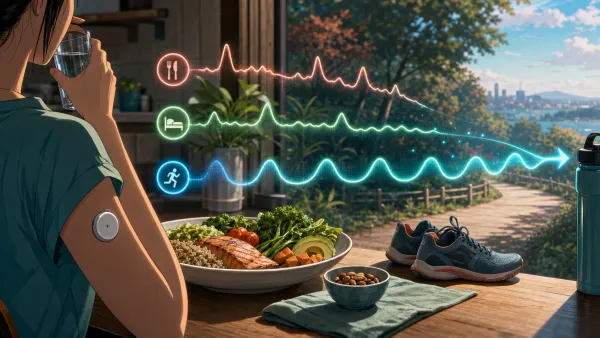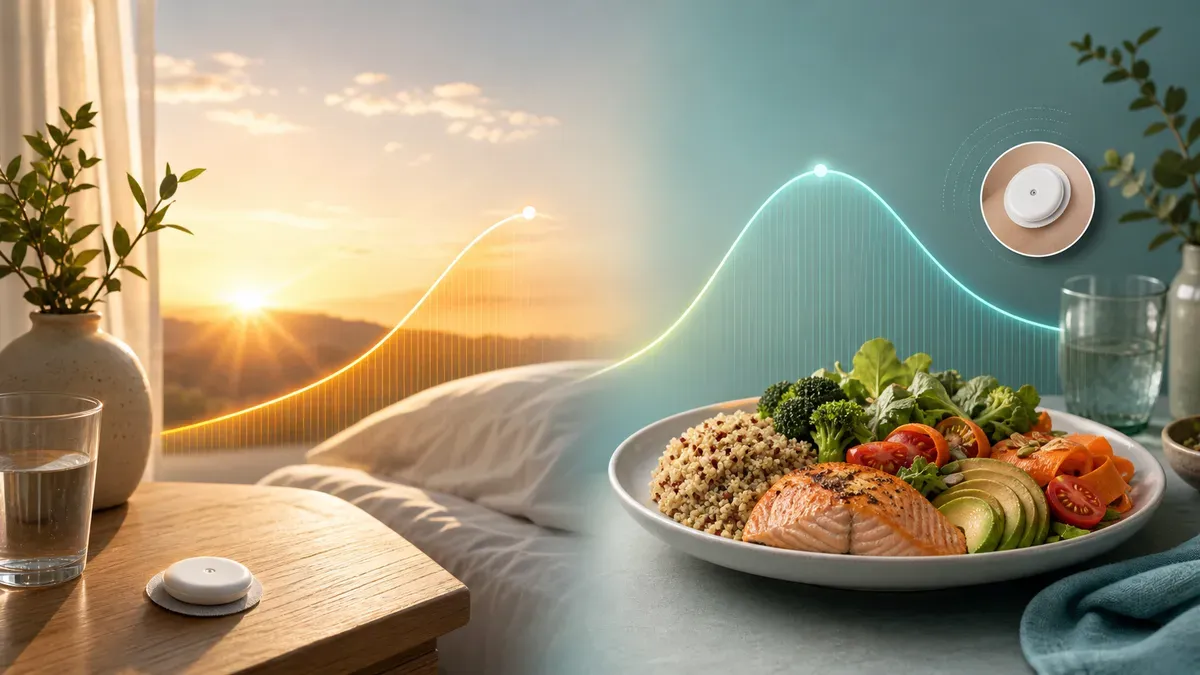
Morning glucose spike vs post-meal spike: which matters more?
Morning glucose spike vs post-meal spike depends on timing, peak, recovery, and baseline. Learn which CGM pattern matters more and what to track next.
Your glucose rises in the morning before breakfast. It also rises after meals. Which one should you worry about more?
The answer depends on the shape of the pattern.
A morning glucose spike usually reflects overnight liver glucose output, circadian hormones, sleep quality, stress, late eating, or the “feet-on-the-floor” rise that appears after waking. A post-meal glucose spike reflects how your body handles a specific meal: carbohydrate dose, food order, muscle glucose uptake, insulin response, and activity after eating.
Those patterns are not interchangeable. A post-meal spike tells you how well you process a challenge. A morning spike tells you where your baseline is drifting when no meal is involved.
For the meal-related curve, first check when glucose typically peaks after eating.
For most adults without diabetes who are using a CGM for longevity or metabolic-health insight, repeated post-meal spikes are often the earlier and more actionable signal. You can test meal order, carbohydrate quality, protein, fiber, walking, training, and timing within days. But if morning glucose is persistently elevated or stays high for hours, it may be the stronger warning sign because it points to baseline insulin resistance, poor sleep, late-night fuel, medication effects, or clinician-relevant dysglycemia.
If the spike follows a late dinner and a poor night of sleep, use late eating vs poor sleep to decide which lever to test first.
This article compares the two patterns. For the broad glucose-and-aging overview, start with glucose and longevity. For the specific mismatch where HbA1c is normal but spikes look high, read normal HbA1c with glucose spikes.
What you’ll learn:
- What a morning glucose spike usually means
- What a post-meal spike usually means
- Which pattern matters more in different scenarios
- How to read CGM curves without overreacting to one point
- What labs and wearable trends help explain the pattern
The short answer
If you have to prioritize one pattern, use this rule:
| Pattern | What it usually tells you | When it matters most |
|---|---|---|
| Morning spike before food | Baseline regulation, overnight liver glucose output, sleep and stress physiology | When it is repeated, high, prolonged, or paired with rising fasting glucose, insulin, triglycerides, waist, or blood pressure |
| Post-meal spike | Meal handling, insulin response, muscle glucose uptake, meal composition, and activity timing | When it repeats after ordinary meals, peaks high, stays elevated at 2 hours, or creates a lot of time above your target range |
For a metabolically healthy person with normal labs, a brief post-meal rise after a large mixed meal is usually less concerning than a persistent morning elevation that starts before any food. But for a person whose fasting labs are normal and whose CGM shows repeated high peaks after ordinary meals, post-meal spikes may be the first visible sign that average markers are hiding early insulin resistance.
So the practical answer is:
- Morning spike matters more when baseline glucose is drifting up.
- Post-meal spike matters more when fasting values are normal but meal recovery is poor.
- Both matter when HbA1c, fasting glucose, fasting insulin, triglycerides, blood pressure, waist, or symptoms are moving in the wrong direction.
- Neither should be interpreted from one reading. Confirm the pattern across several days and use lab context when decisions matter.
The American Diabetes Association’s 2026 Standards of Care list premeal and peak post-meal glucose goals for many nonpregnant adults with diabetes, but those are clinical treatment goals, not diagnostic rules for healthy CGM users. If you have diabetes, prediabetes, pregnancy, hypoglycemia, glucose-lowering medication, or repeated very high readings, interpret the pattern with a clinician.
What is a morning glucose spike?
A morning glucose spike is a rise that happens before breakfast, often between the last part of sleep and the first hours after waking. People notice it in different ways:
- CGM is flat overnight, then rises before the first meal.
- Finger-stick glucose is higher on waking than expected.
- Glucose rises after getting out of bed even before coffee or food.
- A late dinner keeps glucose elevated overnight, and the morning value never fully returns to baseline.
In diabetes literature, the classic version is the dawn phenomenon: an early-morning glucose rise not caused by food. It is linked to circadian biology, counter-regulatory hormones, and hepatic glucose production. In plain language, the liver releases glucose as the body prepares to wake. If insulin sensitivity is lower, or if the liver is already overproducing glucose overnight, that normal wake-up signal can become an exaggerated glucose rise.
Morning glucose can also rise from non-dawn causes:
- poor sleep or sleep fragmentation
- late alcohol or a late high-fat, high-carb dinner
- illness, inflammation, or pain
- emotional stress
- early intense exercise
- dehydration
- steroid medication or other medication effects
- sensor compression or early-sensor noise
That is why the timing matters. “Glucose is high at 7 a.m.” is not enough information. You want to know whether it climbed from a stable overnight baseline, stayed high all night, dropped low then rebounded, or rose only after you stood up.
For broader fasting-glucose interpretation, use fasting glucose by age and risk zone. This article focuses on the shape of the morning curve.
What is a post-meal glucose spike?
A post-meal spike is the rise after eating. It is not automatically bad. Glucose is supposed to rise after carbohydrate-containing food. The useful questions are:
- How high did it peak?
- How fast did it rise?
- How long did it stay elevated?
- Was the meal ordinary or unusual?
- Was the baseline already high before the meal?
- Did it return toward baseline by 2 to 3 hours?
- Does the same meal cause the same response repeatedly?
Post-meal spikes are affected by more than carbohydrate grams. Food order, fiber, protein, fat, processing, meal timing, sleep, stress, and recent exercise all change the curve. Eating carbohydrates after vegetables and protein can flatten the rise. A short walk after a meal can improve post-meal glucose disposal because working muscle can take up glucose without needing as much insulin.
This is why post-meal data is so actionable. If breakfast cereal produces a high, long curve but eggs, yogurt, oats with protein, or a post-breakfast walk flatten it, you learned something useful in a week. That does not mean every spike is dangerous. It means the pattern is modifiable.
For the broader CGM framework, see CGM for non-diabetics.
Which matters more? Use the baseline-plus-recovery rule
The cleanest way to compare morning and post-meal spikes is to separate baseline from recovery.
Morning spike is mainly a baseline signal
Morning glucose matters because it happens without a meal. If it is repeatedly high, the body may be maintaining a higher glucose set point before the day even starts.
That can suggest:
- reduced hepatic insulin sensitivity
- higher overnight liver glucose output
- sleep disruption or sleep apnea
- late eating that extends glucose exposure into the night
- stress physiology and cortisol load
- medication effects
- worsening prediabetes or diabetes control in people already at risk
Morning glucose is more concerning when it stays high for hours, when it is rising over weeks, or when fasting insulin, HOMA-IR, triglycerides, waist-to-height ratio, blood pressure, or liver markers are also worsening.
Post-meal spike is mainly a challenge-response signal
Post-meal glucose matters because it shows how your body handles food. A person can have normal fasting glucose and a normal HbA1c while still showing exaggerated responses after ordinary meals. That is the pattern people often miss until they use CGM, an oral glucose tolerance test, or targeted post-meal testing.
Post-meal glucose is more concerning when:
- the same ordinary meal repeatedly causes a high peak
- glucose remains elevated around 2 hours
- the curve takes 3 or more hours to return near baseline
- time above range accumulates across the day
- spikes happen with high fasting insulin, high HOMA-IR, high triglycerides, low HDL-C, or increasing waist circumference
Monnier and colleagues showed in people with type 2 diabetes that postprandial glucose excursions contribute more to overall hyperglycemia at lower HbA1c levels, while fasting hyperglycemia contributes more as diabetes worsens. The exact percentages do not transfer directly to healthy CGM users, but the concept is useful: early dysglycemia may show up after meals before fasting numbers dominate the picture.
The practical decision table
| Your pattern | More important signal | Why |
|---|---|---|
| Normal morning, brief meal spikes after unusual meals | Usually neither urgent | The pattern may reflect meal context more than metabolic dysfunction |
| Normal morning, repeated high spikes after ordinary meals | Post-meal spike | Meal handling may be the earliest visible weakness |
| High morning, normal meal recovery | Morning spike | Baseline regulation may be the bigger issue |
| High morning and high meal spikes | Both | Baseline and challenge response are both stressed |
| Morning spike only after late dinner or poor sleep | Context first | Fix timing and sleep before assuming disease progression |
| Post-meal spike only after intense exercise or sensor anomaly | Context first | Not all glucose rises mean impaired meal handling |
How to read a CGM curve without overreacting
CGM is useful because it shows patterns. It is also easy to overinterpret because it produces hundreds of data points per day.
Do not judge a spike by the highest pixel on the chart. Use four measurements.
1. Baseline
For a meal, baseline is the glucose level before eating. For morning glucose, baseline is the overnight level before the rise.
A meal peak of 145 mg/dL means something different if baseline was 82 than if baseline was already 118. A morning rise to 120 means something different if overnight glucose was 78 than if glucose sat near 115 all night.
2. Peak
Peak height matters, but only with context. ADA clinical targets for people with diabetes often use peak postprandial glucose below 180 mg/dL as one treatment goal. Many non-diabetic longevity users choose tighter personal ranges, but those tighter ranges are not formal diagnostic thresholds.
Instead of arguing about one universal spike cutoff, ask whether the peak is repeated, meal-specific, prolonged, and supported by lab context.
3. Recovery
Recovery is often more informative than the peak.
Useful questions:
- Is glucose clearly falling by 90 to 120 minutes?
- Is it near baseline by 2 to 3 hours?
- Does it stay elevated until the next meal?
- Does dinner glucose remain elevated into sleep?
A sharp but brief rise after a large carbohydrate meal may be less meaningful than a moderate rise that stays high for several hours.
4. Time above range
The 2019 international consensus on CGM interpretation standardized the idea of time in range, time above range, and time below range for diabetes care. For most adults with type 1 or type 2 diabetes, the standard target range is 70-180 mg/dL. Healthy and longevity-focused users often look at tighter descriptive ranges, such as time above 140 mg/dL, but those should be treated as pattern metrics rather than diagnoses.
Time above range helps compare morning and post-meal patterns fairly. A morning rise to 125 that lasts 4 hours may create more exposure than a meal peak to 155 that resolves quickly. A dinner curve that stays elevated into sleep may matter more than a breakfast curve that comes down quickly.
What causes each pattern?
Morning and post-meal spikes can have different drivers, so the fix is different.
| Driver | More likely to affect morning glucose | More likely to affect post-meal glucose |
|---|---|---|
| Poor sleep | Yes | Yes, especially next-day meals |
| Late dinner | Yes, especially overnight carryover | Yes, especially dinner |
| High-glycemic meal | Sometimes if late | Yes |
| Low muscle mass | Yes, through insulin resistance | Yes, through lower glucose sink |
| Low activity after meals | Less direct | Yes |
| Stress and cortisol | Yes | Yes |
| Alcohol | Can disrupt overnight glucose | Can alter meal response |
| Medication effects | Yes | Sometimes |
| Sensor artifact | Yes, especially compression | Yes, especially rapid changes |
The key is to avoid one-size-fits-all fixes.
If the issue is post-meal glucose, the highest-yield tests are usually meal composition, food order, walking, strength training, and carbohydrate timing. If the issue is morning glucose, the highest-yield tests are usually sleep quality, late eating, alcohol, evening stress, medication review, and fasting-insulin context.
For the muscle side of glucose disposal, see muscle mass vs body weight. For the physiology of glucose uptake, see how to improve insulin sensitivity.
What to test next
The goal is not to order every test. It is to explain the pattern.
If morning glucose is the concern
Track:
- 7 to 14 days of wake-up glucose
- overnight CGM baseline
- bedtime glucose
- dinner timing and alcohol
- sleep duration, awakenings, snoring, and next-day fatigue
- morning stress or early intense exercise
Labs and measurements to discuss with a clinician:
- fasting glucose
- HbA1c
- fasting insulin and HOMA-IR
- triglycerides and HDL-C
- ALT, AST, and GGT if fatty-liver context is possible
- blood pressure
- waist-to-height ratio
If morning glucose is repeatedly high, do not try to solve it only by eating a bedtime snack or skipping breakfast. Those experiments can change the CGM line while leaving the underlying physiology unchanged.
If post-meal glucose is the concern
Track:
- pre-meal baseline
- meal contents and order
- peak timing
- 2-hour value
- recovery time
- post-meal steps or walking
- sleep the night before
- training within the last 24 to 48 hours
Labs and measurements to discuss:
- fasting insulin and fasting glucose from the same draw
- HOMA-IR
- HbA1c
- triglycerides, HDL-C, and ApoB
- waist circumference or waist-to-height ratio
- an oral glucose tolerance test if the clinical question is impaired glucose tolerance
If the post-meal pattern is real, start with low-risk experiments: vegetables or protein first, carbohydrates later in the meal, a 10- to 15-minute walk within 30 minutes of eating, more fiber, fewer liquid carbohydrates, and resistance training.
How SuperAge helps interpret the pattern
CGM shows glucose. SuperAge helps you interpret the context around it.
That context matters because morning and post-meal glucose are not only food problems. They are recovery, sleep, stress, activity, and body-composition problems too.
Use SuperAge alongside CGM to compare:
- sleep duration and wake-up glucose
- HRV trend and morning glucose
- resting heart rate and overnight glucose
- post-meal steps and meal recovery time
- strength-training consistency and post-meal peaks
- body-composition trend and insulin-resistance markers
- biological-age trend and metabolic labs
For example, if morning glucose rises after three short sleep nights and HRV drops at the same time, the next step may be sleep recovery rather than changing breakfast. If post-meal spikes improve after strength training resumes, the signal may be muscle glucose disposal. If both morning and post-meal curves worsen while waist and triglycerides rise, the pattern deserves a broader metabolic-health review.
That is the useful way to use wearable data: not as a panic meter, but as a pattern-matching tool.
What to do first
Choose the first intervention based on the dominant pattern.
If morning glucose is the main issue
Try this sequence for 2 weeks:
- Finish dinner 3 hours before bed when possible.
- Keep dinner carbohydrates consistent rather than swinging from very low to very high.
- Avoid using alcohol as a sleep aid.
- Prioritize sleep regularity and a cool, dark room.
- Take an easy evening walk after dinner.
- Compare wake-up glucose with sleep duration, awakenings, and HRV.
If morning glucose remains repeatedly high, bring the pattern to a clinician, especially if fasting labs or symptoms support it.
If post-meal glucose is the main issue
Try this sequence for 2 weeks:
- Start meals with vegetables, protein, or both.
- Move starches and sweets later in the meal.
- Replace liquid carbohydrates with whole-food carbohydrates.
- Walk 10 to 15 minutes after the meal that spikes most.
- Keep protein consistent across meals.
- Add or resume resistance training 2 to 3 times per week.
Do not chase a perfectly flat line. The goal is lower exposure, better recovery, and a pattern that matches better labs and better energy.
When to get medical input
Get clinician input promptly if you see:
- repeated fasting or morning glucose in the diabetes-range zone
- repeated post-meal readings around or above 200 mg/dL
- symptoms such as excessive thirst, frequent urination, unexplained weight loss, blurred vision, or fatigue
- hypoglycemia, especially if you use glucose-lowering medication
- pregnancy or possible gestational diabetes
- known diabetes with a worsening dawn pattern
- major discordance between HbA1c, CGM, and finger-stick readings
CGM can reveal useful patterns, but it is not a diagnosis by itself. Lab testing, medication context, symptoms, and clinician judgment matter.
Frequently asked questions
Is morning glucose higher because I ate carbs the night before?
Sometimes. A late high-carbohydrate meal can keep glucose elevated into sleep, especially if it is also high in fat or paired with alcohol. But a true morning rise can also happen after a normal dinner because of dawn physiology, poor sleep, stress, or hepatic insulin resistance. Compare bedtime, overnight, and wake-up glucose before blaming one food.
Is a post-meal spike worse than high fasting glucose?
Not always. A brief post-meal rise that resolves quickly is different from persistently high fasting or morning glucose. But repeated high post-meal spikes after ordinary meals can reveal impaired meal handling before fasting glucose or HbA1c becomes abnormal.
Should I use 140 mg/dL or 180 mg/dL as my spike threshold?
Use thresholds as context, not as a single verdict. In diabetes care, 180 mg/dL is a common post-meal treatment target boundary. In non-diabetic CGM use, time above 140 mg/dL is often used descriptively because it captures smaller excursions. What matters most is repetition, duration, recovery, and lab context.
Can poor sleep raise both morning and post-meal glucose?
Yes. Poor sleep can raise morning glucose and reduce next-day insulin sensitivity, making the same meal produce a higher curve. If both patterns worsen after short or fragmented sleep, fix the sleep variable before making major diet conclusions.
Does walking after meals help morning glucose too?
It can help indirectly, especially after dinner, because it lowers post-meal exposure and may improve overnight glucose. But persistent morning elevation often needs a broader review of sleep, late eating, stress, alcohol, medication, fasting insulin, and liver-metabolic context.
Key takeaways
- Morning glucose spikes are baseline signals. They matter most when repeated, prolonged, or paired with worsening fasting labs and metabolic markers.
- Post-meal spikes are challenge-response signals. They matter most when ordinary meals repeatedly cause high peaks or slow recovery.
- Recovery time often matters more than peak height. A moderate curve that stays high for hours can be more meaningful than a brief peak.
- CGM is pattern discovery, not diagnosis. Use labs and clinical context when decisions matter.
- SuperAge adds the missing context. Sleep, HRV, activity, body composition, and biological-age trends help explain why a glucose curve changed.
See the pattern behind the spike
A single glucose number can make you overreact. A repeated pattern can help you act intelligently.
Ready to connect glucose, sleep, recovery, activity, and biological-age trends? Download SuperAge and start tracking the context that turns glucose data into better decisions.
References
- American Diabetes Association Professional Practice Committee. “6. Glycemic Goals, Hypoglycemia, and Hyperglycemic Crises: Standards of Care in Diabetes-2026.” Diabetes Care. 2026;49(Suppl 1):S132-S154. doi:10.2337/dc26-S006.
- Battelino T, Danne T, Bergenstal RM, et al. “Clinical Targets for Continuous Glucose Monitoring Data Interpretation: Recommendations From the International Consensus on Time in Range.” Diabetes Care. 2019;42(8):1593-1603. doi:10.2337/dci19-0028.
- Monnier L, Lapinski H, Colette C. “Contributions of fasting and postprandial plasma glucose increments to the overall diurnal hyperglycemia of type 2 diabetic patients: variations with increasing levels of HbA1c.” Diabetes Care. 2003;26(3):881-885. doi:10.2337/diacare.26.3.881.
- Monnier L, Colette C, Dejager S, Owens D. “The dawn phenomenon in type 2 diabetes: how to assess it in clinical practice?” Diabetes & Metabolism. 2015;41(2):132-137. doi:10.1016/j.diabet.2014.10.002.
- Shukla AP, Iliescu RG, Thomas CE, Aronne LJ. “Food order has a significant impact on postprandial glucose and insulin levels.” Diabetes Care. 2015;38(7):e98-e99. doi:10.2337/dc15-0429.
- DiPietro L, Gribok A, Stevens MS, Hamm LF, Rumpler W. “Three 15-min bouts of moderate postmeal walking significantly improves 24-h glycemic control in older people at risk for impaired glucose tolerance.” Diabetes Care. 2013;36(10):3262-3268. doi:10.2337/dc13-0084.
Related Articles

HbA1c normal but glucose spikes: which result should you trust?
HbA1c normal but glucose spikes can mean early insulin resistance, meal-specific exposure, or A1c bias. Learn what to repeat and how to track the pattern.