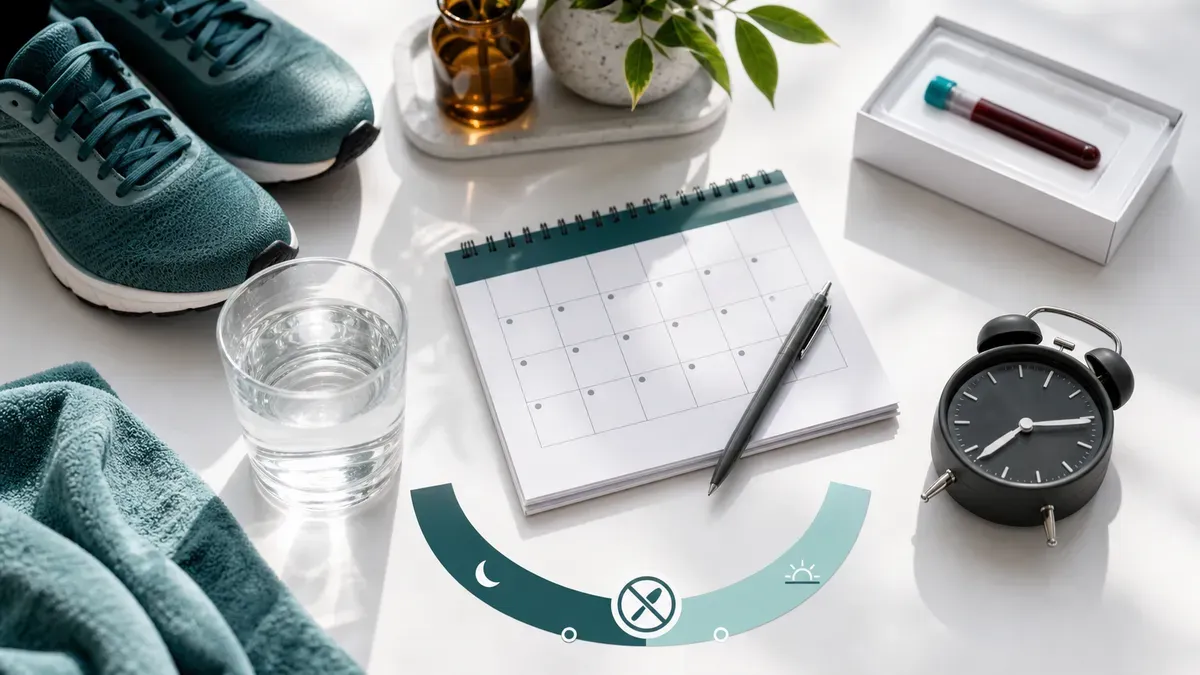
How to prepare for a longevity blood test so results are useful
Prepare for a longevity blood test with a practical checklist for fasting, exercise, sleep, illness, alcohol, medications, hydration, and repeat timing.
Quick answer
For a useful longevity blood test, keep the test conditions boring and repeatable: follow the panel’s fasting instructions, avoid hard exercise and alcohol beforehand, do not test through acute illness when the goal is a baseline, keep timing consistent, and record medications, supplements, sleep, workouts, and unusual stress. The goal is not to make the result look better; it is to make the result easier to compare.
Key facts
- Blood test preparation -> reduces noise: fasting, exercise, sleep, illness, alcohol, hydration, and collection method can all change interpretation.
- Fasting instructions -> depend on the test: glucose, insulin, triglycerides, and some metabolic panels are easier to trend when the fasting window is consistent.
- Unexpected result -> deserves context: repeat surprising values under similar conditions before changing a longevity plan.
A longevity blood test is only as useful as the conditions around it. If you test after a sleepless night, a hard workout, a late dinner, alcohol, acute illness, or a rushed finger-prick collection, the result may still be real, but it may not represent your usual baseline.
Preparation does not mean gaming the test. It means reducing avoidable noise so your results can be compared with prior and future panels. This matters most when you are tracking small changes in glucose, triglycerides, insulin, inflammation, kidney markers, liver enzymes, thyroid markers, or biological-age scores.
If you are still choosing what to test, start with our annual longevity blood test checklist. This guide focuses on the day-before and day-of details that make the numbers more interpretable.
Key takeaways
- Follow the fasting instructions for the specific panel. Many tests do not require fasting, but fasting can matter for glucose, insulin, triglycerides, and some metabolic comparisons.
- Avoid hard training for 24 to 48 hours before a baseline panel unless your clinician intentionally wants to measure post-training effects.
- Do not test during acute illness, injury, fever, unusual stress, or severe sleep loss if the goal is a stable baseline.
- Keep timing consistent. Morning tests are easier to compare for fasting markers, hormones, hydration, and daily routine.
- Do not stop prescribed medication unless your clinician tells you to. Record medications, supplements, alcohol, sleep, exercise, and illness context instead.
- Repeat unexpected results under similar conditions before making a major longevity decision.
1. Confirm whether fasting is needed
Fasting rules depend on the test. MedlinePlus notes that fasting means not eating or drinking anything except water for a set period, often 8 to 12 hours, when a test requires it. Many modern lipid panels can be interpreted without fasting, but triglycerides, fasting glucose, fasting insulin, and some metabolic comparisons are easier to trend when the fasting window is consistent.
Do not guess. Check the lab order, collection kit, or clinician instructions. If one marker requires fasting and another does not, the stricter instruction usually controls the panel. Water is generally allowed and helps avoid dehydration, but coffee, alcohol, calories, and supplements can affect some results.
For longevity tracking, the most important point is repeatability. If your baseline ApoB was non-fasting and your next test is fasting, the comparison may still be useful, but triglycerides and some calculated values may not line up cleanly.
2. Keep exercise boring before the test
Hard exercise can move several markers. Resistance training, long endurance sessions, intense intervals, and unusual volume can affect muscle enzymes, liver-adjacent enzymes, creatinine, inflammation, glucose, hydration, and sometimes blood counts. That does not mean exercise is bad. It means a post-workout panel may answer a different question.
For a stable longevity baseline, keep the 24 to 48 hours before the draw ordinary. Walk, move lightly, and avoid unusually hard training. If your goal is to evaluate how training affects a marker, document the workout and repeat the same conditions next time.
This is especially important for hs-CRP. A high result after hard training, injury, poor sleep, or infection may deserve a repeat instead of a big conclusion. Use our guide to when to repeat hs-CRP after one high result before treating one spike as your baseline.
3. Do not test through illness
Acute illness can change inflammatory markers, white blood cells, liver enzymes, glucose, resting heart rate, HRV, sleep, and appetite. A blood draw during infection may be clinically necessary, but it is not a clean longevity baseline.
If the test is elective, wait until you are back to normal for at least several days. If you recently had fever, dental work, injury, vaccination, unusually poor sleep, travel stress, or a heavy alcohol weekend, note it in your records. The note may explain a result that otherwise looks mysterious.
4. Standardize timing
Morning testing is not mandatory for every marker, but it is practical. It makes fasting easier, reduces meal-related variation, and helps compare hormones or metabolism-related markers. If you track testosterone, cortisol-related markers, thyroid context, fasting insulin, or glucose, timing consistency becomes more important.
Try to test at a similar time of day, after a similar fasting window, with similar sleep and exercise conditions. That does not make the result perfect. It makes year-to-year comparison less noisy.
5. Record medications and supplements
Medication and supplement context can matter more than the raw result. Statins, thyroid medication, blood pressure medication, diabetes medication, hormone therapy, steroids, iron, biotin, creatine, high-dose vitamin D, niacin, omega-3 supplements, and many other products can affect lab interpretation.
Do not stop prescribed medication to make a result look better. Instead, record what you took and ask your clinician if anything should be paused before testing. Biotin is a common example because it can interfere with some immunoassays, including certain thyroid and hormone tests. The right pause window depends on the test and the clinician’s instructions.
6. Control alcohol, late meals, and sleep
Alcohol, late eating, short sleep, and stress can shift glucose, triglycerides, liver enzymes, resting heart rate, HRV, and appetite signals. For a clean baseline, avoid alcohol for at least the day before testing, keep dinner normal, and aim for an ordinary sleep schedule.
You do not need a perfect wellness day. You need a representative day. If you slept three hours or had a late heavy meal, rescheduling may produce a more useful baseline.
7. Respect the collection method
Venous draws and at-home finger-prick kits have different failure modes. For venous draws, timing, fasting, hydration, and medication context are usually the main issues. For finger-prick kits, technique matters too: warm hands, clean skin, enough sample volume, avoiding excessive squeezing, drying time, packaging, and shipping temperature.
If you are deciding between routes, read doctor-ordered labs vs at-home kits for longevity tracking. Convenience is useful only if the sample can answer the question.
8. Repeat unexpected values
The most important prep rule is not before the test. It is after the result. If a marker is unexpectedly high, low, or discordant with your usual pattern, repeat it under controlled conditions before changing too much.
For example, high triglycerides with normal ApoB may point to recent food, alcohol, insulin resistance, genetics, medication, or a transient state. Our guide to high triglycerides with normal ApoB explains how to think through that pattern.
Where SuperAge fits
SuperAge helps you track the context that labs often miss: sleep, training load, HRV, resting heart rate, cardio fitness, body composition, and prior biomarker history. Add notes about fasting, exercise, alcohol, illness, and medications beside each panel. Over time, those notes make it easier to see whether a lab change is a health trend, a preparation artifact, or a one-off event.
FAQ
Should I fast before every longevity blood test?
No. Follow the order or kit instructions. If you are still choosing a panel, start with the annual longevity blood test checklist and then keep fasting conditions consistent for markers you want to trend.
Should I exercise before a blood draw?
Avoid unusually hard training for 24 to 48 hours if the goal is a baseline. Hard exercise can move muscle enzymes and inflammatory markers, so a high hs-CRP may need a repeat under calmer conditions; see when to repeat hs-CRP.
What should I do with an unexpected value?
Document sleep, alcohol, illness, exercise, medications, and the collection method, then repeat the marker when appropriate. Patterns such as high triglycerides with normal ApoB are easier to interpret when the test context is clear.
Track test context with SuperAge
Want your labs to be easier to interpret over time? Download SuperAge to connect biomarker history with Apple Watch sleep, HRV, training load, cardio fitness, and notes about each blood draw.
References
Related Articles

PhenoAge vs KDM biological age: why calculators disagree
PhenoAge vs KDM biological age explained: why calculators return different ages, what each model measures, and how to compare results safely over time.