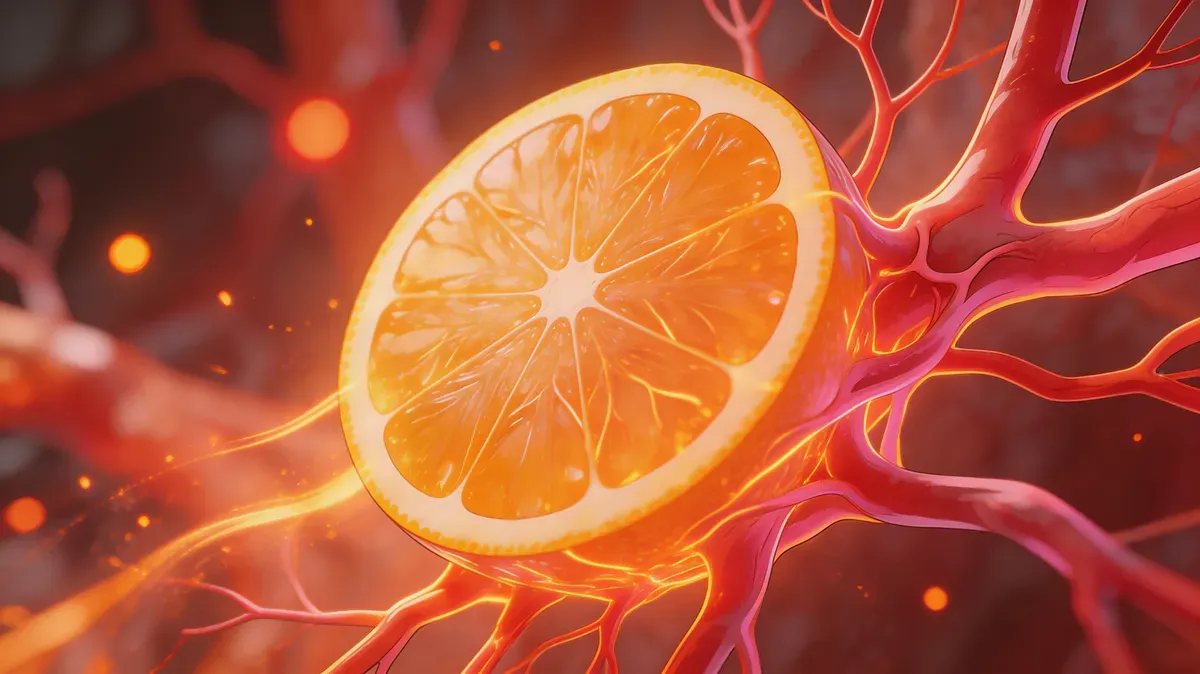
Hesperidin: citrus flavonoid for vascular health and longevity
Hesperidin is the hidden flavonoid in orange peels that protects your blood vessels. Discover its evidence-based benefits for circulation and aging.
The most bioactive compound in an orange isn’t vitamin C — it’s hesperidin, a flavonoid concentrated in the white pith and peel that most people throw away. Yet hesperidin delivers measurable improvements in endothelial function, blood pressure, and capillary integrity that rival many pharmaceutical interventions.
A 2019 meta-analysis in the American Journal of Clinical Nutrition found that 500 mg/day of hesperidin lowered systolic blood pressure by 4–5 mmHg and improved flow-mediated dilation (a gold-standard measure of arterial health) by 2.5% — on par with moderate exercise programs.
If you’re squeezing oranges and tossing the pulp, you’re literally throwing away the most valuable part.
What you’ll learn:
- Why hesperidin is unique among citrus polyphenols
- How it protects capillaries and large arteries differently
- Best food sources and whether supplementation is worth it
- The connection between vascular aging and biological age
What is hesperidin?
Quick definition: Hesperidin is a flavanone glycoside found almost exclusively in citrus fruits — particularly in the peel, pith, and membranes of oranges, lemons, and tangerines — with potent vascular and anti-inflammatory effects.
Once absorbed, hesperidin is metabolized by gut bacteria into hesperetin, the active form that enters the bloodstream and interacts with endothelial cells. This means your gut microbiome partly determines how much benefit you extract from each orange you eat.
Unlike vitamin C, hesperidin is heat-stable and survives cooking, juicing, and long storage.
Why hesperidin matters for your health
- Capillary protection: Strengthens small blood vessel walls, reducing fragility
- Endothelial function: Improves flow-mediated dilation within 4–6 weeks
- Anti-inflammatory: Inhibits NF-κB signaling and lowers inflammatory markers
- Lipid modulation: Modest reductions in LDL and triglycerides in trials
The science behind hesperidin and vascular aging
Your vascular system is your longevity system. Arterial stiffness and endothelial dysfunction begin in your 30s, decades before clinical disease. They’re driven by oxidative stress, inflammation, and reduced nitric oxide availability — the same pathways hesperidin targets.
How hesperidin protects your blood vessels
- Boosts nitric oxide: Hesperetin upregulates eNOS (endothelial nitric oxide synthase), improving vasodilation
- Reduces oxidative stress: Quenches ROS in endothelial cells and LDL particles
- Inhibits inflammation: Lowers TNF-α, IL-6, and CRP in clinical trials
- Protects capillaries: Increases capillary resistance — the reason it’s approved in Europe for chronic venous insufficiency
Vascular aging and longevity
Arterial stiffness is one of the strongest independent predictors of cardiovascular death and all-cause mortality. Recent work in Hypertension showed that pulse wave velocity — the standard measure of arterial aging — correlates tightly with biological age scores derived from blood biomarkers.
This connects hesperidin directly to the broader goal of lowering biological age through targeted vascular support.
6 proven ways to increase hesperidin intake
1. Eat whole oranges, not just juice
Why it works: Hesperidin concentrates in the white pith and membranes — the parts discarded when juicing. A whole orange delivers 40–60 mg of hesperidin; a glass of juice from the same orange delivers under 20 mg.
How to do it:
- Choose whole oranges over juice daily
- Eat some of the white pith with each segment
- Include tangerines, mandarins, and clementines for variety
Expected results: 3× more hesperidin per fruit compared to juice alone.
2. Add citrus zest to cooking
Why it works: Orange and lemon zest contain 10–20× more hesperidin per gram than the fruit flesh. It’s the most concentrated food source on the planet.
How to do it:
- Grate 1 tsp (~0.1 oz / 2 g) of zest into salad dressings
- Add to baked goods, rice, fish, and poultry
- Use organic citrus when eating the peel
Expected results: Significant hesperidin boost from very small amounts.
3. Drink herbal teas with citrus peel
Why it works: Dried citrus peel tea is a traditional Chinese remedy specifically valued for vascular effects — and it happens to be extremely high in hesperidin.
How to do it:
- Steep dried orange or tangerine peel for 5–10 minutes
- Combine with ginger or green tea for synergistic benefits
- 1–2 cups daily
Expected results: Sustained low-dose hesperidin intake across the day.
4. Consider supplementation for cardiovascular risk
Why it works: Trials showing BP and endothelial benefits typically use 500 mg/day of standardized hesperidin — a dose difficult to achieve from food alone.
How to do it:
- Look for hesperidin supplements standardized to >90% purity
- Sometimes sold as “Diosmin + Hesperidin” (common for venous support)
- Take with a meal for better absorption
The information provided does not replace professional medical advice. Consult your healthcare provider before starting any supplementation.
Expected results: Measurable BP and endothelial improvements within 4–8 weeks.
5. Pair hesperidin with vitamin C for synergy
Why it works: The original 1936 discovery of flavonoids was as “vitamin P” — because they potentiated vitamin C’s effects on capillary permeability. Modern research confirms real synergy.
How to do it:
- Whole citrus naturally provides both
- Pair hesperidin supplements with vitamin C-rich foods
- Avoid high-dose isolated vitamin C without cofactors
Expected results: Enhanced capillary integrity and antioxidant defense.
6. Support your gut microbiome
Why it works: Hesperidin absorption depends on bacterial β-glucosidase activity in your gut. Poor microbial diversity reduces hesperetin production by 50–70%.
How to do it:
- Eat fermented foods (yogurt, kefir, sauerkraut) regularly
- Include diverse plant fibers daily
- Avoid unnecessary antibiotic courses
Expected results: Better extraction of hesperidin from every citrus serving.
How to track vascular aging
Key metrics to monitor
| Metric | Optimal Range | What It Indicates |
|---|---|---|
| Systolic BP | < 120 mmHg | Arterial pressure load |
| Pulse wave velocity | Age-adjusted | Arterial stiffness |
| Flow-mediated dilation | > 7% | Endothelial function |
| hs-CRP | < 1.0 mg/L | Vascular inflammation |
| Ankle-brachial index | 0.9–1.3 | Peripheral circulation |
These feed into the broader biomarker panel used in how biological age is calculated.
How SuperAge helps you track vascular longevity
Vascular aging is invisible until it isn’t. SuperAge gives you continuous insight into the metrics that matter — before damage becomes symptom.
Automatic cardiovascular tracking
Through Apple Watch, SuperAge captures resting heart rate, HRV, and blood pressure (when logged) — all downstream of your vascular health.
Personalized insights
The app connects your dietary patterns (rich in polyphenols or poor) to your cardiovascular biomarker trends over time.
Progress visualization
Track how daily habits — like eating whole citrus, walking more, sleeping better — compound into measurable biological age changes.
Frequently asked questions
Is hesperidin the same as vitamin P?
Historically, flavonoids including hesperidin were called “vitamin P” after being discovered to work alongside vitamin C on capillary permeability. The name was later dropped when it became clear they aren’t true vitamins, but the biological synergy is real.
Can I get enough hesperidin from food alone?
From whole citrus and zest, you can reach 100–200 mg/day — meaningful for general health. For the 500 mg/day used in blood-pressure trials, supplementation is usually needed.
How long until hesperidin improves blood pressure?
Most trials show effects within 4–8 weeks of daily 500 mg intake. Endothelial function improvements appear even earlier, sometimes within 3–4 weeks.
Does hesperidin interact with medications?
It can interact with blood thinners and some blood pressure medications. Always consult your healthcare provider before adding supplements, especially if you take cardiovascular drugs.
Key takeaways
- Whole citrus beats juice: The pith and membranes hold most of the hesperidin.
- Zest is concentrated: 1 tsp of peel can outperform a whole fruit.
- Target vascular biomarkers: BP, FMD, and CRP respond measurably to consistent intake.
- Vascular age drives biological age: Healthier arteries mean a younger calculated age.
Start supporting your vessels today
Your arteries age silently. The flavonoids in a simple orange — eaten whole, with the pith — are one of the oldest and most evidence-backed tools to slow that process.
Ready to take control? Download SuperAge and start tracking the vascular metrics that shape your biological age.
References
- Morand C et al. — “Hesperidin contributes to the vascular protective effects of orange juice,” American Journal of Clinical Nutrition, 2011
- Salden BN et al. — “Randomized clinical trial on the efficacy of hesperidin 2S on validated cardiovascular biomarkers,” American Journal of Clinical Nutrition, 2019
- Mas-Capdevila A et al. — “Effect of hesperidin on cardiovascular disease risk factors,” Nutrients, 2020
- Li C, Schluesener H — “Health-promoting effects of the citrus flavanone hesperidin,” Critical Reviews in Food Science and Nutrition, 2017
Last updated: April 2026. This article is regularly reviewed to ensure accuracy.
Related Articles

Curcumin and turmeric: anti-inflammatory powerhouse or overhyped supplement?
Curcumin may help joint pain and inflammation, but absorption, dose, safety, and evidence quality decide whether turmeric supplements are useful.