What age can you start climbing? Readiness for children and adults
Find the right age to start climbing by checking child readiness, teenage finger loading, adult health, and supervision. Plan a suitable first step at any age.
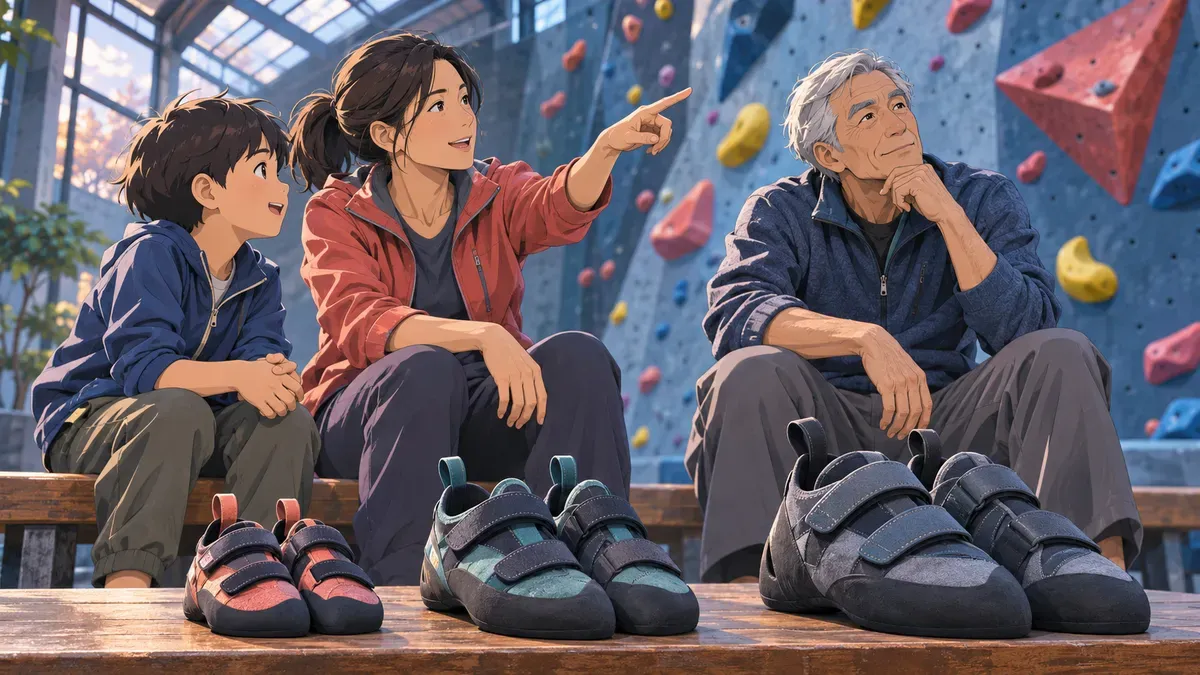
The right age to start climbing depends on the person, the activity, and the supervision available. A child exploring a few low holds, a teenager joining a coached group, and a 60-year-old booking a first lesson need different starting conditions.
There is no birthday that makes every child ready and no universal upper age limit that makes every adult unsuitable. The useful decision is whether the proposed session matches current attention, movement, health, and confidence. Starting is also different from training hard or climbing independently.
Quick answer
Choose a supervised, age-adapted introduction when the learner wants to participate, can respond to the teaching offered, and has equipment and activities suited to their size and abilities. Preschool children generally need playful movement rather than formal training. Adolescents need particular protection from excessive finger loading. Adults can consider starting in midlife or later, with individual adaptations and medical advice when health or fall consequences make suitability uncertain.
Key facts
- Sports readiness combines physical, cognitive, and social abilities; age alone cannot establish it.
- Climbing facilities set their own entry and supervision conditions; admission does not establish independent competence.
- Growing fingers contain vulnerable growth plates that require age-appropriate loading.
- Adult health and functional ability shape the starting plan more usefully than a birthday alone.
- Pain or loss of control changes the decision from progressing to stopping and reassessing.
Use age as context, then assess the actual activity
The American Academy of Pediatrics describes sports readiness through the skills a task demands. Its general guidance favors play before age six and increasingly structured, adapted activities as children develop. These are developmental guideposts, not validated climbing minimum ages (AAP guidance).
| Life stage | A useful starting question | What to prioritize |
|---|---|---|
| Preschool years | Can this be a willing, closely supervised movement game? | Play, simple directions, frequent pauses, and an easy exit |
| School-age childhood | Can the child follow the session’s rules and communicate discomfort? | Adapted instruction, suitable equipment, and enjoyment |
| Adolescence | Does training respect growth and changing tolerance? | Technique, varied movement, recovery, and finger symptoms |
| Adult beginner | Can the format accommodate present abilities and limitations? | Instruction, manageable effort, and realistic progression |
| Later-life beginner | What do health, balance, and fall consequences require? | Individual assessment and an adapted, supervised format |
This table is a planning aid, not a test that clears someone to climb. A learner may need support that an age-based group cannot provide. Conversely, needing adaptations does not automatically exclude participation: discuss them before booking.
Check readiness through five practical questions
Use these questions to organize a conversation with an instructor. They are practical prompts, not a medically validated screening tool.
- Does the learner want to try? Curiosity is enough; pressure to match a sibling, parent, or friend is not a useful reason to go higher. Agree that stopping is allowed.
- Can instructions be understood in the proposed setting? The important issue is whether teaching can be communicated reliably, including through demonstration or other appropriate adaptations.
- Can the learner respect boundaries with the available support? Examples include waiting outside another climber’s landing area and responding when asked to pause. If that requires more supervision, arrange it in advance.
- Can discomfort or fear be communicated? Work out a simple way to signal pain, confusion, or the wish to come down. Do not interpret silence as comfort.
- Can the activity and equipment fit the person? Ask the instructor to assess reach, movement, footwear, harness suitability when relevant, and a manageable way to finish.
A child who can scramble confidently may still need help managing attention around other climbers. An adult with good general fitness may need a low-pressure introduction to height. Assess the whole situation rather than treating strength as the admission test.
For young children, separate movement play from training
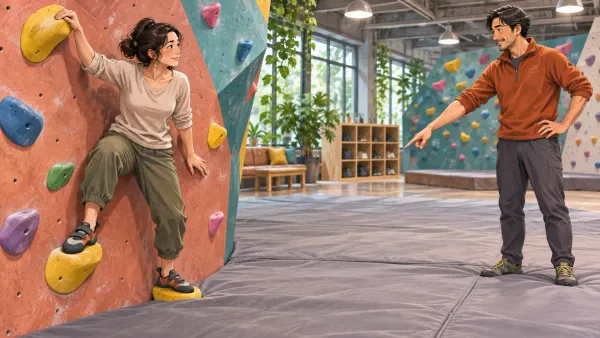
A young child’s first experience can be about noticing footholds, moving sideways close to the floor, or following a simple demonstration. The instructor should choose the terrain, boundaries, and supervision. Being close to the floor still requires attention to falls and other people.
Let the activity finish while it remains enjoyable. An interested child may climb briefly, watch, and return later. A reluctant child can observe without being persuaded onto a taller wall. There is no need to turn the visit into a competition or to interpret an early finish as failure.
Keep the wider movement week varied. The Canadian Paediatric Society’s readiness guidance also emphasizes development, interest, and appropriately adapted activities. A climbing session can sit alongside other play rather than replacing it with a single-sport identity.
Ask the facility about its minimum age, group format, supervision arrangements, and equipment fit. The BMC’s guidance for climbing with children explains that these conditions differ between walls. A parent being present does not establish competence to supervise climbing or operate a rope system. If you are new too, book instruction for the relevant roles.
Adolescents need a plan for growing fingers
An adolescent may solve difficult moves while the skeleton is still developing. Performance is not proof that adult loading methods are appropriate. Finger growth plates are a specific concern in youth climbing, particularly around the growth spurt.
The BMC’s growth-plate injury guidance identifies repeated finger loading as an important problem. Focal finger-joint pain should not be dismissed as ordinary growing pains or hidden with tape so training can continue. Stop the aggravating activity and arrange medical assessment, especially for persistent pain, swelling, or reduced movement.
A campus board is a training apparatus with rungs used for demanding hand movements. The BMC advises under-18 climbers against feet-off or dynamic campus-board use. This is specific guidance about a loading method, not a ban on ordinary supervised climbing. Reaching 18 also does not make a beginner ready for advanced finger training.
A 2026 primary study examined 488 injured climbers presenting at two specialist centers. It supported attention to adolescent growth plates and proposed delaying campus-board and added-weight climbing training until growth-plate closure. Because the registry contained injured climbers and no uninjured control group, it cannot estimate a new participant’s injury probability or prove that a particular training method causes or prevents injury (Schöffl and colleagues).
For a young beginner, make the next goal a controlled movement or a useful skill. Keep the coach informed about growth, other sport commitments, and symptoms. Avoid adding maximal finger sessions because improvement on the wall seems fast. Progression should leave room for recovery and changing coordination.
Starting at 40, 50, 60, or later: match the format to your health
You do not need to have climbed as a child to ask for an adult beginner lesson. Tell the instructor what you can comfortably do now, what feels uncertain, and what you hope to try. Someone returning after decades away should describe that gap too: past skill does not establish present load tolerance.
Discuss relevant concerns before attending, including osteoporosis or a previous fragility fracture, recent surgery, painful hands or shoulders, major balance difficulties, or a condition affecting exertion. A clinician can help determine whether restrictions or preparatory work are needed. This is individual suitability advice, not a requirement for every healthy adult to obtain medical clearance.
Consider the consequences of coming off the wall. Bouldering involves potential ground landings even with mats. An instructor-managed top-rope session may change those demands, but equipment and competent belaying remain essential, and rope support does not eliminate risk. Do not assume either format is universally safer for an older beginner.
Climbing can be one part of a varied activity routine. For adults 65 and older, the CDC recommends aerobic, muscle-strengthening, and balance activities, adapted to ability and health. That general guidance does not establish climbing as a proven falls-prevention treatment or a replacement for the whole activity mix (CDC recommendations). Our exercise restart guide after 60 helps organize that wider starting point.
Choose one appropriate next step
The readiness decision should end with a concrete action. These examples illustrate options rather than clinical prescriptions:
- Ready for a supported introduction: a willing child can follow adapted directions, and the provider offers suitable teaching and equipment. Book that session and keep the goal modest.
- Needs a different format: an adult likes the movement but is concerned about ground landings. Discuss an instructor-led alternative and any health restrictions before booking.
- Needs more support or more time: a child repeatedly enters landing zones despite the supervision available. Ask about a different group, individual instruction, or waiting before another attempt.
- Needs assessment first: a teenager has ongoing focal finger pain, or an adult has an unresolved injury or a health concern affecting participation. Address that issue before adding climbing load.
Once the readiness question is settled, use our first indoor climbing session guide for booking and induction details. Later, the climbing movement guide provides a separate route into footwork and body positioning. Neither article replaces practical instruction.
Keep adult progress in a wider health context
For an adult learner, useful notes include the activity tried, perceived effort, confidence, and any discomfort afterward. Give unfamiliar loading time to settle before increasing it; our rest-day guide explains how recovery fits a training week. The complete exercise guide puts climbing alongside other forms of movement.
SuperAge can help adults view available Apple Health activity, sleep, and recovery trends on their iPhone. Use that context alongside your own training notes. A favorable score cannot establish a child’s developmental readiness, confirm growth-plate closure, assess an injury, or authorize a harder climb. Climbing suitability still depends on the person, professional advice when needed, and competent instruction.
FAQ
What is the minimum age to start climbing?
There is no single minimum that applies to every activity or provider. Check the session’s entry conditions, then assess willingness, understanding, support, and equipment fit. A preschool movement game and independent climbing require very different abilities.
Can a four-year-old try climbing?
Possibly in a program specifically adapted to that child and age group. Ask the provider rather than assuming general admission includes suitable teaching. Keep it playful and supervised, allow an easy stop, and avoid treating participation as readiness for formal training.
Is six the best age to begin climbing lessons?
Six is a general developmental reference in pediatric sports guidance, not a climbing-specific threshold. Some children need a different pace or more support. Match the lesson to the child’s abilities and interest rather than booking because of a birthday.
Can teenagers use a campus board?
The BMC advises under-18s against feet-off or dynamic campus-board training. Growing fingers need protection from inappropriate loading. Discuss youth training with a qualified coach, and seek assessment for focal finger pain rather than training through it.
Am I too old to start climbing at 50 or 60?
Age alone does not answer that question. Current health, movement, balance, fall consequences, and suitable instruction matter. Tell the provider you are new, discuss adaptations, and obtain individual clinical advice if a condition or injury makes participation uncertain.
Do I need to do pull-ups before starting?
No universal pull-up target establishes beginner readiness. Ask for easy, adapted terrain and practical teaching. Comfortable movement and the ability to follow the taught safety system matter more than passing an arbitrary strength challenge.
Can a child climb independently after one lesson?
One lesson does not establish independent competence. Follow the provider’s supervision and assessment requirements. Climbing, belaying, using an autobelay, and supervising another person are separate responsibilities that require appropriate instruction and demonstrated skills.
When should someone postpone the next climbing session?
Postpone and seek advice for unresolved focal pain, swelling, loss of function, or a health concern affecting participation. Stop a session when attention, control, or willingness deteriorates. After a fall, suspected serious injury requires prompt medical care.
Key takeaways
- Assess the person and proposed session together; a birthday cannot clear someone to climb.
- Give young children adapted play, reliable supervision, and permission to stop.
- Protect adolescent fingers and take focal joint pain seriously.
- Let adult health, function, and fall consequences guide adaptations.
- Treat introductory participation, hard training, and independent competence as separate decisions.
Plan a starting point you can repeat
Ask a qualified instructor what an appropriate first step looks like for you. For adult health context over time, explore SuperAge alongside your activity and recovery notes.
References
- American Academy of Pediatrics. Is your child ready for sports?. General developmental guidance; updated June 2024.
- Canadian Paediatric Society. When is my child ready for sports?. Development, interest, and adapted sport participation.
- British Mountaineering Council. Getting started: indoor climbing with kids. Supervision, provider conditions, and equipment suitability.
- British Mountaineering Council. Growth plate stress fractures in teenage climbers. Youth finger loading and recognition of injury.
- British Mountaineering Council. Campus boards: guidance on use. Under-18 feet-off and dynamic campus-board guidance, approved by the UIAA Medical Commission.
- Schöffl VR et al. Training composition and finger injuries in sport climbing: a 6-year multicenter registry analysis of 488 climbers. Frontiers in Sports and Active Living. 2026;8:1994765. doi:10.3389/fspor.2026.1994765.
- Centers for Disease Control and Prevention. Older adults: adding activity recommendations. General activity mix for adults 65 and older.
Related Articles
Hiking safety: plan a day hike and know when to turn back
Build a hiking safety plan for your next day hike. Match the route to your group, pack for delays, set turnaround rules, and recognize when to seek help.