Beep test guide: protocol, scores, and how to improve
Learn how the beep test works, set up the 20 m shuttle protocol, record scores, estimate VO2 max, and retest your aerobic fitness reliably today.
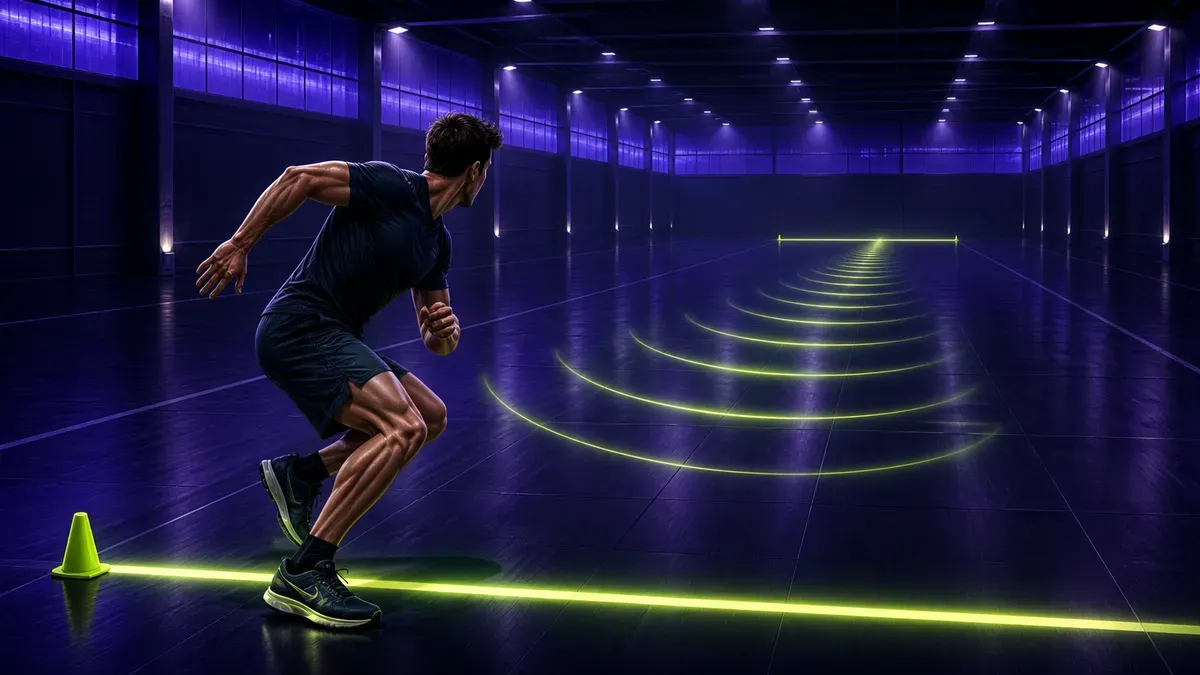
The beep test is a progressive 20 m shuttle run that turns a strip of flat ground and a timed audio track into a demanding field test of aerobic fitness. You run between two lines, arrive with each beep, and continue as the beeps accelerate until you can no longer hold the pace. Your final level, shuttle, and speed provide a repeatable performance score and can be used to estimate VO2 max.
The test is simple, but a useful result depends on strict setup. A different audio version, a course that is 19 m instead of 20 m, a slippery floor, unclear stopping rules, or a hard workout the day before can move the score. Treat the beep test as a standardized measurement rather than an improvised conditioning challenge.
Quick answer
How does the beep test work? Mark two lines exactly 65.6 ft (20 m) apart, use one identified 20 m shuttle-run audio protocol, warm up, then run back and forth so you reach the opposite line at each beep. The original one-minute-stage protocol starts at 5.3 mph (8.5 km/h) and increases by 0.3 mph (0.5 km/h) each minute. Record the last fully completed shuttle, not only the level. Keep the same audio, surface, footwear, timing, and stopping rule whenever you retest.
The result estimates cardiorespiratory fitness; it does not directly measure oxygen uptake. Laboratory cardiopulmonary exercise testing with respiratory-gas analysis remains the criterion method when a precise clinical VO2 value is required.
Key facts
- The 20 m shuttle run estimates cardiorespiratory fitness from progressive running performance.
- The audio track controls speed and stage timing throughout the test.
- Level plus shuttle records a more precise result than level alone.
- Repeated conditions reduce noise when you compare two test dates.
- A matched prediction equation converts final speed into an estimated, not measured, VO2 max.
What is the beep test?
The beep test is also called the 20 m shuttle run, multistage fitness test, or bleep test. The classic protocol was developed as a practical alternative to laboratory testing for schoolchildren, healthy adults, and athletes in sports that involve repeated starts, stops, and changes of direction.
Participants run continuously between parallel lines while an audio signal sets the pace. Early shuttles feel easy. The interval between beeps then shortens in stages, so speed rises until the runner reaches volitional exhaustion or misses the required line according to the chosen stopping rule.
This makes the test a hybrid demand. It strongly reflects aerobic power, but it also includes:
- acceleration and braking at every line;
- turning skill and lower-body coordination;
- tolerance for progressively intense running;
- motivation and familiarity with the audio;
- traction, footwear, temperature, and course accuracy.
That is why a beep-test estimate and a laboratory VO2 max are related but not identical. A 2015 meta-analysis of 57 studies found moderate-to-high criterion validity for estimating maximal oxygen uptake, with stronger validity in adults than children under the original Leger protocol. A later systematic review found strong evidence that the 20 m shuttle run is a valid field test for cardiorespiratory fitness in healthy adults aged 19–64.
Use the test when you need a low-cost, repeatable field measure. Use direct laboratory testing when an exact oxygen-uptake value, medical supervision, or clinical decision is the priority. Our guide to Apple Watch VO2 max versus laboratory testing explains the same distinction between estimation and direct gas analysis.
What you need to run the test
The setup is minimal, but every item protects repeatability.
| Item | Requirement | Why it matters |
|---|---|---|
| Course | Flat, non-slip lane at least 72 ft (22 m) long | Provides the measured 20 m plus safe room beyond each line |
| Markers | Two parallel lines and visible cones | Makes the turning target unambiguous |
| Measurement | Long tape or calibrated measuring wheel | A small distance error repeats on every shuttle |
| Audio | One identified 20 m protocol and reliable speaker | Different versions can start or progress differently |
| Recording sheet | Level, shuttle, total laps, notes | Preserves the raw result for later comparison |
| Support | Test administrator, and a spotter or supervisor when appropriate | Applies the same rules and responds if symptoms occur |
Mark the inside edge of each line exactly 65.6 ft (20 m) apart. The runner must know whether the rule requires touching the line with a foot or merely reaching it before the signal. Use the rule supplied with the selected audio and do not change it halfway through a test block.
Leave clear deceleration space beyond both ends. Remove bags, benches, loose cones, and other trip hazards. For a group test, give each runner a lane wide enough to turn without contact.
Choose the audio before you compare scores
“Beep test” is a family name, not a guarantee that every recording is identical. The classic one-minute protocol begins at 5.3 mph (8.5 km/h) and raises speed by 0.3 mph (0.5 km/h) per minute. Other school, military, app, or team versions may use a different opening speed, stage duration, warm-up cue, shuttle count, or termination rule.
Write down the audio name or version. If you switch recordings, start a new baseline. Do not convert the old and new results as though only the speaker changed.
Beep test protocol: step by step
The beep test is maximal. Do it when you are healthy, recovered, and prepared for hard running—not at the end of an exhausting workout.
1. Screen the day, the runner, and the environment
Postpone the test for fever, acute illness, a new injury, unusual fatigue, or a surface made unsafe by rain, ice, heat, or poor traction. People with known cardiovascular, respiratory, metabolic, neurological, or significant musculoskeletal conditions should follow individualized medical or exercise-professional advice before maximal testing.
Stop immediately for chest pressure or pain, faintness, confusion, unusual or extreme shortness of breath, or a fast or irregular heartbeat that feels abnormal. The American Heart Association lists these as warning signs during activity that merit stopping and contacting a health professional; urgent or persistent symptoms require emergency assessment.
2. Standardize the previous 24 hours
For a clean training comparison:
- avoid a hard lower-body or interval session the previous day;
- keep food and caffeine timing similar to prior tests;
- arrive normally hydrated;
- use the same shoes and surface;
- test at a similar time of day and in similar weather;
- record illness, poor sleep, soreness, heat, wind, and any medication change.
These notes help explain a score without turning one disappointing test into a false conclusion about lost fitness.
3. Warm up without creating fatigue
Use 10–15 minutes of progressive preparation:
- Walk or jog easily for 5 minutes.
- Perform dynamic ankle, hip, and trunk movements.
- Run two or three relaxed 20 m shuttles.
- Practice two controlled line turns.
- Complete two short progressive strides, then rest 2–3 minutes.
Do not make the warm-up a hidden workout. The goal is to rehearse the movement and raise temperature while preserving energy for the test.
4. Start behind one line and follow the pace
Begin on or just behind the starting line according to the audio instructions. Run to the opposite line and arrive by the next beep. Turn efficiently and travel back on the following signal.
Early on, avoid racing ahead and waiting. Arrive close to the beep, keep steps controlled, and turn without a wide loop. Repeated early surges waste energy that the protocol is designed to add later.
5. Apply one stopping rule consistently
Many protocols end the test after the runner fails to reach the line for two consecutive shuttles, but this is not universal. Some allow the runner to recover after one miss; others use a warning system or stop at volitional exhaustion. Use the exact rule linked to your audio.
An administrator should announce a miss clearly and record the last shuttle completed under the rules. The runner should also stop for pain, loss of safe coordination, or medical warning signs rather than chase one more level.
6. Cool down and save the raw result
Walk for several minutes after stopping. Record:
- protocol and audio version;
- final completed level and shuttle;
- total completed shuttles or distance, if the track provides it;
- final stage speed;
- peak heart rate and rating of perceived exertion, if used;
- surface, shoes, weather, time of day, and stopping reason.
The raw performance is more durable than a single calculator estimate. You can apply an appropriate equation later, but you cannot reconstruct an unrecorded shuttle count.
How beep test scoring works
The most common score format is level.shuttle. A result such as 9.6 means the runner completed shuttle 6 of level 9 under that specific audio track. It does not mean 9.6 minutes, 9.6 mph, or 96 shuttles.
Keep four outputs when possible:
| Output | What it tells you | Best use |
|---|---|---|
| Level + shuttle | Exact stopping point within the audio | Day-to-day coaching record |
| Total shuttles | Completed 20 m lengths | Simple comparison and research tables |
| Total distance | Shuttles × 65.6 ft (20 m) | Work completed under the protocol |
| Final stage speed | Prescribed speed at the last completed stage | Input for a matched VO2 max equation |
For example, 72 completed shuttles equal 4,724 ft (1,440 m). That distance does not show how the laps were distributed across levels, so retain the level and shuttle too.
Estimating VO2 max from final speed
In the original adult validation, the following equation was derived for adults aged 18–50:
Estimated VO2 max = -27.4 + (6.0 × final speed in km/h)If the final protocol speed is 7.8 mph (12.5 km/h), the estimate is:
-27.4 + (6.0 × 12.5) = 47.6 mL/kg/minThat number is a prediction from a specific protocol and sample, not a respiratory-gas measurement. The original authors also published an age-adjusted equation for young people and treated adult age as 18 within that model. Since then, researchers have created other equations for different populations.
Equation choice matters. A 2021 study in collegiate women field-hockey athletes compared six equations with direct treadmill testing: two produced valid group estimates in that sample, while four overestimated VO2 max. Age, sex, fitness level, sport, and training history can change bias. Use an equation validated for your population and exact test version; never choose the calculator that returns the most flattering number.
If you want age- and sex-specific context for a measured or consistently estimated value, use our VO2 max norms guide. Do not mix those VO2 bands with an unmatched beep-test conversion.
What is a good beep test score?
There is no single “good” level for every person. A defensible comparison must match at least the protocol, age group, sex, and population. Sport teams and employers may also set task-specific standards that are not health cutoffs.
Use this hierarchy:
- Your own standardized trend. Did you complete more shuttles under the same conditions?
- A matched team or program distribution. Compare with people doing the same protocol for the same purpose.
- Published age- and sex-specific norms. Confirm that the sample and audio version match.
- Estimated VO2 max context. Use only a population-appropriate equation.
For children and adolescents, a large international analysis assembled 20 m shuttle-run norms from more than 1.1 million participants aged 9–17 across 50 countries. Those percentiles are not adult standards. For recreational adults, personal change is often more useful than an unsourced internet table that hides its protocol.
One level higher is not automatically a physiological breakthrough. The change may combine better aerobic fitness, improved pacing, sharper turns, greater motivation, cooler weather, or simple familiarization. That is not a flaw; it is a reason to standardize and interpret the result as field-test performance.
How accurate and reliable is the beep test?
The evidence supports the beep test as a useful field estimate, with important limits.
The original 1988 study reported test–retest reliability coefficients of 0.95 in adults and 0.89 in children. A 2022 systematic review found strong evidence for high reliability of the 20 m shuttle run in adults. Reliability means repeated testing can rank and track people consistently under controlled conditions; it does not mean every estimated VO2 value is exact.
Criterion validity is also solid at the group level. The 2015 meta-analysis reported population correlations ranging from 0.66 to 0.84 when performance alone estimated maximal oxygen uptake, and 0.78 to 0.95 when variables such as age, sex, or body mass were included. Yet individual error can remain meaningful, and sport-specific work has found underprediction or equation bias in some trained groups.
What can change the score without changing aerobic fitness?
- Course length: an error is repeated dozens of times.
- Audio protocol: stage speed and shuttle counts may differ.
- Turning technique: efficient deceleration saves energy.
- Surface and shoes: traction affects confidence and force.
- Heat, cold, wind, or altitude: the environment changes strain.
- Group dynamics: competition can raise effort or disrupt pacing.
- Recent training: soreness and low glycogen can suppress performance.
- Body-mass change: relative VO2 estimates and running cost can shift.
- Familiarization: learning when to arrive and how to turn improves execution.
The beep test is therefore best for comparing like with like. It should not replace a running-economy assessment, lactate-threshold test, or sport-specific repeated-sprint test when those are the actual performance questions. Read our running economy guide for why two people with similar aerobic ceilings can run at different costs.
A repeatable testing checklist
Use the same checklist before every attempt:
- Same 20 m measurement and line rule
- Same audio file, speaker, and volume
- Same indoor or outdoor surface
- Same footwear category
- Similar time of day and pre-test meal timing
- No acute illness or new pain
- No hard training in the previous 24 hours
- Same warm-up sequence
- Same administrator and stopping rule when possible
- Level, shuttle, total distance, conditions, and reason for stopping recorded
If the first test was your first exposure, consider it a familiarization baseline. A short practice of the audio and turns before the next formal test reduces the chance that technique alone explains the change.
Retest at the end of a meaningful training block—often every 6–8 weeks—rather than every few days. Fitness adaptations need time, while frequent maximal tests add fatigue and encourage score-chasing. If the purpose is general long-term monitoring rather than sport performance, a less frequent cadence may be enough; our six-month functional-fitness checklist covers that broader use case.
How to improve your beep test result
Train the aerobic system first, then add a small amount of test-specific skill. Practicing the full test repeatedly is a poor substitute for a balanced program.
1. Build easy aerobic volume
Complete most running at a conversational intensity you can recover from. For adults, the World Health Organization recommends 150–300 minutes of moderate aerobic activity or 75–150 minutes of vigorous activity per week, plus muscle-strengthening work on at least two days. Those are health guidelines, not a requirement to run every minute.
Start from your current capacity. Three consistent sessions can be more productive than one heroic week followed by missed training. The Zone 2 training guide explains how easy aerobic work supports volume and recovery.
2. Add one interval session
Progressive shuttle performance eventually demands high oxygen uptake. A 2024 umbrella review covering 24 meta-analyses found that high-intensity interval training consistently improves cardiorespiratory fitness in adults compared with no exercise and generally outperforms moderate continuous training.
A practical non-beginner session is:
- 10–15 minutes easy warm-up;
- 4 × 3 minutes hard but controlled;
- 2–3 minutes easy jogging or walking between repetitions;
- 10 minutes easy cool-down.
Do not copy the final beep-test speed as an exact interval prescription. Shuttle speed includes turning, and the final stage is reached under fatigue. Use effort, heart rate, or a validated running pace appropriate to the session. Beginners should first build consistent easy running and can use shorter controlled repetitions.
Our broader guide to improving VO2 max compares intervals, steady aerobic work, and progression in more detail.
3. Practice economical turns
Once every 1–2 weeks, rehearse 6–10 relaxed 20 m shuttles after an easy warm-up:
- approach under control rather than lunging;
- plant near the line without crossing excessively;
- lower your center of mass slightly;
- alternate turning legs when comfortable;
- push away smoothly instead of taking a maximal first step.
This is skill practice, not an exhaustion test. Stop while coordination is crisp.
4. Strengthen braking and propulsion
Two weekly strength sessions can support the repeated deceleration and reacceleration demands. Use movements such as split squats, squats, step-ups, calf raises, and hamstring work with progressive resistance. Keep strength volume compatible with running quality rather than placing heavy leg work immediately before intervals or testing.
5. Manage the training load
Increase one main variable at a time: weekly volume, interval work, or strength load. A sudden jump can make the next test worse even if the long-term plan is sound. Track session difficulty and recovery alongside mileage; the training-load curve guide shows how workload and recovery interact.
How SuperAge can track the response
After the protocol and training questions are answered, longitudinal data can add context. SuperAge brings together Apple Health activity, resting heart rate, heart-rate variability, sleep, VO2 max estimates, and recovery trends so you can compare a test result with the weeks that produced it.
The app cannot validate your 20 m course, diagnose symptoms, or replace laboratory testing. It can help you notice that an unexpectedly low score followed poor sleep, unusually high training load, or a change in cardiovascular trends. Keep the raw beep-test score in your training notes and use digital metrics as supporting evidence, not a reason to ignore how the test was run.
Download SuperAge to view fitness and recovery trends against your own baseline between standardized field tests.
FAQ
Is the beep test the same as a VO2 max test?
It estimates VO2 max from field performance. Direct VO2 max testing measures respiratory gases during a graded exercise test. The beep test is cheaper and scalable; the laboratory test provides the more precise physiological measurement.
How long is each beep test shuttle?
Each shuttle is 65.6 ft (20 m) in the classic protocol. One out-and-back pair is 131.2 ft (40 m), but scores are normally recorded in individual 20 m shuttles.
What speed does the beep test start at?
The original one-minute-stage protocol starts at 5.3 mph (8.5 km/h) and increases by 0.3 mph (0.5 km/h) each minute. Other recordings may start or progress differently, so identify the audio before comparing results.
When does the beep test stop?
It stops when the runner meets the chosen protocol’s miss rule, voluntarily stops from exhaustion, loses safe coordination, develops pain, or experiences a medical warning sign. Many versions use two consecutive missed lines, but not all do.
Can I do the beep test alone?
A healthy, experienced adult can physically run it alone, but an administrator improves line calls, score recording, and safety during a maximal test. Supervision is particularly important for young people, groups, anyone with health concerns, or anyone unfamiliar with maximal exercise.
How often should I repeat the beep test?
For a focused training block, every 6–8 weeks is usually more useful than weekly testing. Keep conditions identical. Test less often when the goal is general health monitoring, and do not repeat maximal testing while ill, injured, or poorly recovered.
Why did my score improve but my watch VO2 max did not?
You may have improved turning, pacing, motivation, or tolerance for shuttle running before the watch algorithm detected a cardiovascular trend. The two methods use different inputs. Compare each metric with its own prior values rather than forcing them to match on one day.
Is the beep test suitable after age 40?
Age alone does not prohibit it, but the test is maximal and turn-intensive. A pain-free, regularly active adult may use it after appropriate screening and preparation. Someone with symptoms, significant medical conditions, balance problems, joint pain, or little recent running should choose professional guidance or a lower-risk submaximal test.
Key takeaways
- The beep test is a progressive 20 m shuttle run that estimates aerobic fitness.
- Exact course length, audio version, surface, and stopping rules determine whether two scores are comparable.
- Record level plus shuttle, total shuttles, final speed, and testing conditions.
- Estimated VO2 max depends on a prediction equation matched to the protocol and population.
- Personal trend under standardized conditions is often more useful than a generic online rating table.
- Improve the result with consistent aerobic work, one recoverable interval session, strength training, and limited turn practice.
- Stop for pain, loss of safe coordination, or cardiovascular warning signs; maximal testing is never worth overriding symptoms.
References
- Leger LA, Mercier D, Gadoury C, Lambert J. The multistage 20 metre shuttle run test for aerobic fitness. Journal of Sports Sciences. 1988.
- Leger L, Gadoury C. Validity of the 20 m shuttle run test with 1 min stages to predict VO2 max in adults. Canadian Journal of Sport Sciences. 1989.
- Mayorga-Vega D, Aguilar-Soto P, Viciana J. Criterion-related validity of the 20-m shuttle run test for estimating cardiorespiratory fitness: a meta-analysis. Journal of Sports Science and Medicine. 2015.
- Lang JJ, et al. Cardiorespiratory fitness is a strong and consistent predictor of morbidity and mortality among adults. British Journal of Sports Medicine. 2024.
- Morrow JR Jr, et al. The reliability and validity of the 20-meter shuttle test in American students 12 to 15 years old. Research Quarterly for Exercise and Sport. 1992.
- Paradisis GP, et al. Multi-stage 20-m shuttle run fitness test, maximal oxygen uptake and velocity at maximal oxygen uptake. Journal of Human Kinetics. 2014.
- Stickland MK, Petersen SR, Bouffard M. Prediction of maximal oxygen uptake from a 20-m shuttle run in runners and squash players. Journal of Sports Sciences. 1998.
- Meredith-Jones K, et al. Does the multistage 20-m shuttle run accurately predict VO2 max in NCAA Division I women field-hockey athletes?. Sports. 2021.
- Tomkinson GR, et al. International normative 20 m shuttle run values from 1,142,026 children and youth representing 50 countries. British Journal of Sports Medicine. 2017.
- Castro-Pinero J, et al. Criterion-related validity of field-based fitness tests in adults: a systematic review. Journal of Clinical Medicine. 2021.
- Artero EG, et al. Reliability of field-based fitness tests in adults: a systematic review. Sports Medicine. 2022.
- Li H, et al. High-intensity interval training and cardiorespiratory fitness in adults: an umbrella review. Scandinavian Journal of Medicine & Science in Sports. 2024.
- World Health Organization. Guidelines on physical activity and sedentary behaviour: at a glance. 2021.
- American Heart Association. Develop a physical activity plan for you. Reviewed 2024.
This article provides general fitness education, not medical diagnosis or clearance for maximal exercise. Seek individualized professional advice when symptoms, chronic conditions, pregnancy, recent illness, injury, or medication changes could affect safe testing. Stop immediately for chest pain or pressure, faintness, confusion, severe unusual breathlessness, or an abnormal rapid or irregular heartbeat.
Related Articles

HIIT cycling workouts: choose intervals that match your goal
HIIT cycling workouts can build aerobic power, repeatability, and speed. Learn five interval formats, intensity cues, progression, recovery, and safety.