Apple Watch vs Oura vs Whoop for longevity tracking in 2026
Apple Watch, Oura, or Whoop for longevity? A head-to-head comparison of sensor accuracy, biological age support, recovery tracking, and daily usability.
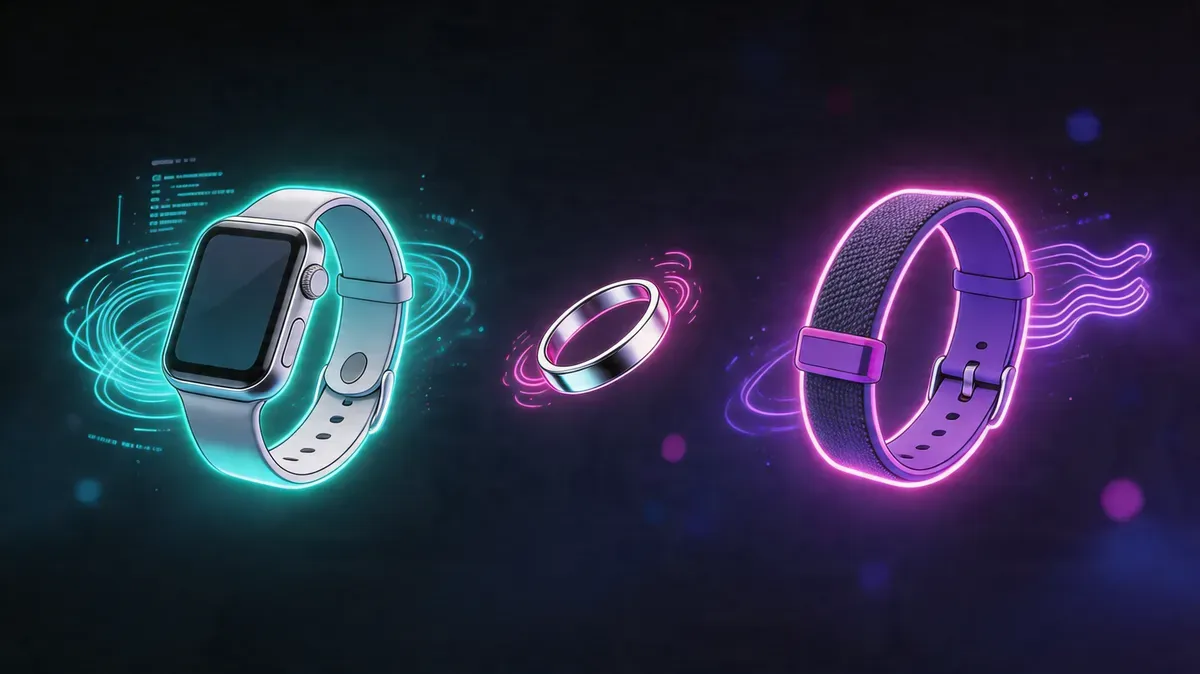
Three wearables have taken over the longevity conversation: Apple Watch, Oura Ring, and Whoop. They all promise to track the signals that matter for aging — heart rate variability, resting heart rate, sleep, recovery — but the way each gets there is very different.
The choice matters more than the marketing suggests. Sensor location, battery, ecosystem, and what the app actually does with your data all shift the experience dramatically. If you want a wearable that supports biological age tracking and long-term healthspan decisions, the right pick depends less on which brand is loudest and more on how you want to engage with the data.
This guide compares the three head-to-head for longevity use: what each measures, how accurate it is, what it costs, and which one fits which user.
What you’ll learn:
- How each device measures the signals that matter for aging
- Accuracy trade-offs between wrist, finger, and arm sensors
- Which ecosystem supports biological age tracking best
- Who should choose which, with clear recommendations
Why wearable choice matters for longevity
Biological age and healthspan are driven by a handful of measurable signals: heart rate variability, resting heart rate, VO2 max, sleep quality, mobility, and recovery capacity. Every major consumer wearable measures at least some of these, but none measure all of them equally well.
Apple Watch is a multi-sensor smartwatch. It covers heart rate, HRV, VO2 max (Cardio Fitness), sleep, blood oxygen, ECG, temperature, walking steadiness, and more. Its data flows into Apple Health, where third-party apps can read from it.
Oura Ring is a finger-worn sensor optimized for sleep, HRV, temperature, and readiness. It does not track fitness or VO2 max directly; it excels at the rest.
Whoop is a screen-less wrist or upper-arm strap that focuses exclusively on strain, recovery, and sleep. There is no clock, no notifications — just a continuous physiological stream, interpreted through Whoop’s app.
Your longevity-tracking experience depends on which of those data models matches how you want to live with the device.
How we compared the three
We judged each wearable on five dimensions relevant to longevity:
- Sensor coverage: how many aging-relevant signals it captures
- Accuracy: how its data compares to lab-grade references — for Apple Watch specifically, see the Apple Watch accuracy breakdown by metric
- Biological age support: whether its ecosystem can produce a biological age score
- Daily usability: does it fit into the way you already live?
- Cost model: one-time purchase, subscription, or both
We excluded generic fitness tracking and step counting, which all three handle adequately.
Quick comparison
| Dimension | Apple Watch | Oura Ring | Whoop |
|---|---|---|---|
| Form factor | Wrist smartwatch | Finger ring | Wrist/arm strap (no screen) |
| HRV | Yes | Yes | Yes |
| Resting HR | Yes | Yes | Yes |
| VO2 max | Yes (Cardio Fitness) | No | No |
| Sleep stages | Yes | Yes (strong) | Yes (strong) |
| Temperature | Yes | Yes | Yes (Whoop 4.0+) |
| Blood oxygen | Yes | Yes | Indirect |
| ECG | Yes | No | No |
| Biological age app | Yes (SuperAge) | Partial (via Apple Health sync) | No native, no SuperAge path |
| Price | From $399 one-time | $299-$499 + $5.99 per month | From $30 per month (hardware included) |
| Ecosystem | Apple Health + third-party | Oura app + Apple Health sync | Whoop app only |
Apple Watch for longevity
Apple Watch is the most complete sensor platform in the category. Heart rate, HRV, VO2 max, sleep, blood oxygen, ECG, temperature, and walking steadiness are all collected, and all of it syncs into Apple Health.
Strengths
- Widest sensor coverage of any consumer wearable
- VO2 max (Cardio Fitness) is one of the strongest single predictors of long-term mortality
- Third-party ecosystem is the largest in the category — including biological age apps like SuperAge
- Medical-grade ECG, irregular rhythm notifications, fall detection
- One-time hardware purchase, no mandatory subscription
Weaknesses
- Wrist-based sensors are less accurate during sleep than ring-based ones
- Battery life is short enough that many users struggle to wear it overnight
- Requires an iPhone
Biological age support. Strong. Apple Health data feeds directly into biological age apps, and the full Apple Watch health features guide covers what signals actually matter.
Best for. iPhone users who want a single device that covers both daily metrics and longevity-grade data, and who are willing to manage charging around sleep.
Oura Ring for longevity
Oura is the sleep-and-readiness specialist. Because the ring sits on the finger, it has an arterial signal rather than a wrist signal — which is why its HRV, resting heart rate, and temperature readings during sleep are widely considered the most accurate in the consumer category.
Strengths
- Best-in-class sleep stage detection and HRV overnight
- Temperature trends useful for circadian and hormonal cycles
- Battery lasts a week — no charging disruption to sleep
- Small, unobtrusive form factor
Weaknesses
- No VO2 max, no fitness tracking beyond activity summary
- Requires a monthly subscription after the hardware purchase
- Data stays mostly inside the Oura app unless you enable Apple Health sync
- Size changes with weight gain or loss require a new ring
Biological age support. Indirect. Oura itself does not produce a biological age score. If you sync to Apple Health, a dedicated biological age app like SuperAge can read Oura’s sleep and HRV data — but Oura alone is not sufficient without fitness signals from another source. The Oura vs Apple Watch health tracking comparison covers the data hand-off in detail.
Best for. Readers who prioritize sleep, recovery, and HRV accuracy and who do not need fitness or VO2 max from the same device. Oura pairs well with Apple Watch for people who want both signals. If you’re evaluating other options, see the best Oura Ring alternatives roundup.
Whoop for longevity
Whoop is the most opinionated of the three. No screen, no notifications, no step goal — just continuous HR, HRV, and sleep data interpreted through the Whoop app’s strain, recovery, and sleep coach.
Strengths
- Strong, continuous HRV and strain scoring
- Hardware is included in the subscription — no upfront hardware sticker shock
- Upper-arm strap option removes wrist-movement noise during sleep
- App interpretation is actively developed and well-designed
Weaknesses
- No VO2 max, no ECG, no blood oxygen
- Data is locked in the Whoop app — limited export to Apple Health
- Subscription is ongoing ($30 per month) with no one-time path
- No biological age score path, native or third-party
Biological age support. Weak. Whoop does not compute biological age and its data does not flow cleanly into Apple Health, which cuts off the third-party biological age app path. If biological age is your goal, Whoop is the weakest of the three on that specific axis.
Best for. People who want recovery-driven training guidance and are comfortable staying inside the Whoop ecosystem. If Whoop does not fit, the Whoop alternatives roundup covers what moves to next.
Which ecosystem supports biological age best?
This is where the three diverge most sharply.
Apple Watch + SuperAge is the cleanest path. Apple Watch captures the widest range of aging-relevant signals (including VO2 max, which Oura and Whoop both skip), Apple Health stores them, and SuperAge translates them into a biological age score. No data silos.
Oura + Apple Health + SuperAge is a partial path. Oura’s sleep and HRV data is excellent and can be read via Apple Health sync, but the missing VO2 max means the biological age score will be less complete unless you also generate fitness data from another source (typically Apple Watch or a Garmin).
Whoop is the hardest path. Data export is limited, there is no biological age engine native to the Whoop app, and there is no clean way to feed Whoop’s signals into a biological age calculator.
If a biological age number is a priority, Apple Watch — standalone or paired with Oura — is the stronger starting point. For a full comparison of every biological age app in 2026, including blood-based and epigenetic options, see the dedicated roundup.
How the three pair together
A lot of serious longevity users end up with more than one of these. Common combinations:
- Apple Watch + Oura: Apple Watch during the day for fitness and ECG, Oura at night for best-in-class sleep and HRV. The cleanest longevity stack if budget allows.
- Apple Watch alone: Adequate for most users, with SuperAge handling the biological age layer. Sleep tracking on Apple Watch is very good in 2026, just not ring-level.
- Whoop alone: Fine for recovery-focused training, but expect compromises on broader longevity tracking.
Pairing with a biological age app matters more than pairing devices. A single wearable + SuperAge beats three wearables with no aging-specific layer on top.
Frequently asked questions
Which is most accurate for HRV?
For overnight HRV, Oura is widely considered the most accurate of the three because of its finger-based arterial signal. Apple Watch and Whoop are close behind but both use wrist-based sensors, which can be noisier during sleep.
Which is best if I only want one device?
Apple Watch. It captures the widest sensor set, integrates with the largest third-party ecosystem, has medical-grade ECG and irregular rhythm detection, and supports biological age tracking through apps like SuperAge.
Is Whoop worth the subscription for longevity?
If your goal is biological age or healthspan tracking specifically, no — the data path is limited and there is no biological age engine. If your goal is recovery-driven training and you are fine with a closed ecosystem, Whoop delivers what it promises.
Can Oura Ring replace Apple Watch for longevity?
Not fully. Oura is excellent at sleep, HRV, and temperature but does not cover VO2 max or daytime fitness. For a complete biological age picture, Oura needs to be paired with a fitness signal from another device.
Do any of these give me an actual biological age score?
None of the three has a native biological age output. Apple Watch data (and Oura data via Apple Health sync) can feed a third-party biological age app like SuperAge. Whoop data cannot, because it does not export cleanly into Apple Health.
Key takeaways
- Apple Watch is the most complete longevity sensor — widest coverage, best third-party ecosystem, strongest biological age support.
- Oura is the sleep, HRV, and temperature specialist — pairs well with Apple Watch but cannot replace it for fitness signals.
- Whoop is the recovery-and-strain specialist — strong for training, weak for biological age due to closed data model.
- Pick your biological age app before your wearable — the biological age layer determines what “good data” means.
- Apple Watch + SuperAge is the cleanest one-device longevity stack in 2026.
Start tracking your biological age today
The device on your wrist or finger is only half the system. The other half is the app that turns its data into a biological age signal you can actually act on.
Ready to see your biological age from your wearable data? Download SuperAge and connect your Apple Watch (and Oura via Apple Health) to get your score from the signals you are already generating.
References
- Chen, L. et al. — “Validation of Apple Watch for cardiorespiratory fitness estimation.”
- Miller, D. J. et al. — “Oura Ring HRV and sleep stage validation against polysomnography.”
- Berryhill, S. et al. — “Effect of wearable fitness trackers on sleep and activity.”
- Shaffer, F. & Ginsberg, J. — “An Overview of Heart Rate Variability Metrics and Norms.”
Last updated: 2026-04-15. This article is regularly reviewed to ensure accuracy.
Related Articles

Biological age after retirement: what changes and what to track
Biological age after retirement can improve or drift. Learn which activity, sleep, social, fitness, and blood markers to track when work structure disappears.