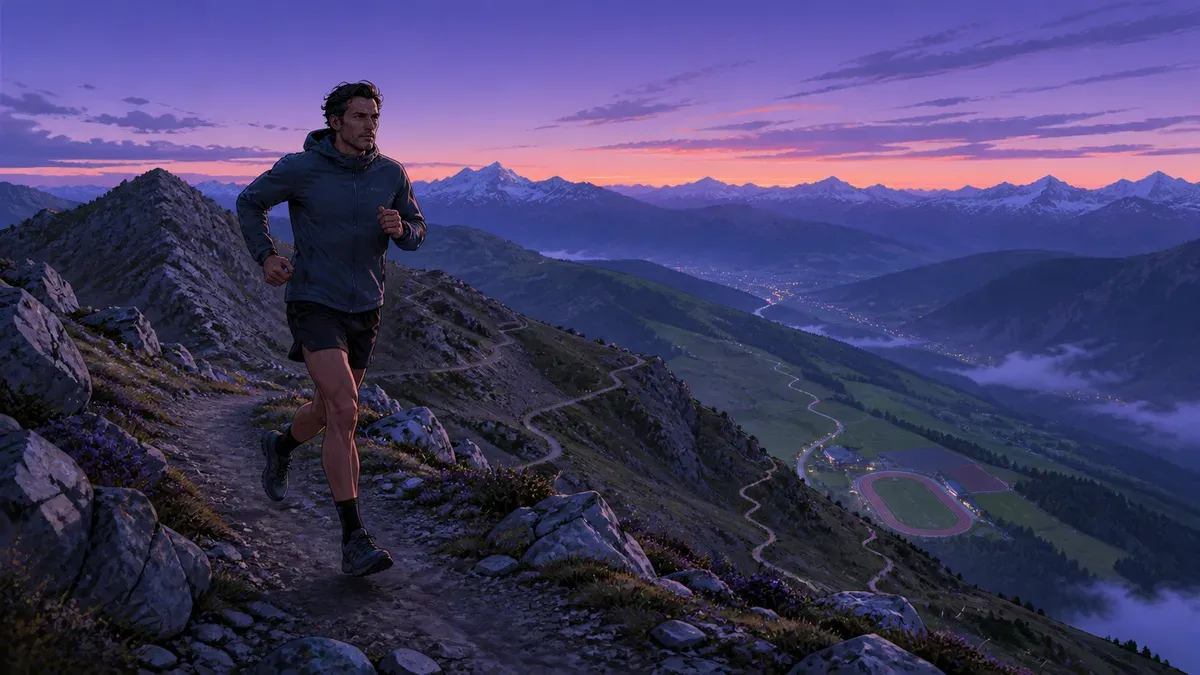
Altitude training for runners: adapt without losing fitness
Altitude training for runners may improve oxygen delivery, but results vary. Learn the dose, iron checks, pacing changes, risks, and return timing.
Altitude training can help some trained runners improve oxygen-carrying capacity, but it is not a guaranteed shortcut to a faster race. The useful version is a controlled training block: enough hypoxic exposure to stimulate adaptation, easy enough running to preserve recovery, adequate iron and energy, and a clear plan for returning to sea level.
Quick answer
Quick answer: Most successful research protocols expose trained endurance athletes to moderate altitude for roughly three to four weeks while protecting workout quality. Benefits vary widely. A runner can gain hemoglobin mass yet show no performance improvement, especially when sleep, iron, fueling, illness, or training intensity deteriorates.
This guide separates altitude physiology from altitude marketing. It explains what changes, what may not change, how the main models differ, and how to plan a conservative camp without treating a smartwatch or pulse oximeter as medical clearance.
Key facts
- Reduced oxygen pressure stimulates erythropoietin, which can support new red-blood-cell production when iron and energy are available.
- Moderate-altitude residence increases hypoxic dose, while lower-altitude training can preserve speed and mechanical quality.
- Altitude lowers absolute running capacity, so sea-level pace targets can turn an easy session into excessive stress.
- Individual response varies substantially, and a higher hemoglobin mass does not guarantee a faster time trial.
- Headache plus worsening neurologic or breathing symptoms requires action, not a harder training session.
What altitude training actually means
Altitude training is planned exercise or residence in an environment where lower barometric pressure reduces the partial pressure of inspired oxygen. The percentage of oxygen in the air is still about 20.9%; fewer oxygen molecules enter each breath because the surrounding pressure is lower.
For endurance training, “moderate altitude” often means about 6,500–8,200 ft (2,000–2,500 m). There is no single magic elevation. The same sleeping height can be a manageable stimulus for one runner and an excessive stressor for another, depending on prior exposure, health, iron status, sleep, training history, and the speed of ascent.
The performance problem is immediate: oxygen delivery falls before adaptation catches up. A review of elite-athlete physiology notes that maximal oxygen uptake can drop progressively with increasing elevation, which makes the same absolute pace more demanding (Wehrlin and Hallén). This is why “train exactly as hard as at home” is usually the wrong opening strategy.
Altitude training is also different from travel safety. A runner may be fit enough to complete a workout and still develop acute mountain sickness. Read the separate altitude sickness and acclimatization guide for ascent planning, AMS, HACE, HAPE, and descent decisions.
The adaptation chain: signal, mechanism, outcome
The attractive story is simple: less oxygen produces more red blood cells, which produce faster running. Real physiology has more links—and more places where the chain can break.
1. Hypoxia creates the signal
The kidneys sense reduced oxygen availability and increase erythropoietin, or EPO. In a classic live-high/train-low study of elite runners, EPO was nearly twice the sea-level value after 20 hours at altitude, then the response evolved over the following weeks (Stray-Gundersen et al.). An early EPO rise is a signal, not proof of a completed adaptation.
2. The bone marrow needs raw materials
Making hemoglobin requires iron, amino acids, energy, and time. Low iron availability can blunt erythropoiesis even when the hypoxic signal is strong. The Australian Institute of Sport advises screening iron status 8–12 weeks before a planned altitude block so that depletion can be assessed and treated under qualified care rather than guessed at during camp (AIS iron guidance).
Do not self-prescribe high-dose iron because a camp is approaching. Ferritin can be affected by inflammation, and excess iron has risks. A clinician or sports dietitian can interpret a complete blood count, ferritin, transferrin saturation, symptoms, diet, menstrual blood loss, and recent training together. Our ferritin and iron guide explains why one number is not the whole diagnosis.
3. Hemoglobin mass may increase
An individual-data meta-analysis of 17 altitude studies estimated that hemoglobin mass rose by about 1.1% per 100 hours of exposure, with wide individual prediction limits. The pooled post-altitude estimate remained about 3.3% above baseline for up to 20 days, but not every athlete responded the same way (Gore et al.).
This is total hemoglobin mass, not merely a higher hemoglobin concentration caused by lower plasma volume. Dehydration can concentrate the blood without creating more oxygen-carrying tissue.
4. Performance may—or may not—follow
The original randomized live-high/train-low experiment found that four weeks of residence near 8,200 ft (2,500 m), with training lower down, improved a 5 km time trial in trained runners while the live-high/train-high and sea-level groups did not show the same race result (Levine and Stray-Gundersen). Later research has been less uniform.
A 2023 meta-analysis reported favorable average effects on VO2 max and hemoglobin, particularly around three weeks near 8,200 ft (2,500 m), but pooled estimates combine different athletes and protocols (Wang et al.). In contrast, a double-blind crossover study found no performance benefit from six weeks of simulated live-high/train-low exposure in highly trained triathletes (Siebenmann et al.). A 2025 study in elite cyclists found that a camp increased total hemoglobin mass, yet the gain decayed quickly after return and did not improve measured performance (Rønnestad et al.).
The honest conclusion is not “altitude works” or “altitude does not work.” It is: a sufficient exposure can improve oxygen transport on average, but the performance effect is small, context-dependent, and individually uncertain.
Live high/train high vs live high/train low
The model determines which compromise you accept.
| Model | Where you live | Where you train | Main advantage | Main limitation |
|---|---|---|---|---|
| Live high, train high | Moderate altitude | Moderate altitude | Simple logistics and continuous exposure | Quality sessions slow; total stress can rise |
| Live high, train low | Moderate altitude | Lower altitude | Preserves faster workouts while retaining exposure | Travel and recovery logistics are harder |
| Live high, base high, intervals low | Moderate altitude | Easy work high, quality work low | Separates aerobic volume from speed quality | Requires careful scheduling and access |
| Live low, train high | Low altitude | Hypoxic room or higher terrain | Convenient, smaller residence burden | Usually a lower total hypoxic dose |
| Intermittent hypoxic exposure | Low altitude | Short passive or exercise exposures | Highly controllable | Evidence and protocols are heterogeneous |
For a serious endurance runner, live high/train low has the clearest historical rationale: accumulate a meaningful sleeping dose while preserving interval velocity and oxygen flux. A 2023 review found that published protocols vary substantially, so the label alone tells you little without altitude, hours per day, duration, training load, and adherence (Bonato et al.).
Recreational runners should not imitate an elite camp merely because the model has research support. If travel stress, work, childcare, poor sleep, or limited access to lower training terrain makes the protocol fragile, a well-executed sea-level block may produce more fitness at lower cost.
Who is most likely to benefit?
Altitude training is most defensible for a healthy, experienced endurance runner who already tolerates consistent volume, has a defined event goal, can spend at least several weeks at moderate altitude, and has coaching or sports-medicine support.
It is less compelling when:
- basic training consistency is still the main limiter;
- the available stay is only a few nights;
- iron deficiency, illness, underfueling, or poor sleep is unresolved;
- every key workout must be completed at the sleeping altitude;
- travel adds more fatigue than the camp can absorb;
- the athlete expects a guaranteed personal best;
- the goal is general health rather than small competitive gains.
Most trials involve trained or elite athletes. Applying their average response to a first-time runner is an inference, not established evidence. If your main opportunity is still aerobic development, the fundamentals in how to improve VO2 max and a consistent running economy program usually deserve priority.
A conservative 21-day altitude block
This example is a planning framework, not a prescription. It assumes an experienced runner has already completed medical and iron screening, reaches moderate altitude without symptoms, and can reduce or relocate quality sessions. English measurements are Imperial first, with Metric equivalents.
| Phase | Exposure and training | Decision rule |
|---|---|---|
| Days 1–3 | Arrive near 6,500–8,000 ft (2,000–2,450 m). Easy runs only; reduce normal duration by roughly 20–30%. | Stop ascent and reduce training if headache, nausea, unusual fatigue, dizziness, or poor coordination develops. |
| Days 4–7 | Restore easy volume gradually. Add short relaxed strides only if sleep, appetite, and symptoms are stable. | Keep intensity based on effort, not sea-level pace. |
| Days 8–14 | Maintain easy volume. Complete one controlled threshold-oriented session lower down when possible; keep long run conservative. | Abandon the quality session if pace requires disproportionate breathing or form deteriorates. |
| Days 15–19 | Repeat only the training pattern already tolerated. Do not add volume and intensity together. | A stable response beats a heroic final week. |
| Days 20–21 | Reduce load and prepare for travel. Avoid a last-minute test workout. | Leave with fitness intact, not with accumulated illness or soreness. |
Three weeks is near the lower edge of many successful research blocks, and more exposure is not automatically better. The important variables are sleeping altitude, hours of exposure, training quality, recovery, and individual response. A recent small study of well-trained runners found similar performance improvement after three weeks of structured simulated-altitude training with different residence strategies, underlining that training design itself matters (Soo et al.).
Adjust pace before you adjust effort
At altitude, a familiar sea-level pace can require a higher fraction of VO2 max. Use the talk test, breathing, perceived exertion, and mechanics to control easy running. Heart rate can provide context, but acute altitude, dehydration, heat, caffeine, sleep loss, and anxiety can all shift it.
For quality sessions, reduce pace or extend recovery. Protect the purpose of the workout. Threshold work should still feel controlled; an easy run should not quietly become tempo. The training-load curve is useful here: altitude is an added stressor even when mileage is unchanged.
Fuel the adaptation
Appetite may fall just when energy demand rises. In a randomized dietary study during a three-week camp at 7,600 ft (2,320 m), elite endurance athletes increased energy, carbohydrate, iron-rich food, and fluid intake; the study supports planning food availability rather than relying on hunger alone (Koivisto-Mørk et al.).
Build each training day around adequate carbohydrate, regular protein, iron-rich foods, and normal hydration. Do not force excess water: overhydration can create its own danger and does not prevent altitude illness. Our hydration guide explains why urine color, thirst, environment, and workload should be interpreted together.
If the camp supports a steep technical mountain race, altitude is only one layer of preparation. Use the skyrunning training guide to integrate climbing, descending, terrain skill, fueling, equipment, and route-safety decisions without confusing hypoxic exposure with complete race readiness.
Safety gates before and during the camp
The Wilderness Medical Society notes that unacclimatized people are at risk above roughly 8,200 ft (2,500 m), while susceptible people can become ill lower down. Gradual increase in sleeping elevation is a strong recommendation; fitness does not cancel the risk (WMS 2024 guidelines).
Get individualized medical advice before altitude training if you have significant heart or lung disease, uncontrolled blood pressure, severe anemia, a prior HAPE or HACE episode, pregnancy, recent serious illness, or marked exercise limitation. Medication decisions belong with a clinician; acetazolamide is not a training enhancer and can affect exercise sensations.
Pregnancy changes both ordinary exercise decisions and altitude planning. Start with the pregnancy exercise safety guide and obtain individual advice before adding hypoxic exposure or travel risk.
Stop training and reassess when
- a headache appears with nausea, dizziness, or unusual weakness after ascent;
- symptoms worsen at rest or after sleep;
- coordination, judgment, or gait changes;
- breathlessness occurs at rest;
- a cough, chest tightness, or falling exercise tolerance progresses;
- resting recovery markers shift sharply alongside symptoms.
Do not ascend with active altitude symptoms. Severe breathlessness at rest, confusion, inability to walk a straight line, or rapidly worsening symptoms are emergencies; descend and seek medical help. A normal wrist oxygen reading does not overrule symptoms.
Track response without turning data into a diagnosis
A simple daily log is more useful than chasing one “altitude score.” Record:
- sleeping elevation and total exposure hours;
- run duration, terrain, effort, and pace;
- morning resting heart rate and your personal HRV trend;
- sleep duration and perceived sleep quality;
- appetite, body-mass trend, and hydration context;
- headache, nausea, dizziness, cough, and unusual fatigue;
- session completion and any pace reduction.
Use a wearable for trends, not clearance. Wrist SpO2 is sensitive to movement, fit, skin temperature, perfusion, and low-saturation conditions. HRV also changes with training load, sleep, illness, alcohol, and travel. The best interpretation combines symptoms, subjective recovery, training quality, and multi-day trends—similar to the approach in our guide to reading HRV over time.
How SuperAge fits after the fundamentals
Once the training and safety plan is in place, SuperAge can organize Apple Watch trends into a consistent review: resting heart rate, HRV, sleep, cardio fitness, training sessions, and recovery context. That can help you notice when an altitude block is preserving adaptation or accumulating strain.
The app cannot diagnose altitude illness, iron deficiency, dehydration, or pulmonary edema. Its useful role is narrower: keep your baseline visible, make day-to-day changes easier to compare, and give you a structured record to discuss with a coach or clinician.
If HRV falls while resting heart rate rises, sleep deteriorates, appetite drops, and easy effort feels harder for several days, treat the pattern as a reason to reduce load and investigate—not as proof that you need a harder stimulus.
Review your training trends with SuperAge
If you use an Apple Watch, download SuperAge on the App Store to keep recovery and fitness trends in one place before, during, and after a camp. Use the record to support decisions with your coach or clinician; never use it to override altitude symptoms.
Returning to sea level and choosing race timing
There is no universally reliable “best day” to race after altitude. Blood volume shifts, neuromuscular sharpness, sleep, travel, and hemoglobin-mass decay do not follow the same clock. Research protocols have tested athletes immediately, after roughly a week, and later, with mixed results.
Plan the return as an experiment:
- Use a previous camp or low-priority event to learn your response.
- Keep the first one or two sea-level sessions controlled; familiar pace may suddenly feel easy enough to overdo.
- Schedule one race-specific rehearsal after travel fatigue settles.
- Avoid changing shoes, fueling, taper, and altitude-return timing simultaneously.
- Compare performance with the same course, conditions, and pre-camp fitness whenever possible.
If the competition itself is at altitude, acclimatization is a different objective. A randomized study of collegiate runners found that athletes living closer to a 5,840 ft (1,780 m) competition altitude performed better early than groups living higher, while those higher groups needed up to 19 days to reduce the initial decrement (Chapman et al.). Match the plan to the race environment, not just the idea of “more altitude.”
Altitude training decision checklist
Before booking a camp, answer these questions:
- Is my goal competitive endurance performance rather than general fitness?
- Have I trained consistently enough that small gains matter?
- Can I stay long enough to accumulate a meaningful exposure?
- Can I preserve easy running and relocate some quality work lower down?
- Have iron status, health risks, and recent illness been reviewed early enough?
- Is there a nutrition, sleep, and symptom-monitoring plan?
- Do I know what will make me reduce training, stop ascent, or descend?
- Is the expected benefit worth the cost and travel stress?
If several answers are no, sea-level consistency is likely the higher-return intervention. Altitude should refine a strong program, not replace one.
Frequently asked questions
How high should runners sleep for altitude training?
Many endurance protocols use roughly 6,500–8,200 ft (2,000–2,500 m), but there is no universal ideal. Prior altitude history, symptoms, iron status, hours of exposure, and the ability to preserve training quality matter as much as the number.
How long does an altitude training camp need to be?
Research with hematological benefits commonly uses about three to four weeks. Shorter stays may improve acclimatization or provide a training experience, but they are less likely to deliver the same total hypoxic dose.
Is live high/train low better than live high/train high?
Live high/train low can preserve faster workout quality while maintaining a residential hypoxic stimulus. It is not automatically superior for every athlete because travel, access, sleep, adherence, and total training load can erase the theoretical advantage.
Will altitude training increase VO2 max?
It may. Pooled studies report average improvements, but individual trials and athletes show variable results. A rise in hemoglobin mass can occur without a meaningful increase in VO2 max or race performance.
Do I need iron supplements before altitude training?
You need iron assessment, not automatic supplementation. The appropriate decision depends on blood tests, symptoms, diet, inflammation, menstrual losses, and medical history. Use clinician or sports-dietitian guidance.
Should I run by pace or heart rate at altitude?
Start with effort, breathing, talk test, and mechanics. Use heart rate as supporting context. Sea-level pace targets often make altitude sessions too hard, while heart rate itself can shift with dehydration, sleep loss, heat, and stress.
Can a pulse oximeter tell me whether it is safe to train?
No. A reading can add context, but symptoms and clinical red flags take priority. Consumer wrist sensors are not designed to clear an athlete for ascent or rule out altitude illness.
When should I race after returning to sea level?
There is no single evidence-based window for everyone. Test your response in lower-priority settings, allow travel fatigue to settle, and avoid changing several race-preparation variables at once.
Key takeaways
- Altitude training is a dose-and-recovery problem, not a guaranteed performance hack.
- Moderate-altitude residence can increase hemoglobin mass, but individual and race responses vary.
- Live high/train low protects workout quality when logistics make it practical.
- Iron screening should happen weeks before camp; supplementation requires qualified guidance.
- Pace must be adjusted to effort, and early training load should be conservative.
- Symptoms override wearable data; worsening neurologic or breathing signs require descent and medical help.
- A structured sea-level program is better than a poorly recovered altitude block.
References
- Levine BD, Stray-Gundersen J. Living high-training low: effect of moderate-altitude acclimatization with low-altitude training on performance. Journal of Applied Physiology. 1997.
- Stray-Gundersen J, Chapman RF, Levine BD. Living high-training low altitude training improves sea-level performance in elite runners. Journal of Applied Physiology. 2001.
- Gore CJ, et al. Altitude training and haemoglobin mass determined by meta-analysis. British Journal of Sports Medicine. 2013.
- Bonato G, Goodman S, Lathlean T. Physiological and performance effects of live high-train low. Current Research in Physiology. 2023.
- Wang C, et al. Effect of altitude training on aerobic capacity: systematic review and meta-analysis. 2023.
- Siebenmann C, et al. Performance after normobaric live high-train low: double-blind crossover study. European Journal of Applied Physiology. 2017.
- Rønnestad BR, et al. Haematological adaptations to high-altitude and heat acclimation training. Experimental Physiology. 2025.
- Luks AM, et al. Wilderness Medical Society clinical practice guidelines for acute altitude illness: 2024 update. Wilderness & Environmental Medicine. 2024.
- Australian Institute of Sport. Iron: how and when do I use it?. Accessed August 2026.
- Koivisto-Mørk A, et al. Dietary adjustments to altitude training in elite endurance athletes. Frontiers in Sports and Active Living. 2020.
- Chapman RF, et al. Living altitude influences endurance performance change over time at altitude. Journal of Applied Physiology. 2016.
- Soo J, et al. Three weeks of base training at moderate simulated altitude. PeerJ. 2024.
This article is educational and is not medical advice. Altitude illness can progress rapidly. Seek individualized guidance for health conditions, medications, iron treatment, pregnancy, prior severe altitude illness, or symptoms during ascent.
Related Articles

Running form drills: technique, cues, and a 10-minute routine
Running form drills can sharpen rhythm and coordination. Learn seven drills, clear cues, common mistakes, and a progressive 10-minute routine for runners.