Alcohol and biological aging: What the research actually shows
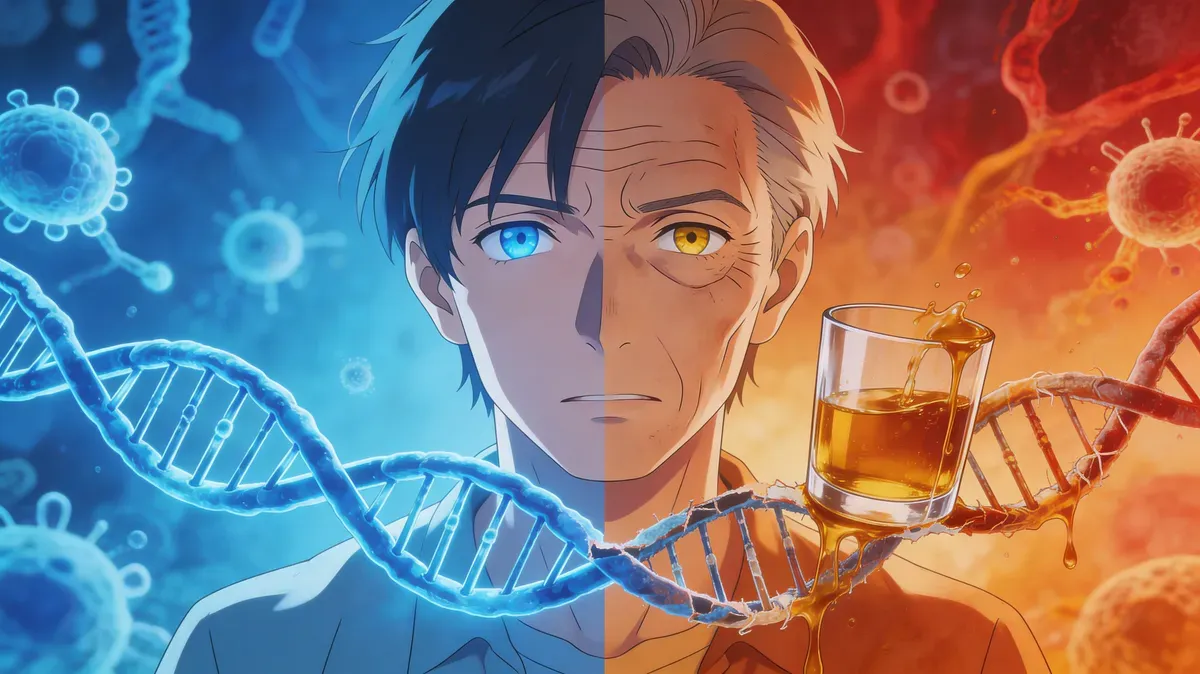
Alcohol and biological aging: how drinking affects telomeres, epigenetic clocks, liver markers, sleep, and the newer evidence on moderate drinking.
Quick answer
Alcohol is best understood as a dose-dependent biological-aging stressor, not a longevity supplement. Higher intake is associated with shorter telomeres, less favorable methylation-age signals, liver-marker changes, and disrupted sleep; current public-health sources do not identify a risk-free level, although absolute risk varies by age, health status, and drinking pattern.
Key facts
- Alcohol -> acetaldehyde -> DNA adducts, oxidative stress, and impaired repair.
- Alcohol exposure -> shorter leukocyte telomeres in UK Biobank, with the strongest genetic evidence at heavier intake.
- Alcohol use -> GrimAge and related methylation signals -> less favorable biological-aging and mortality-risk profiles in several cohorts.
- Alcohol near bedtime -> REM disruption, fragmented second-half sleep, and next-day autonomic strain.
- Lower intake or abstinence -> improved liver enzymes, HRV, and sleep quality over weeks for many people.
The idea that moderate drinking is good for your heart was, for decades, one of the most widely cited findings in nutritional epidemiology. The J-curve. Red wine and resveratrol. The Mediterranean lifestyle. It became cultural shorthand for guilt-free enjoyment — a health permission slip backed by what appeared to be solid science.
That permission slip is being narrowed. A wave of rigorous studies using a method called Mendelian randomization — which reduces the confounding that plagued earlier observational research — has substantially weakened the case for moderate alcohol’s cardiovascular benefits. And simultaneously, a separate body of research focused on biological aging rather than disease endpoints has produced findings that are difficult to ignore: alcohol, especially with regular or heavier exposure, is associated with faster aging signals at the cellular, liver, sleep, and methylation levels.
This is not a temperance argument. It is a longevity argument, built on the specific mechanisms through which ethanol and its metabolites interact with the biology of aging.
What you’ll learn:
- What the research on alcohol and biological aging actually shows
- The science: how alcohol ages you at the cellular level
- Telomere shortening: quantifying alcohol’s aging effect
- Epigenetic clocks and alcohol consumption
- Effects on the liver: GGT, AST/ALT, and beyond
- Alcohol and sleep: the disrupted recovery cycle
- The moderate drinking myth: what Mendelian randomization revealed
- 6 practical strategies for reducing alcohol’s aging impact
- How to monitor alcohol’s effects on your biological age
- How SuperAge quantifies the aging cost of alcohol
- Frequently asked questions
Related context: The mechanisms of aging: a complete guide to why we age · How to prepare for a longevity blood test so results are useful · Adenosine and sleep: The molecule that controls why you feel tired.
What the Research on Alcohol and Biological Aging Shows
Before diving into mechanisms, let’s establish what the research actually demonstrates. Multiple independent lines of evidence — using fundamentally different methodologies — now converge on the same conclusion: alcohol consumption is associated with accelerated biological aging in a dose-dependent manner.
Quick summary: Alcohol is linked to biological aging through at least four pathways: telomere shortening, DNA methylation signals, liver damage, and sleep architecture disruption. The clearest effects appear with regular heavier intake, while lower intake still carries non-zero risk that depends on age, baseline health, and drinking pattern.
Key findings from the literature
| Metric | Effect of alcohol | Population studied |
|---|---|---|
| Telomere length | 32 units/week associated with ~3 years shortening equivalent | UK Biobank, n > 245,000 |
| PhenoAge/KDM | Less favorable biomarker-age profiles in heavier drinkers; estimates vary | Population cohorts |
| GrimAge / methylation signals | Most consistent alcohol-related epigenetic-aging signal | Multiple cohorts |
| DunedinPACE (pace of aging) | Useful pace-of-aging measure; alcohol-specific evidence is still emerging | Validation cohorts |
| Liver enzymes (GGT, AST, ALT) | Dose-dependent elevation | Universal finding |
| Sleep architecture | REM suppression and second-half sleep fragmentation after evening alcohol | Multiple sleep lab studies |
The Science: How Alcohol Ages You at the Cellular Level
Alcohol — ethanol (CH₃CH₂OH) — is a simple molecule with complex biology. When metabolized in the liver, it generates acetaldehyde, one of the most potent genotoxic compounds the human body regularly encounters. It is acetaldehyde, not ethanol itself, that is responsible for many of alcohol’s aging effects.
The oxidative stress cascade
The primary metabolic pathway for alcohol is:
Ethanol → Acetaldehyde → Acetate
The first step, catalyzed by alcohol dehydrogenase (ADH), generates acetaldehyde. The second step, catalyzed by aldehyde dehydrogenase (ALDH2), converts acetaldehyde to acetate. Both steps generate NADH, shifting the liver toward a highly reductive metabolic state that impairs fat oxidation and promotes fat synthesis.
Crucially, acetaldehyde:
- Binds to DNA, forming acetaldehyde-DNA adducts that cause strand breaks and mutations
- Binds to proteins, impairing enzyme function and triggering immune responses
- Depletes glutathione — the liver’s primary antioxidant — by consuming it in detoxification reactions
- Generates reactive oxygen species (ROS) through CYP2E1, the alternative alcohol-metabolizing enzyme induced by chronic drinking
The result is a sustained elevation in oxidative stress that damages mitochondria, accelerates cellular senescence, and impairs the DNA repair machinery that would otherwise correct damage.
Folate and methylation disruption
Alcohol directly interferes with folate absorption in the small intestine and accelerates folate excretion in the kidneys. Since folate is the primary methyl donor for DNA methylation — the epigenetic mechanism underlying most epigenetic clock advancement — alcohol’s disruption of folate metabolism provides a direct mechanistic link between drinking and epigenetic aging.
Alcohol also impairs SAMe (S-adenosylmethionine) synthesis in the liver. Since SAMe is the universal methyl donor, its depletion by chronic alcohol use creates broad methylation deficits affecting gene expression, neurotransmitter metabolism, and antioxidant (glutathione) production simultaneously.
Inflammation: the chronic background fire
Chronic alcohol consumption activates the innate immune system through a pathway involving:
- Leaky gut: alcohol increases intestinal permeability, allowing bacterial lipopolysaccharide (LPS) — the endotoxin from gut bacteria — to translocate into the portal circulation
- Kupffer cell activation: liver macrophages (Kupffer cells) encounter LPS and produce TNF-α, IL-1β, and IL-6 — the core pro-aging inflammatory cytokines
- Elevated hsCRP: chronic drinkers show dose-dependent elevation in systemic inflammatory markers
This chronic, low-grade inflammation is one of the primary drivers of all epigenetic clocks — making alcohol a direct accelerator of inflammaging (inflammation-driven biological aging).
Telomere Shortening: Quantifying Alcohol’s Aging Effect
Telomeres are the protective caps at the ends of chromosomes — repetitive DNA sequences that shorten with each cell division. Their length is considered a measure of cellular aging and replicative capacity. When telomeres become critically short, cells either enter senescence (metabolically active but no longer dividing) or die. Telomere attrition is one of the primary hallmarks of aging.
The UK Biobank data
The largest study to date on alcohol and telomere length analyzed data from more than 245,000 UK Biobank participants. The findings were striking:
- Drinking 32 units of alcohol per week (approximately 4 standard US drinks per day, or just over 1 liter of wine per day) was associated with telomere shortening equivalent to approximately 3 years of biological aging
- The relationship was dose-dependent — even lower drinking levels showed measurable telomere effects
- The association remained significant after adjusting for smoking, BMI, socioeconomic status, and other confounders
- Binge drinking patterns appeared more damaging than the same total alcohol consumed more regularly
The 32-unit threshold in context
32 units/week in UK measures (where 1 unit = 8g alcohol) corresponds to approximately:
- 32 small glasses of beer (13 oz / 375 mL at 4%)
- 32 small glasses of wine (4 fl oz / 125 mL at 12%)
- About 4.5 standard US drinks (14g alcohol each) per day
This level is recognized as heavy drinking by clinical standards, but the dose-response nature of the finding means lower consumption still produces telomere effects proportionally.
Mechanism: acetaldehyde and telomerase
Acetaldehyde directly damages telomeric DNA through two mechanisms:
- Direct adduct formation: acetaldehyde binds to guanine residues in telomeric repeats (TTAGGG), creating structural damage
- Telomerase inhibition: acetaldehyde and reactive oxygen species suppress telomerase activity — the enzyme that repairs and maintains telomere length — impairing the cell’s ability to compensate for telomere attrition
Epigenetic Clocks and Alcohol Consumption
Epigenetic clocks — computational tools that estimate biological age from patterns of DNA methylation across thousands of genomic sites — are among the most sensitive tools for studying biological aging. Alcohol-related signals are clearest for GrimAge and related methylation measures trained on mortality and morbidity; findings for other clocks vary by cohort, drinking definition, and adjustment for smoking, BMI, and socioeconomic factors.
PhenoAge, KDM, and heavy drinking
PhenoAge, one of the most validated biological age algorithms, integrates blood biomarkers into a composite biological age score. Heavier drinking tends to move several PhenoAge and KDM inputs in the wrong direction — liver enzymes, inflammation, glucose control, and albumin status — but the literature does not support one universal “years of aging per drink” conversion.
- Heavy or long-term regular drinking is the clearest risk pattern for worse biomarker-age profiles
- Moderate drinking is harder to interpret because observational studies are vulnerable to healthy-user and former-drinker bias
- Personal tracking is more useful than assuming a fixed population-average penalty: GGT, AST, ALT, hsCRP, glucose, sleep, and HRV show whether your own biology is responding
GrimAge: the mortality-predictive clock
GrimAge is a second-generation epigenetic clock specifically optimized to predict time to death from all causes — and it is even more sensitive to alcohol’s effects. Key findings:
- GrimAge and related methylation markers show some of the most consistent alcohol-associated signals
- Alcohol’s effect on GrimAge is partially mediated through smoking-related methylation patterns (many heavy drinkers also smoke, but the association remains in non-smokers)
- GrimAge captures the biological cost of alcohol’s effects on the liver, immune system, and cardiovascular system simultaneously
DunedinPACE: measuring the speed of aging
DunedinPACE is the newest generation of epigenetic clocks — instead of estimating current biological age, it measures the pace at which a person is aging at the time of measurement. Studies using DunedinPACE have found:
- DunedinPACE is strongly validated as a pace-of-aging biomarker, but alcohol-specific evidence is less mature than the evidence for smoking, obesity, education, and cardiometabolic disease
- It is still a useful tracking endpoint when paired with conventional biomarkers, because it can show whether a broader lifestyle reset is changing the speed of biological aging
- For alcohol specifically, interpret DunedinPACE alongside near-term markers that respond quickly: GGT, AST/ALT, HRV, resting heart rate, and sleep quality
Effects on the Liver: GGT, AST/ALT, and Beyond
The liver is the primary site of alcohol metabolism, and its condition is the most direct biological readout of alcohol’s aging impact. Three liver enzyme markers are particularly informative.
GGT: the most sensitive marker
Gamma-glutamyl transferase (GGT) is the most sensitive biomarker for alcohol consumption — it rises with even modest regular drinking (2–3 drinks/day). As covered in detail in a dedicated GGT article, elevated GGT independently predicts:
- All-cause mortality
- Cardiovascular mortality
- Liver-related mortality
Even within the “normal” range, GGT elevation from alcohol consumption carries measurable cardiovascular risk. GGT is considered by many longevity physicians to be the best functional read-out of cumulative alcohol-related oxidative stress.
AST/ALT ratio: the De Ritis ratio
The AST/ALT ratio (also known as the De Ritis ratio) is a diagnostic tool for differentiating types of liver damage:
- AST/ALT < 1: suggests non-alcoholic fatty liver disease (NAFLD) or viral hepatitis
- AST/ALT > 2: strongly suggests alcoholic liver disease
- AST/ALT > 3: high specificity for alcoholic hepatitis
In alcoholic liver disease, AST rises disproportionately because:
- Alcohol specifically damages mitochondria (where AST is located) more than cytoplasm (ALT’s main location)
- Alcohol depletes vitamin B6 (pyridoxal-5-phosphate), a cofactor required for ALT synthesis — reducing ALT below expected levels
This combination of elevated AST with relatively lower ALT — producing an elevated ratio — is a biochemical fingerprint of alcohol-related liver damage.
The progression of alcoholic liver disease
Alcohol causes liver disease through a predictable progression:
| Stage | Pathology | Reversibility |
|---|---|---|
| Alcoholic fatty liver (steatosis) | Fat accumulation | Fully reversible with abstinence |
| Alcoholic hepatitis | Inflammation + cell death | Partially reversible |
| Alcoholic fibrosis | Scar tissue formation | Partially reversible in early stages |
| Alcoholic cirrhosis | Architectural destruction | Largely irreversible |
The critical insight: the first two stages are fully to largely reversible — and most moderate-to-heavy drinkers are in these stages, not cirrhosis. Reducing or eliminating alcohol produces measurable liver improvement within weeks to months.
Alcohol and Sleep: The Disrupted Recovery Cycle
The relationship between alcohol and sleep is one of the most important — and most misunderstood — aspects of alcohol’s aging biology. Alcohol is widely used as a sleep aid, but its effect on sleep architecture is profoundly damaging.
The two-phase sleep disruption
Alcohol produces a characteristic two-phase disruption of sleep architecture:
Phase 1 (first half of night): Alcohol acts as a sedative, increasing slow-wave sleep (SWS/deep sleep) and reducing sleep onset latency. This is why people fall asleep faster and feel they slept more deeply after drinking.
Phase 2 (second half of night): As alcohol is metabolized and blood ethanol levels fall, a rebound occurs: suppressed REM sleep surges, sleep becomes fragmented, cortisol rises, and arousal increases. This explains the characteristic early morning awakening after drinking, often at 3–4 AM.
The deep sleep suppression effect
Despite the initial deep sleep increase, alcohol consistently reduces total deep sleep (SWS) across a full night when measured by polysomnography:
- Each standard drink consumed within 4 hours of bedtime reduces deep sleep by approximately 7–10%
- Three drinks before bed can reduce total deep sleep by 20–40% across the full night
- This deep sleep suppression impairs the consolidation of declarative memory, growth hormone secretion (which occurs almost exclusively in deep sleep), and cellular repair processes
REM sleep deprivation and biological aging
REM sleep suppression by alcohol has specific consequences:
- Impaired emotional memory processing and stress regulation (REM is critical for emotional consolidation)
- Reduced synaptic pruning and neural plasticity maintenance
- Increased adenosine accumulation (impaired sleep pressure dissipation) leading to next-day cognitive impairment
For a detailed examination of how to protect and improve deep sleep, the mechanisms are largely the same ones damaged by regular alcohol consumption.
The acetaldehyde-circadian clock interaction
Acetaldehyde directly disrupts the molecular circadian clock — the transcription-translation feedback loop that coordinates biological rhythms. This adds a third layer of alcohol’s sleep damage: beyond sedative rebound and REM suppression, alcohol actively desynchronizes the circadian pacemaker, contributing to the fragmented, non-restorative sleep quality reported by regular drinkers.
The Moderate Drinking Myth: What Mendelian Randomization Revealed
The “J-curve” — the observation that moderate drinkers appeared to have lower cardiovascular mortality than abstainers — was one of the most influential findings in 20th-century epidemiology. It shaped medical advice, public policy, and personal behavior for decades.
The problem was confounding. The people who abstained from alcohol in observational studies were not randomly selected from the same pool as moderate drinkers — they included disproportionate numbers of:
- Former heavy drinkers who quit due to health problems (“sick quitter” bias)
- People with chronic illnesses preventing drinking
- Lower socioeconomic status individuals with worse baseline health
When you compare moderate drinkers to truly healthy never-drinkers, the J-curve largely disappears.
Mendelian randomization: a natural experiment
Mendelian randomization uses genetic variants that influence alcohol metabolism as natural randomization instruments. Because a person’s genotype is assigned randomly at conception (before any disease develops), it cannot be confounded by reverse causation or lifestyle factors. The most commonly used variant is the ALDH2 rs671 polymorphism — which reduces aldehyde dehydrogenase activity, making alcohol consumption physically unpleasant (flushing, nausea). People with this variant drink less, providing a natural comparison group.
Results from Mendelian randomization studies are more skeptical of alcohol’s cardiovascular benefit than older observational studies:
- A Lancet Mendelian randomization study of 512,000 Chinese adults (2019) found that genetically predicted alcohol consumption was associated with higher blood pressure and higher stroke risk — no protective J-curve was observed
- A genome-wide association study-based MR in UK Biobank (2022) found that genetically instrumented alcohol consumption was associated with higher risk of coronary artery disease, stroke, and atrial fibrillation, with no protective benefit at any level
- The Global Burden of Disease 2016 analysis concluded that the risk-minimizing level for overall health was zero, while the later GBD 2020 analysis was more age-specific: very low theoretical minimum levels were estimated for young adults, and somewhat higher non-drinker-equivalent levels appeared in older age groups because disease patterns differ by age
The moderate drinking benefit for cardiovascular disease, when it appears in observational studies, is now best treated as uncertain and probably confounded — not as a reliable reason to drink for longevity.
6 Practical Strategies for Reducing Alcohol’s Aging Impact
1. Quantify your actual consumption — honestly
Why it works: Most people underestimate their alcohol consumption by 40–60% when asked to self-report. And standard drink sizes in real-world settings (wine at a restaurant, craft beer at a bar) routinely contain 1.5–2.5 standard drinks in a single serving.
How to do it:
- A US standard drink = 14g pure alcohol = 12 fl oz (355 mL) regular beer (5%), 5 fl oz (148 mL) wine (12%), 1.5 fl oz (44 mL) spirits (40%)
- Track for 2–4 weeks using a log or app to establish your actual baseline
- Calculate your weekly units and compare against the biological aging thresholds
2. Set evidence-based limits — with specific goals
Why it works: Vague intentions (“drink less”) fail at a far higher rate than specific, implementable commitments. Knowing the biological aging thresholds provides meaningful targets.
How to do it:
- If reducing (rather than eliminating): target below 7 drinks per week, with at least 3 alcohol-free days
- Avoid binge drinking (4+ drinks/occasion for women, 5+ for men) — acute high-dose exposure is disproportionately damaging to telomeres and liver
- Never drink within 3 hours of bedtime to protect sleep architecture
3. Protect your liver during alcohol consumption
Why it works: The liver damage from alcohol is driven primarily by acetaldehyde and oxidative stress. Supporting antioxidant capacity and liver health can partially mitigate damage — though it cannot eliminate it, and is not a substitute for reducing consumption.
How to do it:
- Ensure adequate B-vitamin status (B1/thiamine is particularly important — alcohol depletes it rapidly, and severe deficiency causes Wernicke’s encephalopathy)
- Support glutathione production through diet: sulfur-rich vegetables (broccoli, Brussels sprouts, garlic), eggs, quality protein
- Stay well hydrated — alcohol is a diuretic that concentrates acetaldehyde in the body
- Never take acetaminophen (paracetamol) with alcohol — the combination is severely hepatotoxic at doses that would be safe individually
4. Optimize your methylation status
Why it works: Alcohol specifically depletes folate and SAMe — the methylation molecules that underpin epigenetic aging. Supporting methylation health is directly relevant to limiting alcohol’s epigenetic clock advancement.
How to do it:
- Prioritize dietary folate: abundant leafy greens, legumes, asparagus
- Ensure adequate B12 — alcohol impairs B12 absorption over time
- If MTHFR variant is present, use L-methylfolate specifically
- Consider a B-complex particularly if alcohol consumption has been regular and long-term
5. Protect sleep architecture
Why it works: Of all the aging mechanisms of alcohol, sleep disruption may be the most immediately reversible and impactful. Restoring deep sleep quality reverses the hormonal, immune, and cellular repair deficits that alcohol-impaired sleep accumulates.
How to do it:
- Observe a strict 3-hour cutoff between last drink and bedtime
- On drinking occasions, accept that sleep quality will be impaired and plan accordingly (don’t schedule demanding cognitive work the next day)
- If you find you cannot sleep without alcohol (“alcohol dependence for sleep”), seek medical support — this pattern drives both sleep disorder and addiction
- Track your HRV morning after drinking nights vs. alcohol-free nights — the difference will provide powerful personal motivation
6. Use alcohol-free periods as a biological reset
Why it works: The liver has extraordinary regenerative capacity. Alcohol-induced steatosis (fatty liver) is fully reversible within 2–4 weeks of abstinence. GGT levels can drop by 30–50% in 4–6 weeks. Epigenetic changes, while slower to reverse, show measurable improvement with sustained abstinence.
How to do it:
- A 4–6 week complete abstinence period (a “Dry January”- or “Sober October”-style challenge) provides a meaningful biological reset and allows accurate reassessment of your baseline liver enzymes
- Measure GGT, AST, and ALT before and after to quantify the liver benefit — the numbers are motivating
- Use the abstinence period to establish new evening routines that don’t rely on alcohol for relaxation
If kombucha becomes one of those routines, use the kombucha vs alcohol comparison to check its ABV, serving size, sugar, and caffeine; hard kombucha is still alcohol, and a low-ABV option helps only when it replaces an alcoholic drink.
How to Monitor Alcohol’s Effects on Your Biological Age
Recommended monitoring panel
| Biomarker | Target (longevity optimal) | Response to alcohol reduction |
|---|---|---|
| GGT | < 16 U/L | Drops 30–50% within 4–6 weeks of abstinence |
| AST | < 20 U/L | Normalizes within 4–8 weeks |
| ALT | < 20 U/L | Normalizes within 4–8 weeks |
| AST/ALT ratio | < 1.0 | Returns toward < 1.0 as hepatic fat clears |
| MCV (mean corpuscular volume) | 80–90 fL | Normalizes over 3–4 months (red cell turnover is slow) |
| Homocysteine | < 8 μmol/L | Improves with B-vitamin repletion over 8–12 weeks |
| hsCRP | < 1.0 mg/L | Drops 15–25% within 4–8 weeks of abstinence |
| Morning HRV | Age-appropriate; improving trend | Improves measurably within 1–2 weeks of abstinence |
Wearable tracking
Apple Watch provides real-time feedback on two of alcohol’s most immediate biological impacts:
- HRV suppression: resting HRV is measurably lower the morning after drinking — a direct readout of autonomic stress
- Elevated resting heart rate: alcohol-impaired sleep consistently elevates overnight heart rate by 4–8 bpm, detectable in Apple Watch data
Tracking these metrics systematically — comparing drinking nights versus alcohol-free nights — creates a powerful personal feedback loop that no academic paper can replicate.
How SuperAge Quantifies the Aging Cost of Alcohol
One of the most powerful aspects of SuperAge for people examining their relationship with alcohol is its ability to quantify the biological aging cost in objective, personalized terms.
By importing your blood panel — including GGT, AST, ALT, and the full metabolic picture — SuperAge calculates your biological age through validated algorithms including PhenoAge and KDM Biological Age. These algorithms are sensitive to the liver enzyme elevations, inflammatory markers, and metabolic disruptions that alcohol produces. A reduction in alcohol consumption typically produces measurable improvements in biological age scores within 8–12 weeks of monitoring.
The Apple Watch integration provides real-time feedback through HRV and resting heart rate trends — giving you immediate, next-morning data on how last night’s drinking affected your autonomic nervous system recovery. This daily feedback loop is one of the most effective behavioral tools for making the true cost of alcohol consumption personally visible.
Download SuperAge and see what your alcohol consumption is doing to your biological age — in numbers that belong to you, not a population average.
Frequently Asked Questions
Does red wine have special benefits that other alcohol doesn’t?
The resveratrol hypothesis — that red wine’s polyphenol content confers cardiovascular benefits — has largely failed to hold up under rigorous testing. Mendelian randomization studies show no differential benefit for wine vs. other alcohol types. The amounts of resveratrol in a glass of wine (typically 0.1–1 mg) are far below the doses used in laboratory studies (often 50–500 mg). The plant polyphenol benefits of red wine would be better obtained from grape juice, berries, or other polyphenol-rich foods, without the alcohol.
Can the biological aging effects of past drinking be reversed?
Partially. The liver’s regenerative capacity is remarkable — alcoholic steatosis reverses completely with abstinence, and fibrosis in early stages can partially regress. Epigenetic clock advancement from past drinking is more difficult to reverse, but prospective studies following people who reduce or eliminate alcohol show measurable deceleration of epigenetic aging pace. Telomere shortening that has already occurred is largely irreversible, but stopping further attrition prevents continued accelerated aging from this mechanism.
Is there a truly safe level of alcohol consumption?
No public-health body can identify a level that is completely risk-free. WHO states that even low levels carry some risk, and CDC notes that some cancer risks increase with any alcohol use. At the same time, absolute risk depends on age, sex, baseline health, medications, drinking pattern, and the outcome being measured. The honest longevity answer is: less is usually better, binge drinking is clearly worse, and the threshold below which biological-aging cost becomes negligible remains debated.
Does alcohol cause or just accelerate aging?
Both. Alcohol doesn’t cause aging in the sense that abstinent people don’t age — the fundamental biology of aging is independent of alcohol. But alcohol uses the same mechanisms (oxidative stress, DNA damage, methylation disruption, inflammation, sleep impairment) through which aging proceeds, effectively adding fuel to fires that are already burning. It accelerates the pace of aging without changing its direction.
My liver enzymes are normal — does that mean alcohol isn’t affecting my biological age?
Not necessarily. Normal liver enzymes (within lab reference ranges) are a relatively crude and late-stage indicator of liver stress. Epigenetic clock advancement and telomere effects of alcohol occur at consumption levels well below those that would elevate AST or ALT into the abnormal range. GGT is a more sensitive early marker — even modest regular drinking can push GGT above the longevity optimal of 16 U/L while keeping it within the “normal” range. And sleep architecture disruption and HRV suppression occur with a single drink, regardless of liver enzyme status.
Key Takeaways
- Alcohol accelerates biological aging through at least four independent mechanisms: telomere shortening, epigenetic clock advancement, liver enzyme elevation, and sleep architecture disruption
- The biological aging effects are dose-dependent: heavy drinking is associated with telomere shortening, and lower intake should not be treated as biologically neutral
- The moderate drinking cardiovascular benefit is no longer reliable advice: Mendelian randomization and public-health reviews suggest the apparent benefit in older observational studies is likely confounded
- The liver evidence is particularly actionable: GGT, AST, and ALT are highly sensitive to alcohol consumption and highly responsive to reduction — providing measurable feedback within 4–8 weeks
- Sleep disruption from alcohol is immediate and dose-dependent: even one drink before bed measurably reduces deep sleep and elevates next-morning heart rate, detectable in Apple Watch data
- Biological aging effects are partially reversible: abstinence restores liver health, improves HRV, reduces inflammation, and decelerates epigenetic aging pace
Know Your Numbers — Then Make an Informed Choice
This article is not an instruction to eliminate alcohol from your life. It is an argument for knowing the biological cost clearly and making an informed choice with accurate information — rather than one shaped by outdated science or wishful thinking.
Measure your GGT before and after a 4-week abstinence period. Track your HRV on drinking nights versus alcohol-free nights. Calculate your TyG index after adjusting your habits. Let your own data tell you what alcohol is costing you biologically.
That is the only evidence that will ever truly matter to you.
Ready to see the numbers? Download SuperAge and start tracking your biological age — liver markers, epigenetic aging algorithms, HRV trends, and more — all in one place.
References
- Topiwala, A. et al. — “Alcohol consumption and telomere length: Mendelian randomization clarifies alcohol’s effects” — Molecular Psychiatry, 2022.
- Zhao, W. et al. — “Alcohol Consumption and Methylation-Based Measures of Biological Age” — Journals of Gerontology: Series A, 2021.
- Belsky, D.W. et al. — “DunedinPACE, a DNA methylation biomarker of the pace of aging” — eLife, 2022.
- Biddinger, K.J. et al. — “Association of Habitual Alcohol Intake With Risk of Cardiovascular Disease” — JAMA Network Open, 2022.
- GBD 2020 Alcohol Collaborators — “Population-level risks of alcohol consumption by amount, geography, age, sex, and year” — The Lancet, 2022.
- WHO — “Alcohol” fact sheet, updated 2024.
- CDC — “Alcohol Use and Your Health”, updated 2025.
- NIAAA — “What’s a standard drink?” and “Aging and Alcohol”, updated 2025.
- Ebrahim, I.O. et al. — “Alcohol and sleep I: effects on normal sleep” — Alcoholism: Clinical and Experimental Research, 2013.
- Millwood, I.Y. et al. — “Conventional and genetic evidence on alcohol and vascular disease aetiology” — The Lancet, 2019.
Last updated: 2026-06-06. This article is regularly reviewed to ensure accuracy.
Related Articles
The 12 hallmarks of aging explained: What science says drives biological aging
Discover the 12 hallmarks of aging — from genomic instability to dysbiosis — and what current evidence says about lifestyle levers that may influence them.