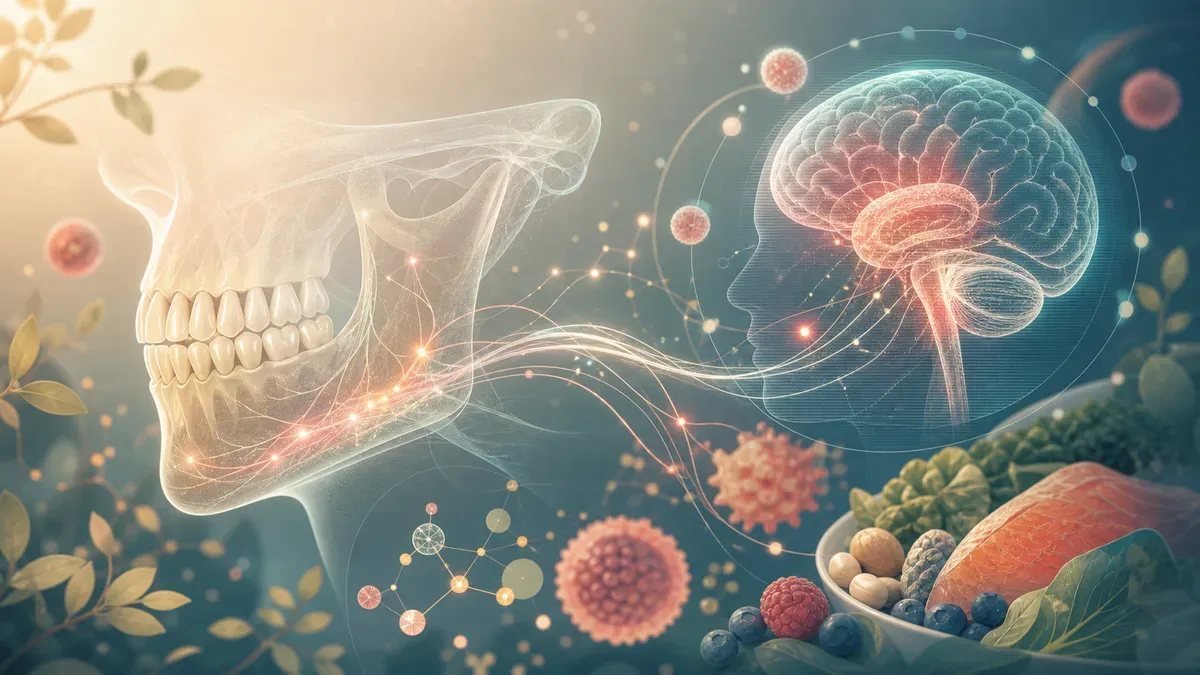
Tooth loss and cognitive decline: what the evidence suggests
Tooth loss and cognitive decline are linked in cohort studies. Learn what the evidence suggests, what it cannot prove, and what to track next.
Tooth loss and cognitive decline are linked in many observational studies, but the link is not simple enough to say that losing teeth directly causes dementia. Missing teeth can reduce chewing function, change diet quality, reflect long-running gum disease, and signal lower access to preventive care. Cognitive decline can also make brushing, flossing, dental visits, and denture care harder, which means the direction can run both ways.
The most useful interpretation is practical: tooth loss is a brain-health flag, not a diagnosis. If an adult is losing teeth in midlife or late life, the question is not only “Can the tooth be replaced?” It is also “What caused the loss, what changed in chewing and nutrition, and what other cognitive-risk signals are present?”
For the broader mouth-body inflammation story, start with oral health and biological age. This article stays narrower: tooth loss, chewing function, cognition, confounding, and what to do without overclaiming.
Quick answer
Tooth loss is associated with higher risk of cognitive decline and dementia in cohort studies, especially when many teeth are missing. The likely pathways are reduced chewing function, lower diet quality, periodontal inflammation, social and access-to-care factors, and reverse causality from early cognitive decline. Treat tooth loss as a reason to protect chewing ability, investigate gum disease, improve nutrition, and monitor cognition, not as proof that dementia is inevitable.
Key facts
- Tooth loss predicts higher cognitive-risk signals in cohort studies.
- Periodontal disease and tooth decay drive most adult tooth loss.
- Chewing function supports diet quality and sensory feedback to the brain.
- Cognitive decline can worsen oral hygiene and dental follow-up.
- Dentures and dental restoration may reduce functional consequences when fitted and used well.
What the evidence says, and what it does not say
Meta-analyses of cohort studies generally find that adults with fewer natural teeth have higher risk of later cognitive impairment or dementia. A 2023 meta-analysis in Frontiers in Neurology concluded that tooth loss was associated with significantly increased risk of cognitive decline and dementia, while emphasizing likely mechanisms such as nutrition, inflammation, and neural feedback.
That sounds strong, but the evidence is still mostly observational. People who lose teeth often differ from people who keep them in many other ways: age, smoking history, diabetes, education, income, dental access, diet, cardiovascular risk, depression, medications, and baseline frailty. Some studies adjust for these factors; none can remove every confounder.
The cautious read is:
| Claim | Evidence strength | Practical meaning |
|---|---|---|
| Tooth loss is associated with cognitive decline | Moderate observational evidence | Worth treating as a risk signal |
| Tooth loss directly causes dementia | Not proven | Avoid deterministic claims |
| Gum disease and inflammation may contribute | Biologically plausible and supported by related evidence | Evaluate periodontal disease, bleeding, pockets, and hs-CRP context |
| Chewing function and diet may matter | Plausible and measurable | Protect nutrition and restore function when possible |
| Dentures or implants prevent dementia | Not established | They may help function, diet, speech, and social participation |
This distinction matters because fear-based oral-health advice can oversell the science. The better frame is: tooth loss clusters with several modifiable brain-aging risks, and the mouth is one place where those risks can become visible.
Why tooth loss could affect cognition
There are four main pathways researchers discuss.
1. Chewing function and brain stimulation
Chewing is not only mechanical. It sends sensory feedback through trigeminal pathways, supports blood flow patterns during eating, and helps maintain normal food variety. When many teeth are missing, especially without well-fitting replacements, chewing becomes slower, less forceful, and more selective.
That can push people away from foods that support brain health: vegetables, legumes, nuts, whole grains, lean proteins, and fibrous foods. The problem is not that one missing tooth changes cognition. The problem is that substantial tooth loss can narrow the diet for years.
2. Nutrition and metabolic risk
Poor chewing function can lead to softer, more processed, lower-fiber diets. That can worsen glucose control, body composition, and inflammation, which are already connected to cognitive aging. If tooth loss leads someone to replace crunchy plants and protein foods with refined carbohydrates, the cognitive-risk pathway may run through metabolism rather than the teeth themselves.
For the nutrition side of brain protection, the MIND diet and brain health guide is a better fit than a dental procedure checklist.
3. Periodontal inflammation
CDC describes periodontitis and cavities as leading causes of tooth loss. Periodontal disease is chronic inflammation and infection around the tissues that support teeth. When it progresses, the gum and bone support breaks down, teeth loosen, and extraction can become necessary.
The mouth-body connection is relevant because chronic periodontal inflammation can raise inflammatory mediators and interact with diabetes, cardiovascular disease, and vascular aging. It overlaps with the broader pattern described in oral health and biological age and oral microbiome, longevity, and mouth inflammation.
4. Reverse causality
Early cognitive decline can reduce oral self-care before a diagnosis is obvious. A person may forget brushing, struggle with flossing, miss dental appointments, use dentures incorrectly, or lose the executive function needed for complex care. In that case, tooth loss is partly an effect of cognitive decline, not only a cause.
This is why tooth loss should be interpreted with other signals: memory changes, medication management, hearing loss, sleep disruption, depression, vascular risk, gait change, and nutrition. If cognitive symptoms are already present, use mild cognitive impairment: early signs and reversibility rather than assuming the dental issue explains everything.
What counts as a concerning pattern?
One extracted tooth after trauma is different from losing several teeth to gum disease. The pattern matters.
| Pattern | Cognitive-risk interpretation | What to ask next |
|---|---|---|
| One missing tooth from injury | Usually not a cognitive signal | Is chewing still normal? |
| Multiple teeth lost to decay | May signal access, diet, dry mouth, or self-care problems | Are cavities recurring? Is saliva low? |
| Teeth lost to periodontitis | Stronger inflammation and systemic-risk signal | Are pockets, bleeding, diabetes, smoking, or hs-CRP present? |
| Rapid new tooth loss in an older adult | Higher concern | Is cognition, medication use, nutrition, or caregiving changing? |
| Full edentulism without functional dentures | Higher functional concern | Can the person chew protein and plant foods? |
| Dentures present but rarely used | Still a chewing-function problem | Are fit, pain, or confidence limiting use? |
The highest-yield question is not “How many teeth are missing?” It is “How much function has been lost, and why?”
What to do first after tooth loss
1. Identify the cause
Ask whether the tooth was lost because of fracture, decay, periodontal disease, trauma, dry mouth, medication effects, or delayed care. The cause determines the prevention plan. If periodontitis is active, replacing teeth without controlling gum disease misses the source.
2. Protect chewing ability
Chewing ability is the functional endpoint. Bridges, dentures, implants, or other dental restoration options should be discussed with a dentist or prosthodontist based on health status, bone support, cost, hygiene ability, and personal goals. The point is not cosmetic perfection. It is being able to eat a brain-supportive diet comfortably.
3. Screen for nutrition drift
Look for quiet dietary changes:
- fewer raw vegetables or salads
- avoiding nuts, seeds, apples, or whole grains
- less protein because meat or legumes are harder to chew
- more bread, pasta, sweets, or soft snack foods
- unintentional weight loss
- low B12, iron, vitamin D, or albumin on labs
If diet quality changed after tooth loss, that is a fixable cognitive-risk pathway.
4. Treat active periodontal disease
If gums bleed, pockets are deep, teeth are mobile, or bone loss is progressing, get periodontal treatment and maintenance. Home care matters, but professional scaling, root planing, and periodontal follow-up may be needed when disease is established.
5. Watch cognition without panic
Tooth loss alone does not mean someone is developing dementia. But if it appears with missed bills, repeated questions, medication errors, falls, new driving problems, depression, hearing loss, or sleep disruption, it belongs in a broader cognitive check.
Hearing is especially important because sensory loss can compound cognitive load. If both tooth loss and hearing loss are present, read hearing loss and cognitive decline and consider whether sensory input, social participation, and nutrition are all changing together.
A practical checklist for families
Use this when an older adult has new or worsening tooth loss.
| Question | Why it matters |
|---|---|
| How many teeth are missing, and when were they lost? | Separates old stable loss from recent decline |
| Was the cause decay, gum disease, fracture, or trauma? | Points to the prevention target |
| Can the person chew protein, vegetables, nuts, and whole grains? | Identifies diet-quality risk |
| Are dentures or replacements comfortable enough to use? | Replacements only help if they restore function |
| Are gums bleeding or pockets worsening? | Signals active inflammation |
| Are diabetes, smoking, dry mouth, or medications involved? | Common drivers of oral breakdown |
| Is the person missing appointments or home-care steps? | May indicate executive-function change |
| Are memory, hearing, mood, sleep, or gait also changing? | Prevents dental tunnel vision |
Families often notice diet and appointment changes before cognitive testing happens. That does not make them diagnostic. It makes them useful context for a clinician, dentist, or caregiver.
How SuperAge fits the picture
SuperAge does not count teeth, diagnose periodontal disease, or detect dementia. It helps connect the body-side signals that often travel with tooth loss risk: inflammation, glucose control, sleep, recovery, activity, resting heart rate, HRV, and biological-age trends.
That context matters. If tooth loss came from long-running gum disease and your hs-CRP, HbA1c, sleep quality, or cardiovascular markers are also drifting, the mouth may be part of a larger aging pattern. If dental restoration improves chewing and diet quality, you can watch whether weight stability, protein intake, energy, and recovery improve over months.
Use SuperAge as a trend log, not a dental substitute. The dentist sees the mouth. The app helps you see whether oral-health changes are part of a broader physiology shift.
FAQ
Does tooth loss cause dementia?
Not proven. Tooth loss is associated with cognitive decline and dementia in observational studies, but confounding and reverse causality remain important. Treat it as a risk signal and functional problem, not as a direct dementia cause.
Are dentures protective for cognition?
Dentures may help chewing ability, diet quality, speech, and social participation when they fit well and are used consistently. Some studies suggest the association between tooth loss and cognition is weaker when function is restored, but dentures themselves are not proven dementia-prevention treatment.
How many missing teeth become concerning?
There is no single cutoff. Risk tends to rise as more teeth are missing, but cause and function matter more than the exact number. Multiple teeth lost to periodontal disease, full edentulism, or recent rapid tooth loss deserve more attention than one old missing tooth from trauma.
Can gum disease affect the brain even before teeth are lost?
Possibly. Periodontal disease creates chronic oral inflammation and can interact with vascular, metabolic, and immune pathways. Tooth loss may be a late marker of a disease process that was active for years before extraction.
What should I track after dental restoration?
Track chewing comfort, protein intake, vegetable and fiber intake, weight stability, blood glucose markers, hs-CRP when available, sleep quality, social participation, and any cognitive symptoms. The goal is restored function and lower systemic load, not only a better-looking smile.
Key takeaways
- Tooth loss is a cognitive-risk signal, not a dementia diagnosis. The association is real in cohort studies, but causality is not settled.
- Function matters more than appearance. Chewing ability, diet quality, and denture use are central.
- The cause matters. Periodontitis, decay, dry mouth, diabetes, and access barriers point to different fixes.
- Reverse causality is common. Early cognitive decline can make oral care harder before a formal diagnosis.
- Use tooth loss as a trigger for a broader check. Look at gum inflammation, nutrition, hearing, sleep, vascular risk, mood, and cognitive symptoms together.
Try SuperAge
To connect oral-health changes with sleep, recovery, inflammation markers, metabolic trends, and biological age, download SuperAge.
References
- Centers for Disease Control and Prevention. About tooth loss.
- Centers for Disease Control and Prevention. About periodontal disease.
- National Institute of Dental and Craniofacial Research. Adult oral health data and statistics.
- National Institute of Dental and Craniofacial Research. Healthy mouth, healthy body.
- Chen J, et al. Tooth loss and the risk of cognitive decline and dementia: a meta-analysis of cohort studies. Frontiers in Neurology. 2023.
- Centers for Disease Control and Prevention. The impact of oral health and dental services on subjective cognitive decline among middle-aged and older U.S. adults. Preventing Chronic Disease. 2025.
Related Articles

Cataracts and cognitive aging: shared risk or vision-loss effect?
Cataracts and cognitive aging may overlap through vision loss, shared vascular risk, activity changes, and confounding. Learn what the evidence suggests.